
What Makes a 5-Axis CNC Machine One of the Best?
A capable 5-axis machining center should do more than move a cutting tool along five axes. It needs to maintain accuracy, provide sufficient cutting performance, and give you reliable access to the surfaces and features your parts require.
Before comparing manufacturers, look at these six factors.
1. Machine Rigidity and Structural Stability
Machine rigidity affects how well a CNC machine handles cutting forces, vibration, and changing loads. It becomes particularly important when you machine hard materials, use long tools, or remove a large amount of material.
A rigid machine structure can help maintain dimensional accuracy and surface quality during demanding operations. However, a heavy machine is not automatically a more accurate machine. The spindle, guideways, rotary axes, thermal behavior, and overall mechanical design all contribute to performance.
Ask the manufacturer how the machine is designed for your intended cutting conditions. If you plan to machine titanium, hardened steel, or other difficult materials, make sure the proposed configuration is suitable for those operations.
2. Work Envelope and Maximum Workpiece Load
The machine’s advertised X, Y, and Z travels do not tell you everything about the size of the parts it can actually machine.
In 5-axis machining, the workpiece and fixture must rotate and tilt inside the machine. A part that fits within the linear-axis travel may still collide with the spindle head, enclosure, or other machine components as the rotary axes move.
Check these details:
-
Maximum workpiece diameter and height
-
Maximum table or pallet load
-
Permitted load distribution
-
Rotary-axis travel and clearance
-
Fixture dimensions and weight
-
Tool length and spindle-to-table clearance
For large aerospace structures, energy components, or heavy molds, workpiece capacity and rotary clearance may eliminate unsuitable machines before you compare spindle specifications.
3. Spindle Speed, Torque, and Power
Spindle performance should match your materials, tools, and cutting strategy.
High spindle speed is useful for small tools, aluminum machining, and fine surface finishing. Higher torque and power can be more important when you use larger tools or machine difficult materials.
Do not compare machines using maximum RPM alone. Check the spindle’s torque curve, power range, tool interface, cooling system, and available spindle options.
For example, a machine configured for high-speed finishing may not be the best choice for heavy roughing. You need to understand the balance between speed, torque, rigidity, and thermal stability.
4. Rotary-Axis Design and Accuracy
The rotary axes determine how the workpiece or cutting tool moves to reach different surfaces and angles.
A trunnion-style machine typically uses a tilting rotary table, while a swivel-head design moves the spindle head around the workpiece. Both can support complex machining, but they handle workpiece size, weight, and accessibility differently.
When comparing machines, examine:
-
Rotary-axis travel and positioning accuracy
-
Maximum continuous and clamping torque
-
Load capacity at different rotary positions
-
Rotary-axis feedback and calibration
-
Collision clearance throughout the machining cycle
A machine’s nominal positioning accuracy does not automatically represent its accuracy across the entire working volume. Ask for the relevant accuracy and repeatability specifications, and clarify the measurement conditions.
5. CNC Control, RTCP, and CAM Compatibility
Your CNC control and programming workflow have a direct impact on how effectively you use five-axis capability.
For simultaneous five-axis machining, you need suitable axis control, tool-center-point management, and a compatible CAM system and postprocessor. Depending on the machine and control, this functionality may be described using terms such as RTCP, TCP, or tool-center-point control.
Before purchasing, confirm that:
-
The machine supports the 3+2 or simultaneous five-axis operations you need.
-
The control supports the required tool-center-point functions.
-
Your CAM software has a suitable postprocessor for the exact machine configuration.
-
Your programmers can simulate rotary-axis motion and check for collisions.
-
Your team can verify the postprocessor before production.
A machine with advanced hardware can still become a bottleneck if your programming workflow is not ready for it.
6. Automation, Service, and Long-Term Support
A five-axis machine is a production investment, not just a piece of equipment. Consider how it will fit into your shop over the next several years.
If you run repeat production, pallet changers, tool management, probing, and automated loading may improve machine utilization. If you mainly produce prototypes or varied low-volume parts, flexibility and setup convenience may be more important.
Also evaluate local technical support, spare-parts availability, installation requirements, operator training, and maintenance procedures. These factors can affect your actual production costs as much as the machine’s purchase price.
Best 5-Axis CNC Machines by Application
Instead of asking which machine is best overall, it is more useful to identify which machine families are worth comparing for your type of production.
The following examples represent established product lines and specific models from different manufacturers. They are not ranked results from a common cutting test. Specifications, options, and availability vary by model and market, so confirm the current configuration with the manufacturer before making a purchasing decision.
1. For Large or Heavy Workpieces: DEPU U Series
If you manufacture large, heavy, or complex components, a compact trunnion-style machine may not provide the workpiece capacity or access you need.
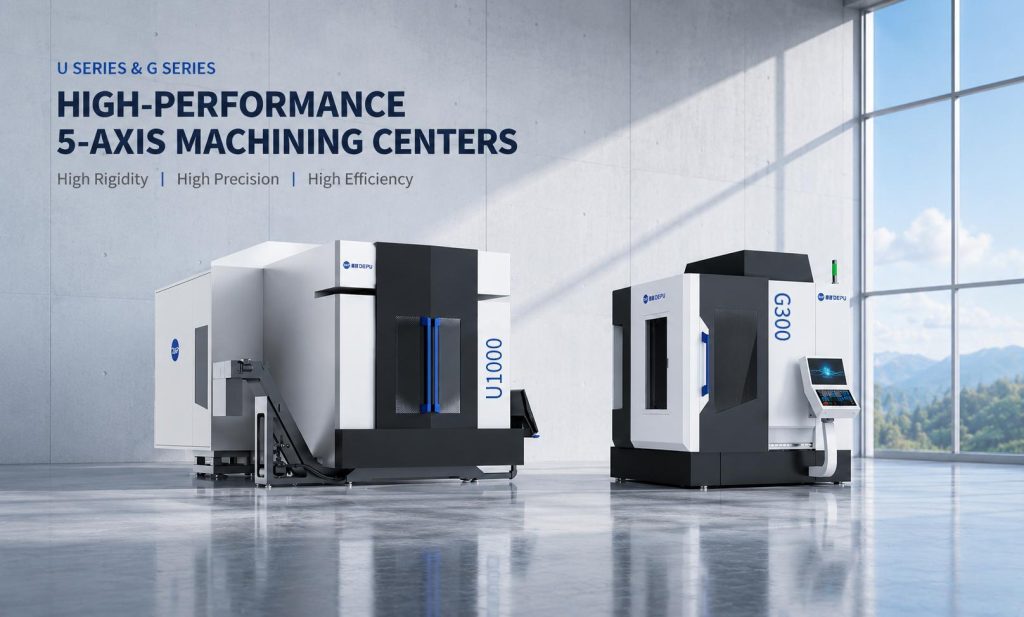
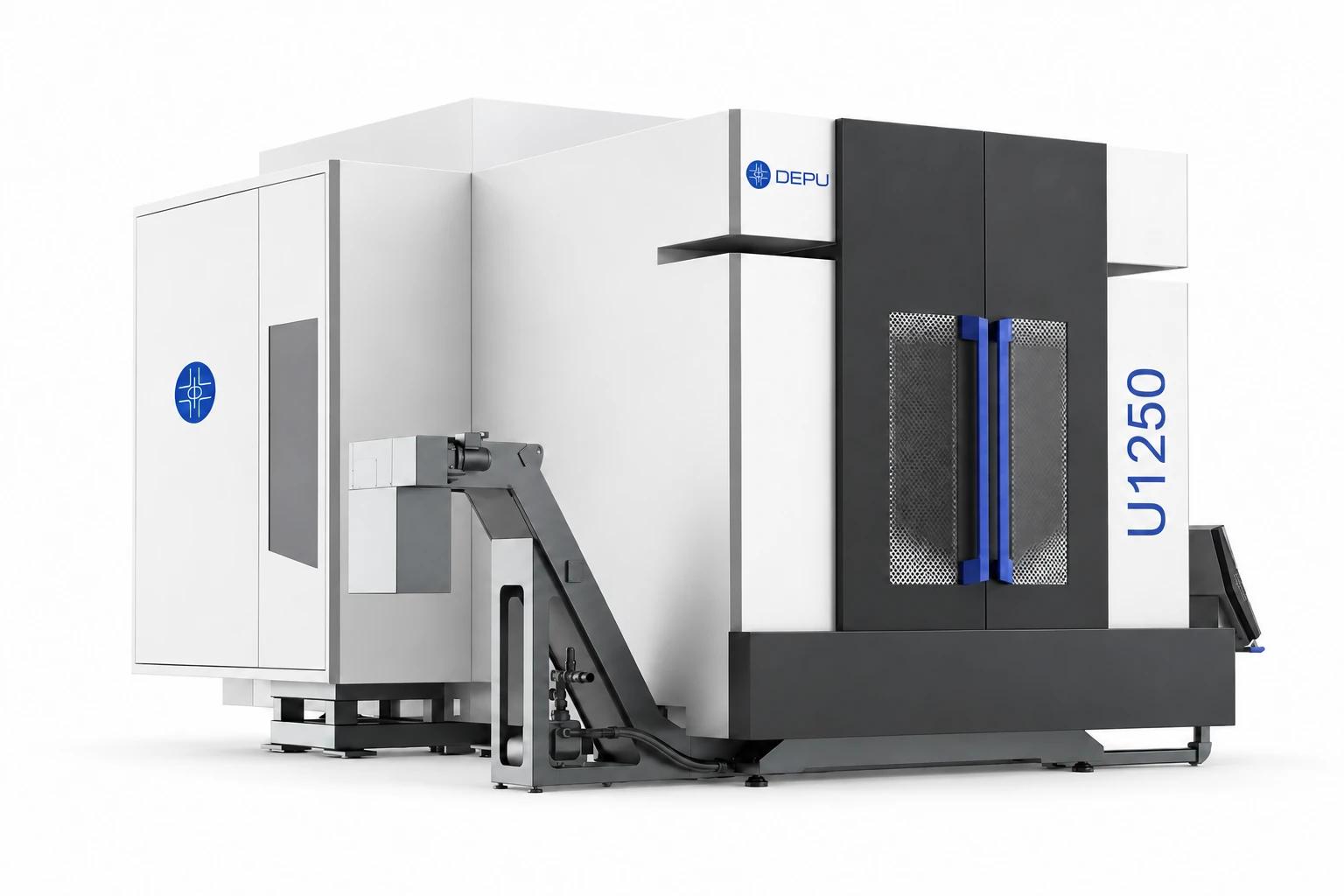
DEPU’s U Series is designed around a tilting-head five-axis configuration. The spindle head swings while the workpiece remains supported on the table. This arrangement is worth considering when rotating a large or heavy workpiece would create practical workholding or capacity challenges.
Potential applications include:
-
Large and heavy mechanical components.
-
Aerospace structural parts.
-
Heavy molds and complex tooling.
-
Energy equipment components.
-
Parts that are difficult to reposition or fixture repeatedly.
DEPU’s published product portfolio includes models such as the U1000, U1250, U1600T, and U2000T. These models belong to a larger-workpiece product family, but their working ranges and load capacities differ. You should compare the exact model against your part dimensions, weight, fixture, and machining requirements.
What to check: Maximum workpiece dimensions, table load, spindle-head rotation, spindle torque, axis travel, foundation requirements, and the clearance available for your longest tools.
2. For Multi-Sided and Automated Production: Mazak VARIAXIS Series
The Mazak VARIAXIS Series is worth including in your comparison if your production requires multi-sided machining, complex surfaces, and potential automation.
One example is the VARIAXIS C-600, a simultaneous five-axis vertical machining center with a tilting rotary table. Its available configurations include different spindle options and tool-storage capacities. Mazak also offers automation options, including a multi-pallet pool configuration.
Consider this machine family if you:
-
Produce complex components with multiple machined surfaces.
-
Need simultaneous five-axis machining.
-
Want to explore pallet-based automation for repeat production.
-
Need to compare different spindle configurations for varied materials.
The C-600 is one example, not a specification reference for every VARIAXIS model. Other models in the family may have different work envelopes, spindle options, and automation capabilities.
What to check: Maximum workpiece dimensions, rotary-table capacity, spindle taper, torque, tool magazine capacity, and available automation packages.
3. For Precision Mold and Complex Component Production: HERMLE C Series
The HERMLE C Series is worth evaluating if your work places a strong emphasis on precision, surface quality, and complex machining.
HERMLE offers five-axis machining centers in different sizes. For example, the C 22 is a compact option for smaller components, while models such as the C 42 and C 52 provide larger working areas and different workpiece capacities.
This product family may be relevant if you:
-
Manufacture precision molds and dies.
-
Produce complex components with demanding geometric requirements.
-
Need consistent machining performance across multiple setups.
-
Want to evaluate a dedicated five-axis machining platform.
The right model depends on the size, weight, and geometry of your parts. You should also examine the machine’s spindle options, tool access, thermal behavior, and measurement capabilities.
What to check: Workpiece envelope, table load, spindle configuration, rotary-axis performance, and the manufacturer’s accuracy specifications under defined conditions.
4. For Flexible Production and Job Shops: Haas UMC Series
The Haas UMC Series is a practical option to consider if you want to add five-axis capability to a general-purpose machining operation.
The UMC family includes different machine sizes, from compact models to larger work envelopes. Depending on the model and configuration, these machines support both 3+2 positioning and simultaneous five-axis machining.
This series may suit you if you:
-
Run a job shop with a variety of part types.
-
Want to reduce setups for multi-sided components.
-
Need a five-axis platform for small or medium-sized parts.
-
Want to compare machine capacity and available options across several models.
One important consideration is the difference between machine travel and usable rotary work envelope. Your part, fixture, and tool must all clear the machine structure throughout the required rotary motion.
What to check: Actual work envelope, table load, spindle power and torque, rotary-axis performance, tool capacity, and the support available from your local Haas Factory Outlet.
5. For Precision Die, Mold, and Medical Components: Makino D Series
The Makino D Series is another product family worth considering, particularly if you manufacture smaller or medium-sized precision components.
Models such as the D300 and D500 are vertical five-axis machining centers. Makino positions these machines for applications that include die and mold manufacturing, medical components, and other complex precision work.
This series may be relevant if you:
-
Machine intricate mold features and complex three-dimensional surfaces.
-
Produce precision components that benefit from shorter tooling.
-
Need a five-axis machine for detailed finishing operations.
-
Want to evaluate thermal stability and rotary-axis accuracy as part of your selection.
The D Series includes machines with different work envelopes and configurations. Do not assume the capabilities of one model apply to the entire family.
What to check: Workpiece dimensions, spindle configuration, rotary-axis design, thermal-control features, and the accuracy requirements of your parts.
6. For General-Purpose 5-Axis Machining: DMG MORI DMU Series
The DMG MORI DMU Series is worth considering if you need a universal five-axis machining center for a broad range of complex components.
The series includes different machine sizes and configurations. For example, the DMU 50 is a compact universal five-axis machining center, while larger DMU models are designed for bigger workpieces and different production requirements.
This product family may be a good fit if you:
-
Produce complex components in different industries.
-
Need multi-sided machining with fewer setups.
-
Require flexibility across different part geometries.
-
Want to compare several machine sizes within one product family.
The main consideration is choosing the right model and configuration. A compact DMU machine and a larger production platform are not interchangeable simply because they belong to the same series.
What to check: Workpiece capacity, spindle configuration, rotary-table performance, automation options, and the level of simultaneous five-axis capability included in the quotation.
7. For Smaller Complex Parts: DEPU G Series
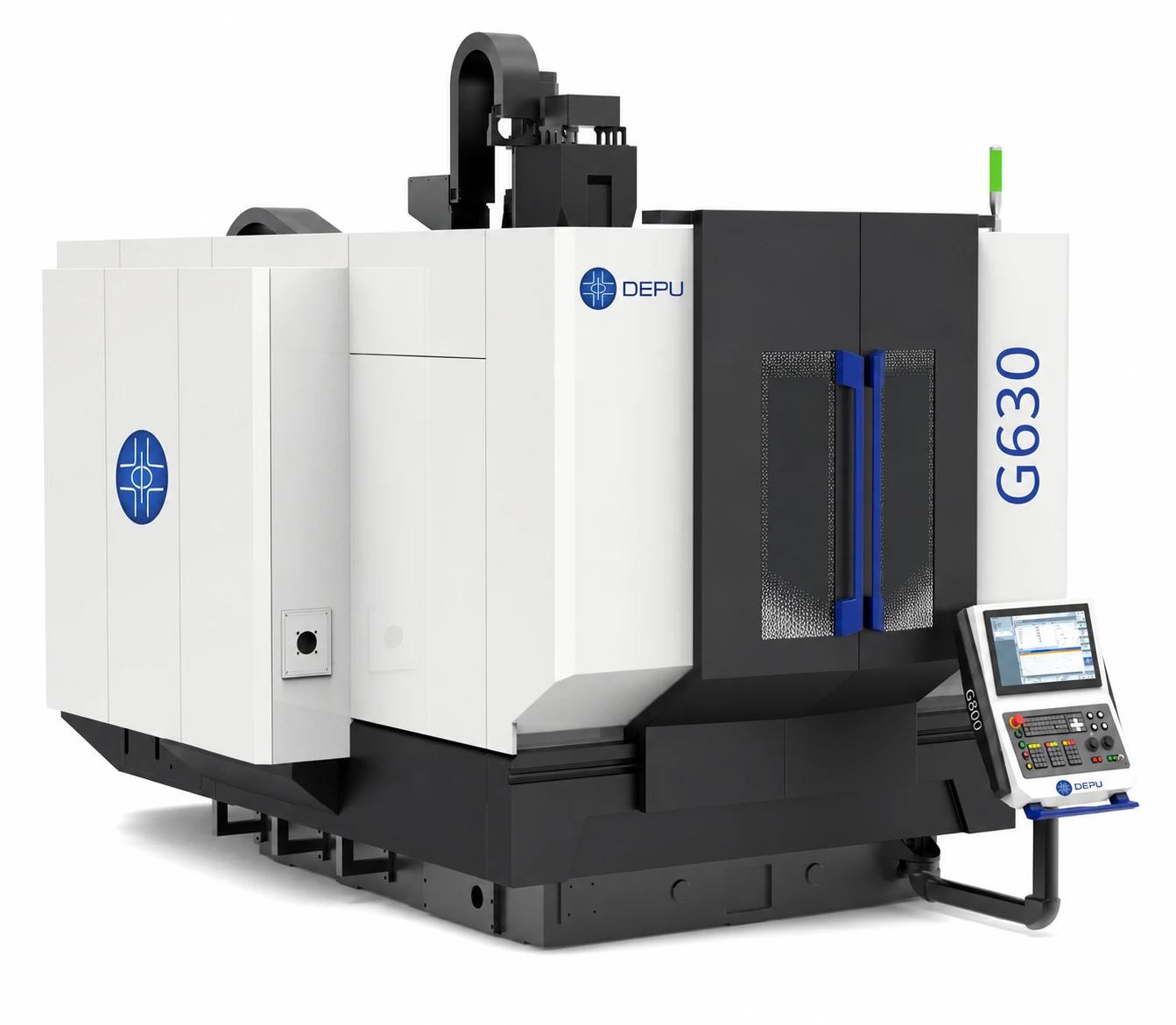
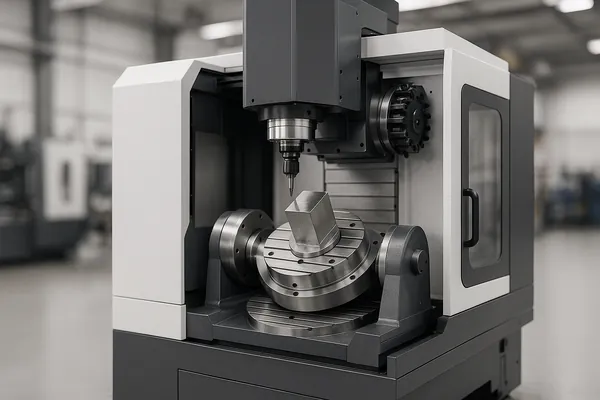
DEPU’s G Series uses a vertical cradle-type five-axis machining configuration. The rotary table tilts and rotates the workpiece, making the series relevant to smaller complex components that require machining from multiple directions.
It may be worth evaluating if you manufacture:
-
Precision components with complex surfaces.
-
Smaller aerospace parts.
-
High-value industrial components.
-
Parts that benefit from fewer repositioning operations.
The G Series includes different machine sizes, such as the G300, G630, and G800. The right choice depends on the part’s swept envelope, fixture arrangement, and load—not just the table diameter.
What to check: Workpiece clearance at different rotary positions, table load, spindle configuration, rotary-axis travel, tool access, and the machine’s accuracy specifications.
DEPU was established in 2014 and focuses on the development and manufacturing of five-axis CNC machine tools and related core components. The company identifies Shenzhen as its global R&D center and Haining, Zhejiang, as its global headquarters and manufacturing base, with facilities covering more than 30,000 square meters. Its engineering team and manufacturing capabilities are relevant considerations when evaluating the company as a potential machine supplier. You should still request application-specific technical documentation and verification before making a purchasing decision.
Trunnion vs. Swivel-Head vs. Gantry: Which Machine Structure Should You Choose?
Machine architecture affects how you load a part, how much space it occupies, and which geometries you can reach.
The three terms below describe different structural approaches. Keep in mind that gantry describes the overall machine structure, while trunnion and swivel-head describe how the rotary motion is arranged. They are not always mutually exclusive categories.
Trunnion-Style 5-Axis Machines
A trunnion machine typically uses a tilting rotary table with two rotary axes. The workpiece rotates and tilts while the cutting tool moves along the linear axes.
Advantages:
-
Good access to multiple sides of many compact and medium-sized parts.
-
Useful for complex surfaces and angled features.
-
Can reduce the number of setups.
-
Often suitable for precision molds and smaller aerospace components.
Limitations:
-
Large or heavy workpieces may exceed table capacity.
-
The part and fixture must fit within the rotary swept envelope.
-
Tall fixtures or long tools can create clearance problems.
Swivel-Head 5-Axis Machines
A swivel-head machine uses rotary motion in the spindle head rather than relying entirely on a tilting worktable.
Advantages:
-
Can be suitable for larger or heavier workpieces.
-
The workpiece can remain fixed on the table during rotary head movement.
-
May provide useful access for large, complex components.
Limitations:
-
Spindle-head geometry can affect tool access.
-
The available angular range varies by machine.
-
You must verify clearance between the spindle head, tool, workpiece, and fixture.
Gantry 5-Axis Machines
Gantry machines use a bridge-like structure that moves over the workpiece. They are often considered for large components that require substantial working space.
Advantages:
-
Suitable for large and sometimes very large workpieces.
-
Can support machining of aerospace structures, molds, and large industrial components.
-
Machine layouts can be designed around long or wide parts.
Limitations:
-
Larger installation footprint and infrastructure requirements.
-
Higher investment and commissioning complexity may apply.
-
The machine’s size alone does not guarantee the required precision or cutting performance.
Which Structure Is Right for Your Parts?
| Your production requirement | Structure worth evaluating |
|---|---|
| Small or medium complex parts | Trunnion |
| Heavy workpieces that are difficult to rotate | Swivel-head |
| Large aerospace structures or molds | Gantry or large swivel-head |
| Multi-sided precision components | Trunnion or swivel-head |
| Large parts requiring substantial working space | Gantry |
Swipe to compare →
Treat this as an initial screening guide, not a final machine-selection rule. The actual part geometry, fixture, tool length, and cutting strategy determine whether a particular machine can complete the job.
How to Choose the Right 5-Axis CNC Machine for Your Shop
Once you have shortlisted several manufacturers, use a consistent evaluation process. This makes it easier to compare machines objectively and avoid paying for features you will not use.
Step 1: Start With Your Actual Parts
Select several representative parts from your current or planned production.
Include the parts that are:
-
Largest or heaviest.
-
Most difficult to fixture.
-
Most demanding in terms of accuracy.
-
Made from the hardest-to-machine materials.
-
Most likely to require simultaneous five-axis motion.
Do not size a machine around an average part if your production also includes occasional components that are much larger or more demanding.
Step 2: Check the Complete Work Envelope
Provide the manufacturer with the part drawings and fixture information.
Ask for confirmation of:
-
Maximum usable workpiece size.
-
Part and fixture weight.
-
Rotary swept envelope.
-
Tool and spindle clearance.
-
Collision risks at the required rotary positions.
If possible, request a machine simulation using your actual part geometry. This is more useful than relying only on the machine’s X, Y, and Z travel figures.
Step 3: Match the Spindle to Your Materials
Your material and cutting strategy should guide spindle selection.
For aluminum and other nonferrous materials, high spindle speed may be useful for small tools and finishing operations. For steel, titanium, and other difficult materials, torque, rigidity, cooling, and cutting stability may carry more weight.
Ask the manufacturer to recommend a spindle configuration based on your actual tools, materials, and operations—not simply the highest available spindle speed.
Step 4: Confirm the Required Five-Axis Capability
Not every job requires simultaneous five-axis machining.
If your parts mainly need machining on multiple faces at fixed angles, 3+2 positioning may be sufficient. If the cutting tool must continuously change orientation while following complex surfaces, you may need simultaneous five-axis interpolation.
Confirm that the machine, CNC control, CAM software, and postprocessor support the operations you intend to run.
Step 5: Request an Application Review or Test Cut
A machine brochure cannot prove that a particular configuration will meet your production requirements.
Before committing to a purchase, ask the supplier to review your drawings, machining strategy, fixture, and accuracy targets. For critical applications, consider a sample machining test or a documented acceptance process.
Agree in advance on what will be measured, how accuracy will be verified, and which conditions apply to the test.
Step 6: Calculate Total Cost of Ownership
The purchase price is only one part of the investment.
Include:
-
Machine and configuration cost.
-
Tooling, fixtures, and workholding.
-
CAM software and postprocessor development.
-
Installation, foundation, and electrical requirements.
-
Operator and programmer training.
-
Maintenance and spare parts.
-
Automation and inspection equipment.
-
Expected utilization and production capacity.
A more expensive machine may be justified if it reduces setups, improves throughput, or enables work that your existing equipment cannot handle. But those benefits should be estimated using your actual production data.
How Much Does a 5-Axis CNC Machine Cost?
The cost of a five-axis CNC machine varies widely. A compact machine for smaller components and a large heavy-duty machining center are fundamentally different investments.
The final price depends on factors such as:
-
Machine size and structural design.
-
Spindle type, power, torque, and speed.
-
Rotary-axis configuration and capacity.
-
CNC control and software options.
-
Tool magazine and automation systems.
-
Probing, measurement, and coolant systems.
-
Installation, training, and service arrangements.
You should also distinguish between the base machine price and the cost of a production-ready system. Tooling, fixtures, CAM software, installation, and operator training can add substantially to the initial investment.
When comparing quotations, make sure the suppliers are quoting equivalent configurations. A lower base price may not include the spindle, tool changer, rotary-axis feedback, or automation features your application requires.
For used machines, evaluate the machine’s maintenance history, spindle condition, rotary-axis accuracy, control generation, service support, and availability of replacement parts. A lower purchase price does not necessarily mean a lower total cost.
Is a 5-Axis CNC Machine Worth the Investment?
A five-axis machine can be a valuable investment when your parts have complex geometries, multiple angled features, or surfaces that are difficult to reach with conventional machining.
Its potential benefits include:
-
Fewer setups and less manual repositioning.
-
Better access to complex surfaces.
-
Reduced cumulative setup errors.
-
Shorter production routes for suitable components.
-
The ability to manufacture parts that may be impractical on three-axis equipment.
However, five-axis capability does not automatically make every job faster or cheaper. Simple prismatic parts may be more economical on a three-axis machine. Some multi-sided components can be handled efficiently with a four-axis setup. Five-axis equipment also requires appropriate programming skills, workholding, training, and process control.
Before investing, compare the total manufacturing cost of your current process with the expected cost of producing the same parts on a five-axis machine. Include setup time, machining time, labor, scrap risk, and machine utilization.
If the machine will spend much of its time producing simple parts that do not need five-axis movement, a less complex machine may be the better investment.
FAQ
Which brand makes the best 5-axis CNC machines?
There is no universally best brand. DMG MORI, Mazak, Makino, HERMLE, Haas, and DEPU are examples of manufacturers with five-axis product families worth comparing. Your best choice depends on workpiece size, material, accuracy requirements, machine configuration, service support, and budget.
What is the best 5-axis CNC machine for aerospace manufacturing?
It depends on the components you produce. Smaller precision aerospace components may suit a compact trunnion-style machine, while large structural parts may require a larger swivel-head or gantry configuration. For titanium and other difficult materials, evaluate rigidity, spindle torque, thermal stability, and cutting performance.
What is the best 5-axis CNC machine for mold making?
For mold manufacturing, prioritize accuracy, surface finish, tool access, spindle performance, and thermal stability. The required machine size depends on the mold dimensions and weight. You should also check whether your CAM workflow supports the tool orientations and finishing strategies your molds require.
Is a trunnion machine better than a swivel-head machine?
Neither structure is automatically better. A trunnion machine can be suitable for many small and medium-sized complex components, while a swivel-head machine may be advantageous when the workpiece is large or heavy and difficult to rotate. Compare the actual work envelope, load capacity, clearance, and machining requirements.
Do you need simultaneous five-axis machining?
Not always. If your parts require machining at several fixed angles, 3+2 positioning may be sufficient. If the tool must continuously change orientation while following complex surfaces, simultaneous five-axis machining may be necessary. Your part geometry and machining strategy should determine the requirement.
Can a small machine shop benefit from a 5-axis CNC machine?
Yes, if the shop regularly produces complex parts that require multiple setups or difficult tool access. A five-axis machine may help a small shop consolidate operations and take on more demanding work. However, you should account for the investment in programming, workholding, training, and maintenance before purchasing.
What should you send a manufacturer before requesting a quote?
Prepare representative part drawings or 3D models, material specifications, workpiece dimensions and weights, fixture information, required tolerances, surface-finish requirements, and estimated production volume. If you already have a CAM system, include its name and version. This information helps the supplier recommend a suitable machine configuration rather than quoting a model based only on its general specifications.
Final Thoughts
The best 5-axis CNC machine is the one that can produce your parts reliably, meet your accuracy requirements, and support your production plan at an acceptable total cost.
Start with your most demanding workpieces. Compare the usable work envelope, rotary-axis design, spindle performance, machine rigidity, CNC control, and available support. Then validate your shortlist with actual part drawings, application reviews, and—where appropriate—test machining.
If you are evaluating DEPU products, compare the G Series and U Series according to the workpiece geometry, size, weight, and required machining access. The G Series uses a vertical cradle-style configuration, while the U Series uses a tilting-head architecture. They address different machining requirements, so the right choice should come from your application rather than the model name alone.
Originally published by DEPU on 24 Nov 2026.