
$110,000 to more than $1 million, depending on its size, machine architecture, spindle, accuracy, automation, and intended application. For example, Haas currently lists its UMC-400 compact 5-axis machining center at a starting price of $110,995, while larger 5-axis systems can cost several hundred thousand dollars or more.
For you as a manufacturer, however, the purchase price is only part of the investment. Freight, rigging, installation, tooling, workholding, CAM software, training, and other production requirements can change the total cost significantly. The better question is not simply “How much does a 5-axis CNC machine cost?” but “How much will the right 5-axis machine cost to get my parts into production?”
How Much Does a 5-Axis CNC Machine Cost?
There is no single standard price for a 5-axis CNC machine because the category covers very different types of equipment.
As a practical budgeting framework, you may encounter:
| Machine type | Typical planning range |
|---|---|
| Compact industrial 5-axis | Around $110,000–$200,000+ |
| Small to mid-size production machines | Around $200,000–$500,000+ |
| High-end production machines | Around $500,000–$1 million+ |
| Large or highly specialized systems | $1 million or more |
Swipe to compare →
These are planning ranges, not fixed market prices. The final quotation depends on the machine configuration, options, application, and supplier.
For a concrete reference, Haas currently lists several UMC models from $110,995 for the UMC-400 to more than $400,000 for certain UMC-1250 configurations. Its VR series, designed for larger and more complex 5-axis applications, extends beyond $500,000 in some configurations.
That illustrates an important point: two machines can both be called 5-axis CNC machines while having very different prices and capabilities.
What Can You Get for $200K, $500K, or $1 Million?
Looking at your budget in relation to your application is more useful than focusing on one average price.
Around $200,000
At this level, you may be considering a compact or smaller industrial 5-axis machine.
This type of machine can make sense for:
-
Small to medium-sized components
-
Complex precision parts
-
Molds and dies
-
Prototypes
-
General multi-sided machining
-
Parts that benefit from fewer setups
For example, Haas currently lists the UMC-400 at $110,995 before applicable taxes, rigging, freight, and installation charges. The published machine includes simultaneous 5-axis machining, a 40-taper spindle, and a 30+1 tool changer.
A machine in this general price class can be attractive if your parts fit within its work envelope and you don’t need the capacity or specialized features of a much larger system.
Around $500,000
With a budget around $500,000, you can consider a broader range of production-oriented machines and configurations.
Depending on the manufacturer and application, you may be able to specify:
-
Larger work envelopes
-
Higher spindle power or torque
-
More robust machine structures
-
Larger rotary systems
-
Larger tool magazines
-
Advanced probing
-
Higher levels of automation
-
Features for demanding continuous 5-axis work
This range may be relevant if you’re producing aerospace, medical, energy, mold, or other complex industrial components.
However, don’t assume that a $500,000 machine is automatically a better investment than a $200,000 machine. If your parts are small and your production requirements are modest, paying for a much larger machine may simply increase your capital cost.
$1 Million or More
At this level, you’re generally looking at large, highly specialized, or extensively configured equipment.
Potential applications include:
-
Large aerospace components
-
Heavy industrial workpieces
-
Large molds
-
Complex structural components
-
Large work envelopes
-
Specialized accuracy requirements
-
Extensive automation
-
Heavy-duty machining
At this price level, you should evaluate the entire manufacturing solution rather than comparing the machine price alone.
What Determines the Price of a 5-Axis CNC Machine?
The biggest differences in price usually come from the machine’s architecture, capacity, performance, and configuration.
Machine Size and Work Envelope
The larger the workpiece you need to machine, the more substantial the machine generally needs to be.
You aren’t only paying for longer X, Y, and Z travel. A larger machine may also require:
-
Larger structural components
-
Higher load capacity
-
Larger rotary axes
-
More powerful drives
-
Greater structural rigidity
-
More substantial workholding
-
More demanding installation requirements
A compact machine designed for small precision components is fundamentally different from a machine designed to handle large aerospace structures or heavy industrial parts.
Trunnion vs. Swivel-Head Configuration
Machine architecture has a major effect on both capability and price.
A trunnion-style 5-axis machine rotates and tilts the workpiece. This can be effective when you’re machining smaller or medium-sized parts from multiple directions.
A swivel-head 5-axis machine changes the orientation of the spindle while the workpiece remains on the table. This architecture can be advantageous when you’re working with large or heavy parts that are difficult to rotate.
Neither configuration is universally better. You should choose based on:
-
Part dimensions
-
Part weight
-
Required tool access
-
Workholding
-
Cutting strategy
-
Required rotary-axis movement
Spindle Power, Torque, and Speed
The spindle is another major factor.
High spindle speed can be valuable for small tools and high-speed machining, while power and torque become increasingly important when you’re removing large amounts of material or machining difficult metals.
Don’t choose a spindle based only on its maximum RPM.
When comparing machines, consider:
-
Maximum speed
-
Power
-
Torque
-
Spindle taper
-
Tool interface
-
Cooling
-
Thermal behavior
If you’re machining titanium, hardened steel, or other difficult materials, the appropriate spindle and machine structure may be very different from what you need for aluminum.
Rotary-Axis Performance
The rotary axes are fundamental to 5-axis machining.
When comparing machines, look at:
-
Rotary-axis range
-
Positioning accuracy
-
Repeatability
-
Maximum speed
-
Load capacity
-
Mechanical design
-
Calibration capability
A larger rotary table isn’t automatically better. What matters is whether the rotary system can handle your workpiece and provide the movement and accuracy your parts require.
CNC Control and Simultaneous 5-Axis Capability
If you need continuous simultaneous 5-axis machining, confirm that the machine and CNC control are configured for it.
Some applications only require 3+2 machining, where the rotary axes position the workpiece or tool before the linear axes perform the cutting operation.
Other parts require simultaneous 5-axis interpolation, where the axes coordinate their movements continuously during cutting.
Your CAM software and postprocessor also matter. A sophisticated machine is of limited value if your programming system cannot reliably generate, simulate, and verify the required toolpaths.
Rigidity and Thermal Stability
A higher machine price can reflect a more robust mechanical structure rather than simply more features.
If you’re making aggressive cuts in hard materials, structural rigidity can affect vibration, tool life, surface finish, and dimensional consistency.
Thermal behavior also matters for precision work. Spindle heat, ambient temperature changes, and thermal deformation can influence machining accuracy.
For demanding applications, evaluate the machine as a complete system rather than comparing isolated specifications.
Automation and Tool Management
Automation can add substantially to the purchase price.
Depending on your production requirements, you may consider:
-
Larger tool magazines
-
Tool measurement
-
Workpiece probing
-
Pallet changers
-
Pallet pools
-
Robotic loading
-
Chip conveyors
-
High-pressure coolant
-
Coolant filtration
-
Automated inspection
These options can make sense for high-volume production, but they may not provide enough value for a low-volume job shop.
What Additional Costs Should You Budget For?
The machine quotation isn’t necessarily the same as your total project cost.
Haas, for example, explicitly states that its published starting prices do not include applicable taxes, rigging, freight, or installation.
Depending on your project, you may also need to budget for the following.
Freight and Rigging
Large machine tools can require specialized transportation, unloading, and rigging.
The cost depends on:
-
Machine size
-
Machine weight
-
Shipping distance
-
Access to your facility
-
Required lifting equipment
-
Installation location
Installation and Commissioning
Installation may include:
-
Machine positioning
-
Leveling
-
Electrical connections
-
Calibration
-
Controller setup
-
Testing
-
Initial commissioning
Always ask exactly what your supplier includes.
Site Preparation
Your facility may need modifications before the machine arrives.
Check:
-
Floor capacity
-
Foundation requirements
-
Electrical supply
-
Compressed air
-
Cooling requirements
-
Chip and coolant handling
-
Machine access
-
Door and ceiling clearance
Tooling and Workholding
You may need:
-
Cutting tools
-
Toolholders
-
Collets
-
Vises
-
Fixtures
-
Probes
-
Tool presetting equipment
-
Specialized workholding
The cost can vary substantially depending on the parts you’re producing.
CAM Software and Postprocessors
If you’re moving from 3-axis machining to simultaneous 5-axis machining, your current CAM setup may not be sufficient.
You may need:
-
5-axis CAM functionality
-
A machine-specific postprocessor
-
Simulation and verification
-
Collision checking
-
Programming training
Discuss these requirements with both the machine supplier and your CAM provider before placing the order.
Training and Maintenance
Your operators and programmers may need training in:
-
Machine operation
-
5-axis programming
-
Workholding
-
Tool setup
-
Rotary-axis calibration
-
Preventive maintenance
-
Troubleshooting
You should also consider spare-parts availability and technical support over the machine’s expected service life.
Is a Used 5-Axis CNC Machine Cheaper?
Usually, yes, but the purchase price alone doesn’t tell you whether a used machine is a good deal.
Used machines can reduce your initial capital investment and may give you access to higher-end equipment at a lower price.
Advantages of Buying Used
You may benefit from:
-
Lower upfront cost
-
Faster access to an existing machine
-
Lower depreciation
-
Access to higher-end equipment for less capital
Risks of Buying Used
Before buying, inspect:
-
Spindle condition
-
Rotary-axis backlash
-
Linear-axis accuracy
-
Tool changer
-
Control electronics
-
Calibration status
-
Maintenance records
-
Operating hours
-
Replacement-parts availability
-
Controller support
A low purchase price can become expensive if the machine requires major repairs, recalibration, or outdated electronic components.
For critical production, ask for inspection and calibration documentation rather than relying only on the seller’s description.
Is a 5-Axis CNC Machine Worth the Money?
A 5-axis machine costs more than a conventional 3-axis machine, but the additional investment can make sense when it changes your production process.
Potential benefits include:
-
Fewer setups
-
Less manual repositioning
-
Better access to complex surfaces
-
Reduced fixture changes
-
More consistent part orientation
-
Improved access for certain cutting operations
-
Potentially shorter production cycles for complex parts
The economic benefit depends heavily on what you’re currently doing.
Compare Your Current Process With the Proposed 5-Axis Process
Suppose you currently machine a complex component using several setups on a 3-axis machine.
Your process might involve:
-
Programming
-
Fixture manufacturing
-
Initial setup
-
First machining operation
-
Re-fixturing
-
Alignment
-
Second machining operation
-
Additional inspection
-
Additional handling
A 5-axis machine may consolidate some of these operations.
That doesn’t mean every part will automatically be faster or cheaper on 5-axis equipment. Your tooling, programming, machine utilization, material, tolerances, and production volume all affect the result.
The most useful comparison is therefore your current production process versus the proposed 5-axis process, not simply the price of a 3-axis machine versus a 5-axis machine.
Do You Actually Need a 5-Axis CNC Machine?
Before spending hundreds of thousands of dollars, determine whether five axes solve a real production problem for you.
A 3-Axis Machine May Be Enough If You Produce:
-
Simple prismatic components
-
Flat surfaces
-
Straight pockets
-
Basic drilling patterns
-
Parts that can be efficiently machined from one or two directions
In these cases, a 5-axis machine may provide capabilities you rarely use.
3+2 May Be Enough If You Need:
-
Multiple machining angles
-
Angled drilling
-
Multi-sided access
-
Indexed positioning
but don’t need continuous tool-orientation changes during cutting.
Simultaneous 5-Axis Makes More Sense If You Regularly Machine:
-
Complex freeform surfaces
-
Aerospace components
-
Complex molds
-
Impellers
-
Turbine-related components
-
Medical components
-
Parts requiring continuous tool orientation
The correct choice depends on your actual CAD geometry and machining process.
How to Get an Accurate 5-Axis CNC Machine Quote
If you want a useful quotation, don’t simply ask a manufacturer, “How much is your 5-axis CNC machine?”
Give the supplier enough information to determine the appropriate configuration.
Step 1: Provide Your Part Information
Include:
-
CAD model or drawings
-
Maximum part dimensions
-
Part weight
-
Material
-
Critical tolerances
-
Surface-finish requirements
-
Deep cavities or difficult features
Step 2: Explain Your Production Requirements
Tell the manufacturer:
-
Expected monthly or annual volume
-
Current production method
-
Number of setups
-
Current cycle time, if available
-
Target production requirements
-
Required shift pattern
-
Automation requirements
Step 3: Define the Machine Requirements
Discuss:
-
Work envelope
-
Table load
-
Spindle speed
-
Spindle power
-
Spindle torque
-
Tool interface
-
Tool magazine capacity
-
Rotary-axis configuration
-
CNC controller
-
Probing
-
Coolant requirements
Step 4: Ask What Is Included
Make sure the quotation clearly states whether the price includes:
-
Machine
-
Standard tooling
-
Optional tooling
-
Probing
-
Chip conveyor
-
Coolant system
-
Freight
-
Installation
-
Commissioning
-
Training
-
Warranty
-
Software
-
Postprocessor
This makes competing quotations much easier to compare.
How Should You Compare 5-Axis CNC Machine Quotes?
Don’t automatically choose the lowest quotation.
Instead, compare the complete production solution.
| Factor | Questions to ask |
|---|---|
| Machine architecture | Is it suitable for your part size and weight? |
| Work envelope | Can your largest parts be machined with adequate clearance? |
| Spindle | Does its power, torque, and speed match your materials? |
| Rotary axes | Do they provide the required range and performance? |
| Rigidity | Is the structure appropriate for your cutting loads? |
| Controller | Does it support your required machining strategy? |
| CAM | Is the postprocessor compatible with the machine? |
| Automation | Do you actually need pallets, robotics, or additional tooling? |
| Installation | What’s included in commissioning? |
| Service | Where will technical support come from? |
| Warranty | What components and services are covered? |
| Total cost | What will the machine cost once it’s production-ready? |
Swipe to compare →
A machine that costs more may be the better investment if it eliminates multiple setups or meets your production requirements substantially better.
Conversely, paying for capabilities you don’t use can unnecessarily increase your capital cost.
What Should You Look for in a 5-Axis CNC Manufacturer?
When you’re investing hundreds of thousands of dollars in a machine, the manufacturer matters almost as much as the equipment.
Look beyond the sales quotation and evaluate:
-
Engineering capability
-
Machine architecture
-
Manufacturing capability
-
Quality-control processes
-
Testing and calibration
-
Installation support
-
Operator training
-
Technical support
-
Spare-parts availability
-
Long-term service capability
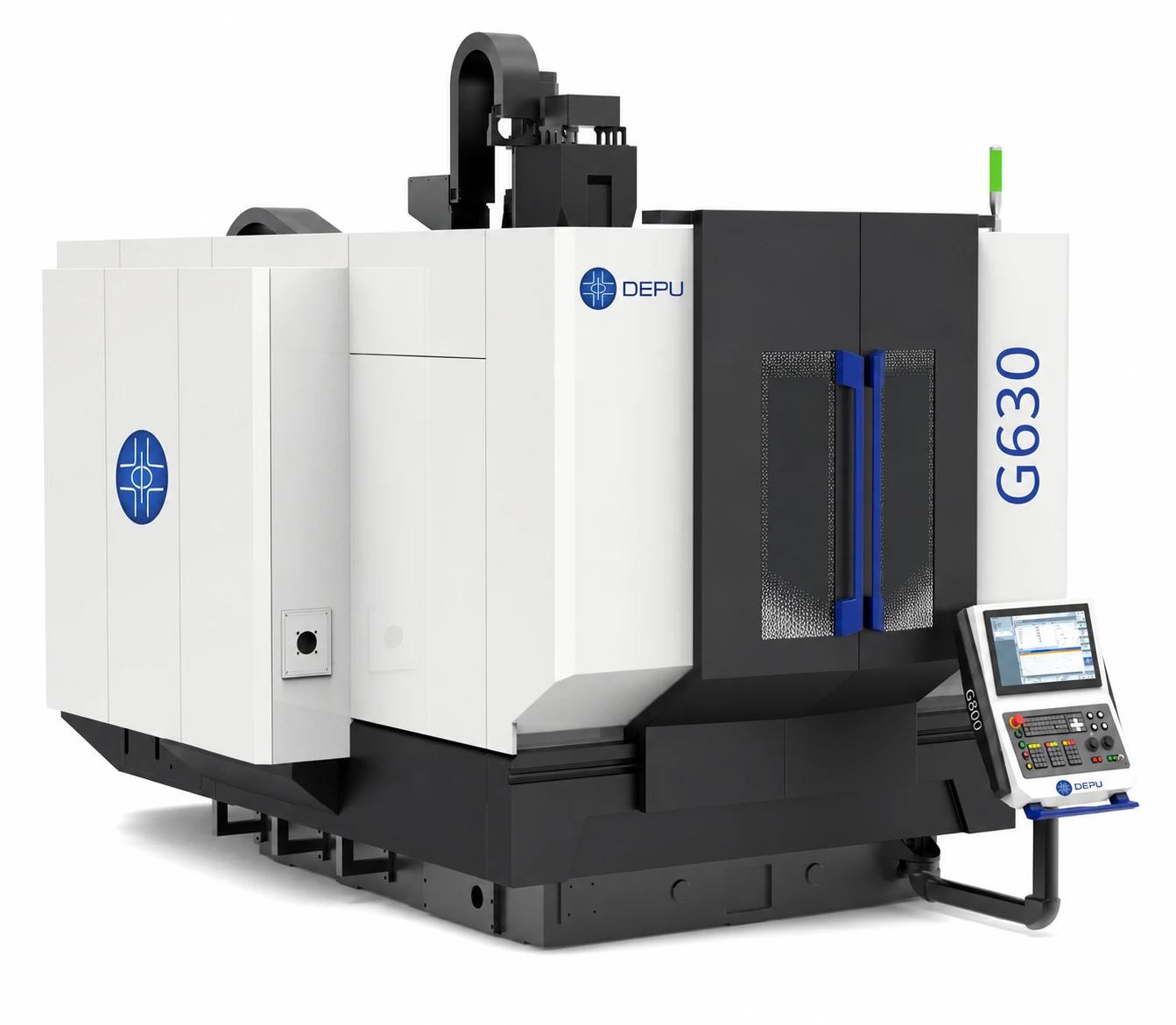
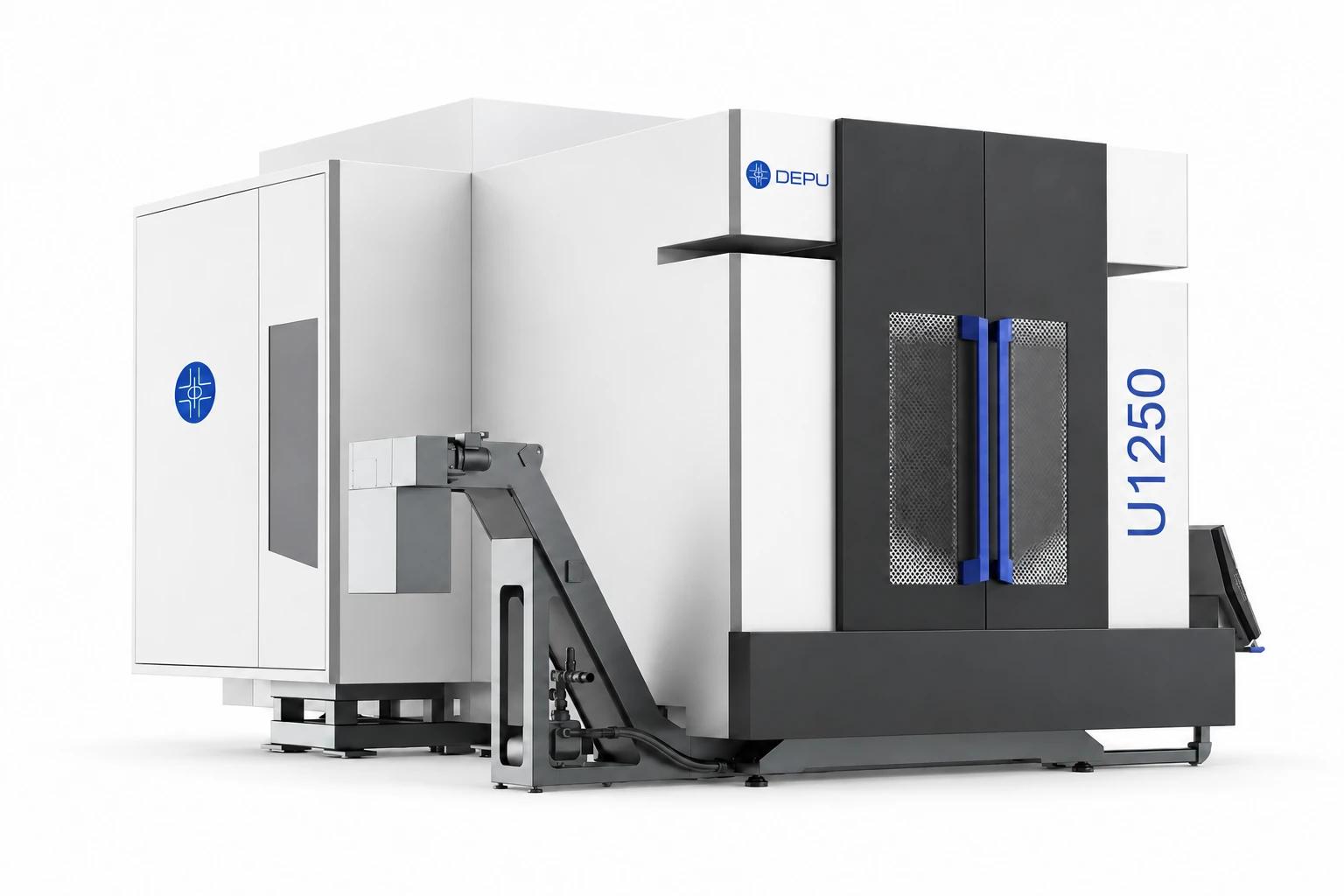
DEPU is a manufacturer focused on high-end 5-axis CNC machine tools. Its current product range includes G Series vertical trunnion machines and U Series swivel-head machines designed for different workpiece sizes and machining requirements.
DEPU also reports that its R&D team includes engineers from Germany and Taiwan, with many engineers having more than 20 years of R&D experience. The company reports cooperation with the Southern Industrial Technology Research Institute, the School of Mechanical Engineering at Chongqing University, and the Southern Institute of Space Technology. It also reports ISO and CE certifications, a High-Tech Enterprise certificate, utility model patents, and design patents.
These credentials can provide useful background when evaluating a supplier, but you should still verify the specific certifications, machine specifications, inspection documentation, service terms, and application support that apply to the machine you’re purchasing.
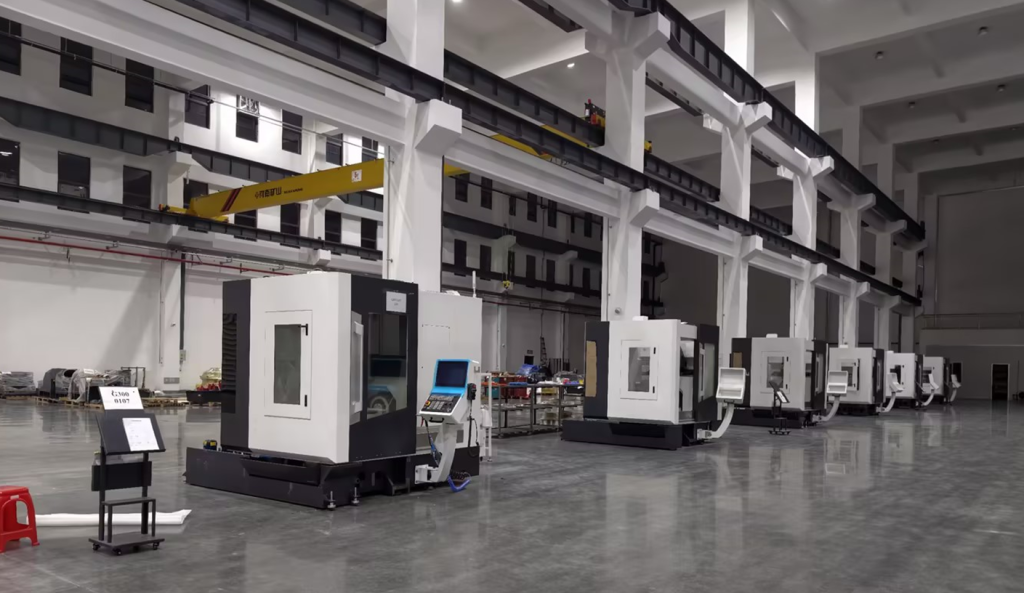
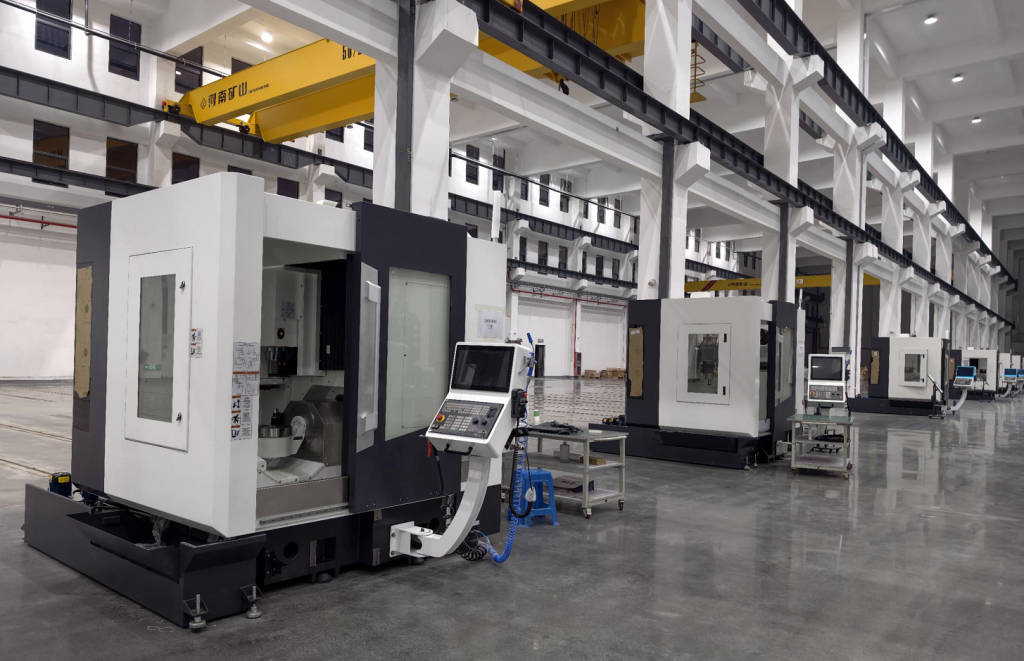
DEPU’s current manufacturing expansion also includes its Haining Smart Manufacturing Base, which the company announced as operational in October 2026 for scaled production of its G Series and U Series 5-axis machining centers.
Final Takeaway
A 5-axis CNC machine can cost a little over $100,000 for a compact machine and more than $1 million for large or highly specialized systems. Current manufacturer pricing demonstrates how widely the market can vary.
But you shouldn’t choose your budget by looking at the machine price alone.
Your actual investment includes the machine configuration, spindle, rotary axes, controller, tooling, workholding, CAM, installation, training, maintenance, and production requirements.
The best way to buy a 5-axis CNC machine is to start with your parts and your production process, then work backward to the machine configuration you actually need.
FAQ
How much does a basic 5-axis CNC machine cost?
A compact industrial 5-axis machine can start in the low six figures. Haas currently lists the UMC-400 at a starting price of $110,995. Larger machines and more extensively configured systems can cost several hundred thousand dollars or more.
Is $200,000 enough for a 5-axis CNC machine?
It can be, depending on your application. A $200,000 budget can put some compact or smaller industrial 5-axis machines within reach, but you also need to account for options, freight, installation, tooling, software, and other production costs.
Why do some 5-axis CNC machines cost more than $1 million?
Large work envelopes, heavy workpiece capacity, high rigidity, specialized machine architectures, demanding accuracy requirements, extensive automation, and application-specific configurations can all increase the price substantially.
Is a used 5-axis CNC machine worth buying?
It can be, particularly when reducing upfront capital cost is important. However, you should carefully inspect the spindle, rotary axes, linear axes, controller, calibration, maintenance history, and availability of replacement parts before buying.
What is included in a 5-axis CNC machine price?
It depends on the supplier and quotation. The base price may not include freight, rigging, installation, tooling, fixtures, software, training, or optional automation. Request an itemized quotation so you know exactly what you’re paying for.
Does a more expensive 5-axis CNC machine always produce better parts?
No. A higher price does not automatically guarantee better machining results. Machine rigidity, rotary-axis performance, thermal stability, spindle capability, workholding, tooling, programming, and process control all matter.
Is a 5-axis CNC machine worth the investment?
It can be, particularly when you’re machining complex parts that require multiple setups on conventional equipment. The best way to evaluate the investment is to compare your complete current production process with the proposed 5-axis process.
Originally published by DEPU on 18 Nov 2026.