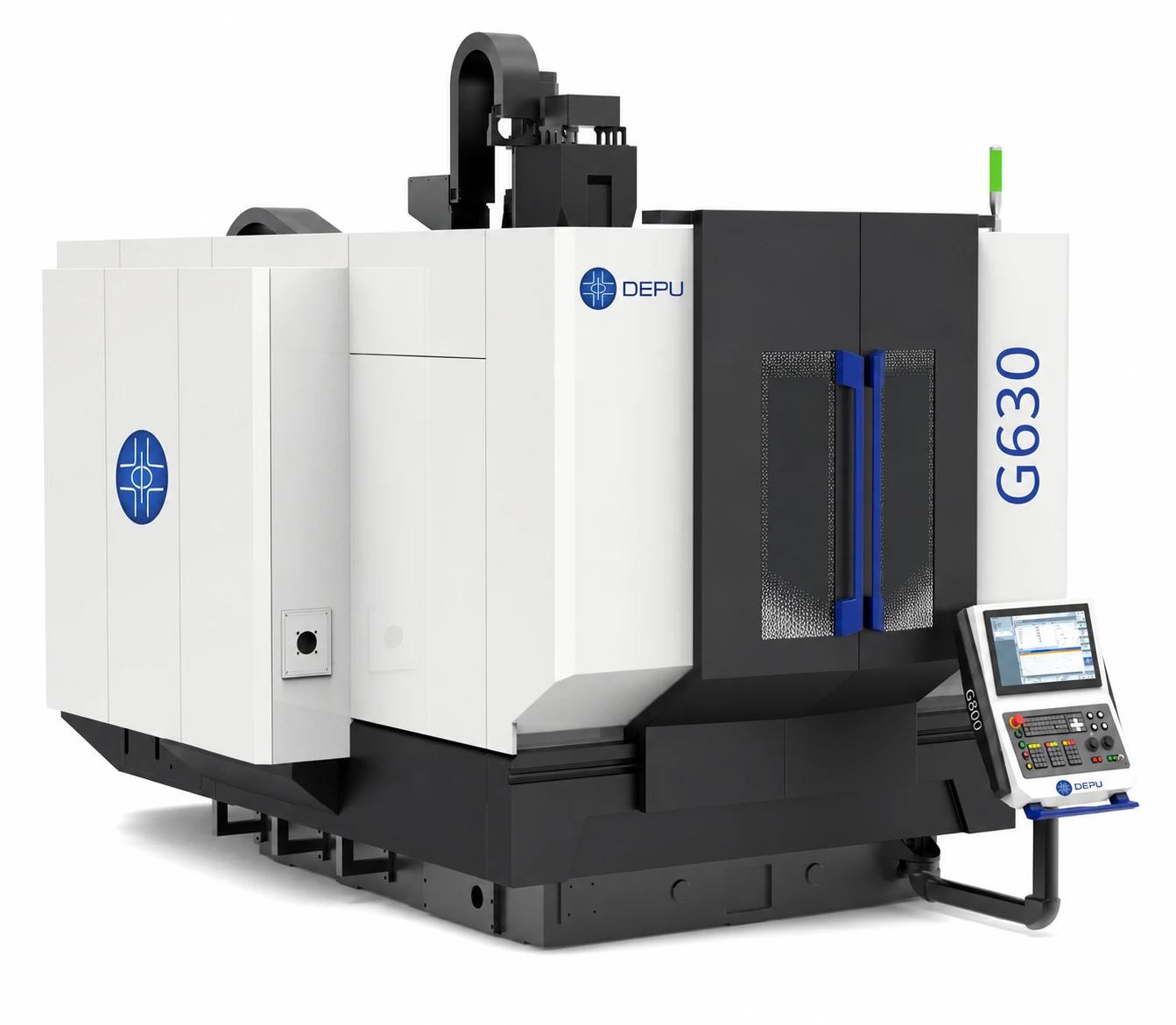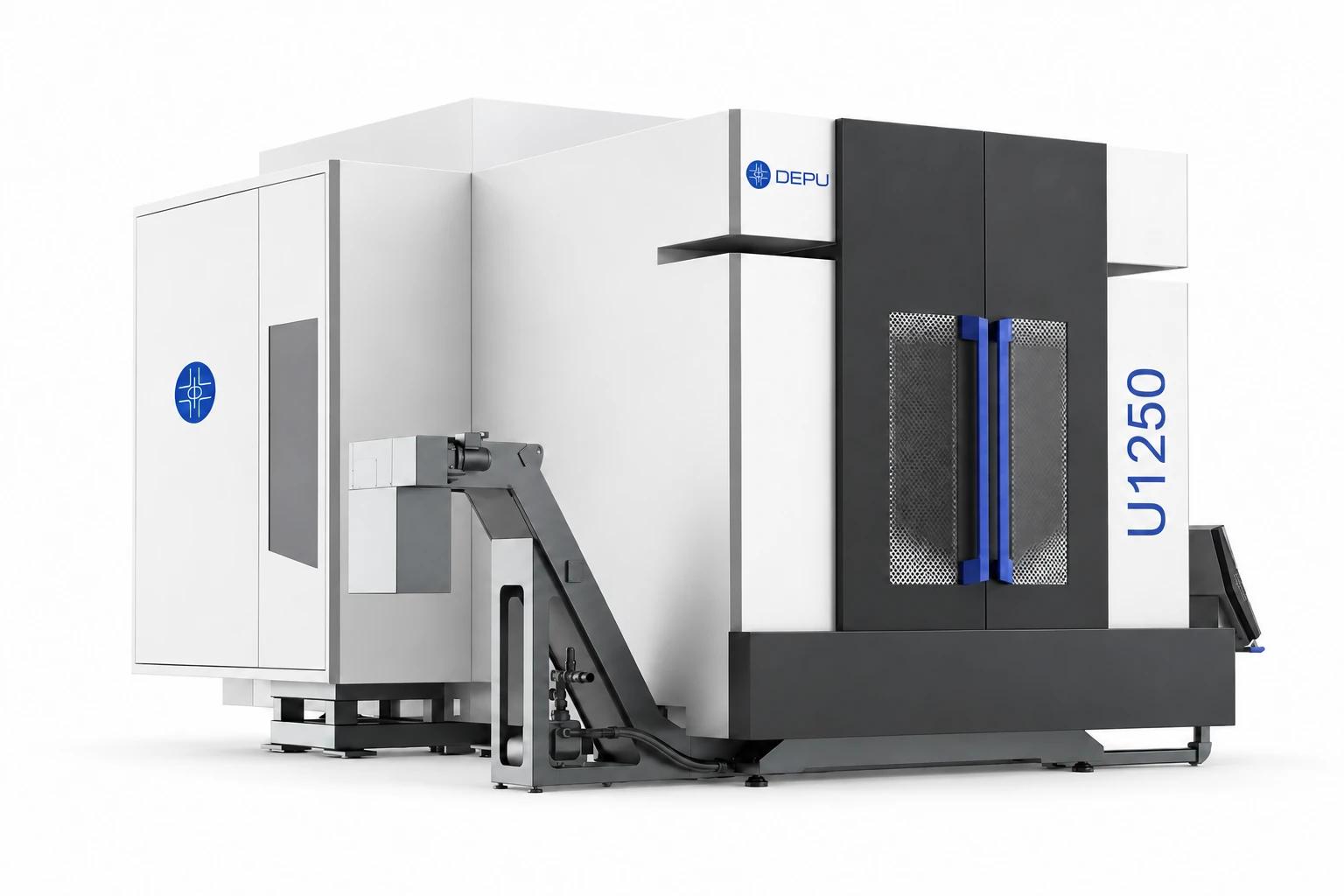

six controlled axes do not necessarily mean all six axes can move simultaneously during cutting. That depends on the machine’s mechanical design, CNC controller, and supported interpolation functions.
If you’re evaluating CNC equipment for aerospace, medical, automotive, moldmaking, or other precision manufacturing work, the important question isn’t simply how many axes a machine has. You need to understand what those axes actually do, whether they solve a specific machining problem, and whether the added complexity is worth the investment.
This guide explains how six-axis CNC machines work, how they compare with five-axis machines and six-axis industrial robots, and how to decide which configuration makes sense for your production needs.
What Is a 6-Axis CNC Machine?
A 6-axis CNC machine is a computer-controlled machine tool with six controlled axes of movement. These movements allow the machine to position and orient the cutting tool, the workpiece, or both.
In a conventional CNC milling machine, three linear axes control movement along the X, Y, and Z directions. Additional axes can provide rotary or other controlled movements, depending on the machine’s design.
A common six-axis milling configuration combines three linear axes with three rotary axes. However, not every machine described as six-axis uses the same arrangement. Some machines use multiple rotary movements in the spindle head, while others distribute movement between the tool and workpiece.
The term “six-axis” describes the number of controlled axes being counted. It does not, by itself, tell you the machine’s architecture or how many axes can participate in one cutting operation.
Understanding the Six Axes: X, Y, Z, A, B, and C
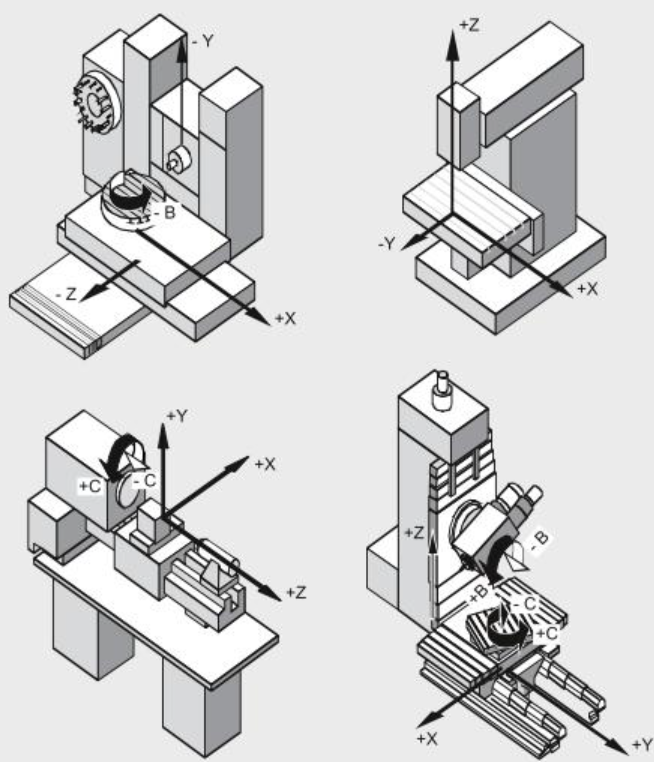
In the conventional CNC coordinate system, X, Y, and Z identify the three primary linear directions. A, B, and C identify rotary axes around the X, Y, and Z directions, respectively.
| Axis | Movement type | Basic function |
|---|---|---|
| X | Linear | Movement along the X direction |
| Y | Linear | Movement along the Y direction |
| Z | Linear | Movement along the Z direction |
| A | Rotary | Rotation around the X axis |
| B | Rotary | Rotation around the Y axis |
| C | Rotary | Rotation around the Z axis |
Swipe to compare →
These letters describe coordinate directions, not a universal physical layout. For example, one machine may use a tilting table and a rotating table, while another may use a multi-axis spindle head.
The physical movement assigned to each axis depends on the machine’s kinematic design. You should also avoid assuming that every six-axis machine uses exactly XYZABC. Specialized turning, mill-turn, and multi-tasking machines may count and arrange their axes differently.
For the standard axis naming conventions, see Siemens’ .
How Does the Sixth Axis Add More Movement?
A typical five-axis milling machine combines three linear axes with two rotary axes. This allows the cutting tool or workpiece to change orientation, making it possible to machine complex surfaces from different directions without repeatedly removing and repositioning the part.
A six-axis configuration adds another controlled movement. Depending on the machine design, that movement may provide another way to orient the tool, rotate the workpiece, or position a component during machining.
For example, an additional rotary movement may help control the tool’s orientation around an existing tool axis. This can be useful for certain complex geometries or specialized machining paths.
However, an extra axis does not automatically make every part easier to machine. Its value depends on whether it improves tool access, reduces repositioning, or enables a cutting path that would otherwise be difficult or impractical.
How Does a 6-Axis CNC Machine Work?
A six-axis CNC machine works by coordinating its controlled movements according to a programmed toolpath. The CNC controller interprets the machining program and sends commands to the relevant axes.
The machine’s kinematic structure determines how those movements translate into the relative position and orientation of the cutting tool and workpiece.
Linear and Rotary Axis Movement
Linear axes move machine components along straight paths. Rotary axes turn components around defined axes.
During machining, the controller coordinates these movements to maintain the required relationship between the cutting tool and the workpiece.
Depending on the machine, the movements may include:
-
Moving the cutting tool across the workpiece.
-
Tilting or rotating the spindle head.
-
Turning or repositioning the workpiece.
-
Coordinating several linear and rotary movements along a programmed path.
The tool and workpiece do not have to move in the same way on every machine. Some designs move the workpiece using rotary tables, while others move the spindle head or combine both approaches.
How the CNC Controller Coordinates Six Axes
The CNC controller manages axis positions, movement speeds, and coordinated motion. During simultaneous machining, it calculates how the controlled axes must move together to follow the programmed toolpath.
This requires more than having six motors or six axis drives. The control system must support the required interpolation functions, and the machine’s mechanical configuration must be accurately represented in the control and programming environment.
Machine kinematics describe the relationship between the machine’s physical components and their movements. CAM software uses this information to generate machining paths and, in many workflows, simulate machine movement before production.
The Role of CAM Software and Machine Kinematics
Six-axis machining can be challenging to program because the software must account for the machine’s actual geometry, axis arrangement, and movement limitations.
Before selecting a six-axis machine, check whether your CAM system supports its specific kinematic configuration. You should also confirm that the postprocessor is designed for the machine and controller you intend to use.
A suitable workflow should account for:
-
The machine’s actual axis arrangement.
-
Linear and rotary travel limits.
-
Tool and workpiece collision risks.
-
Tool orientation and cutting conditions.
-
The controller’s simultaneous interpolation capabilities.
-
Simulation and postprocessor compatibility.
A machine with more axes is not automatically easier to program. If your CAM software cannot generate reliable toolpaths for its configuration, the additional movement may create more work rather than improve production.
True 6-Axis CNC vs. 5+1-Axis Machining
One of the most important questions to ask a machine manufacturer is whether all six axes can participate in coordinated movement during cutting.
The term “six-axis” can describe the total number of controlled axes, but it does not always tell you how many axes can interpolate simultaneously along a machining path.
What Is Simultaneous Six-Axis Machining?
In simultaneous six-axis machining, six controlled axes are coordinated during a cutting operation. Their movements work together to maintain the required relationship between the tool and workpiece.
This capability can be useful when a part requires complex tool orientation or a machining path that cannot be handled efficiently by a particular five-axis configuration.
However, simultaneous six-axis capability must be verified for the specific machine and operating mode. A machine’s total axis count alone does not prove that all six axes can interpolate together during cutting.
What Does a 5+1-Axis Configuration Mean?
The term “5+1-axis” is often used to describe a machine with six controlled axes where five axes handle the main machining movements and the additional axis performs a separate positioning or auxiliary function.
For example, the additional axis might be used to:
-
Reposition a workpiece between machining operations.
-
Index a component to another position.
-
Rotate a fixture or pallet.
-
Support a separate handling or setup operation.
The term is not a universal technical classification with one fixed definition across all machine manufacturers. Suppliers may use it differently, so you should ask exactly what the sixth axis does.
How to Verify a Machine’s Actual Axis Capabilities
Before purchasing a machine advertised as six-axis, ask the manufacturer these questions:
-
What are the six controlled axes?
-
Which axes can move simultaneously during an actual cutting operation?
-
Does the sixth axis participate in interpolated cutting, or is it used only for positioning?
-
What are the travel limits and rotary ranges of each axis?
-
Which CNC controller and CAM software support this configuration?
-
Can the manufacturer demonstrate the machine machining a representative part?
If possible, provide the supplier with a real CAD model or sample component. A machining demonstration based on your part geometry is more useful than a general statement about the machine’s axis count.
6-Axis vs. 5-Axis CNC Machines: What Is the Difference?
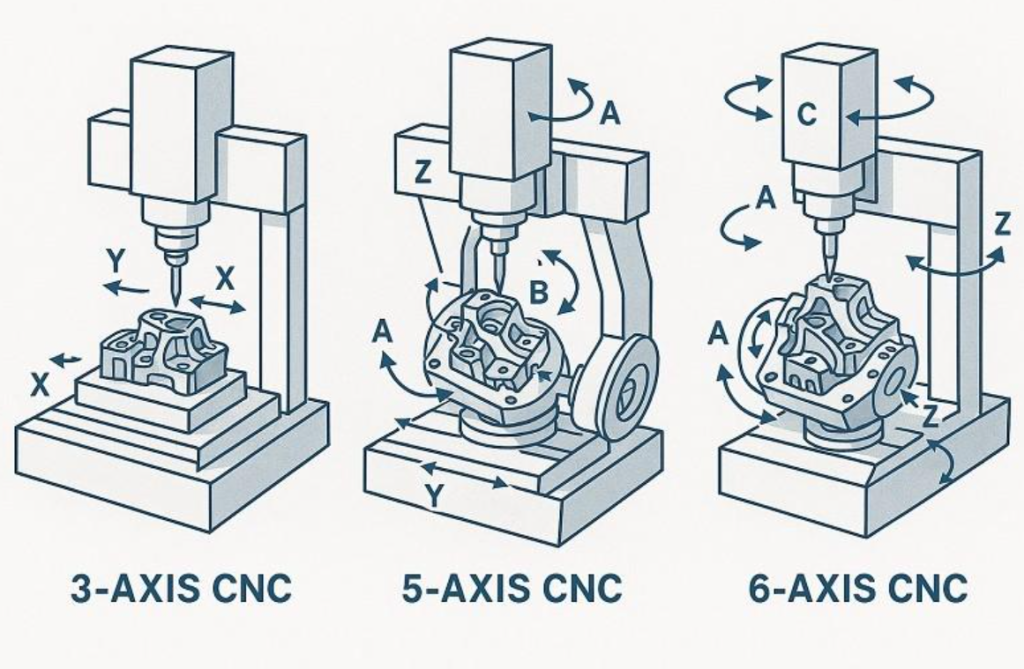
The main difference is the number and arrangement of controlled movements. A conventional five-axis machining center uses three linear axes and two rotary axes. A six-axis machine has one additional controlled axis, although its function and arrangement depend on the machine design.
That extra movement may provide more flexibility, but it also introduces additional mechanical and programming considerations.
| Comparison | 5-Axis CNC | 6-Axis CNC |
|---|---|---|
| Number of controlled axes | Five | Six |
| Typical milling configuration | Three linear and two rotary axes | Varies by machine architecture |
| Tool orientation | Multiple orientations for complex machining | Potentially additional orientation control |
| Programming | Requires multi-axis CAM capabilities | May require more complex kinematic programming |
| Applications | Complex surfaces, molds, aerospace and medical components | Specialized parts requiring additional movement |
| Equipment considerations | Wide range of established machine configurations | More dependent on the specific machine design |
Swipe to compare →
Machining Flexibility and Tool Accessibility
Five-axis machining already provides substantial flexibility. You can approach many surfaces from different directions, machine complex contours, and reduce the need for multiple setups.
A sixth axis may improve access to certain features or support more complex tool orientations. This can be useful when the part geometry creates limitations for a particular five-axis machine configuration.
But the additional axis does not guarantee that every hidden surface, deep cavity, or undercut becomes accessible. Tool length, spindle geometry, fixture design, machine travel, and collision clearance still matter.
Evaluate the actual toolpath and workpiece rather than assuming that a higher axis count eliminates all machining restrictions.
Accuracy, Rigidity, and Programming Complexity
More axes do not automatically mean higher machining accuracy.
Accuracy depends on the complete machine system, including its mechanical structure, guideways, rotary-axis performance, spindle, thermal stability, calibration, and control system.
Additional axes introduce more factors to manage. Rotary-axis positioning errors, mechanical compliance, thermal effects, and calibration can influence the final result.
For demanding metal-cutting applications, machine rigidity and cutting stability are especially important. A well-designed five-axis machining center may be a better choice for a particular job than a six-axis system that offers more movement but does not provide the required stiffness or accuracy.
Equipment Cost and Production Efficiency
A six-axis machine may involve additional mechanical components, control functions, programming requirements, and maintenance considerations. These factors can affect the purchase price and total cost of ownership.
On the other hand, if the additional axis reduces complex repositioning, improves access, or makes a difficult operation practical, it may provide a production advantage.
To evaluate the investment, compare the complete production process:
-
Number of setups required.
-
Machining and repositioning time.
-
Fixture and workholding requirements.
-
Programming and verification time.
-
Expected scrap and rework risks.
-
Operator training and maintenance needs.
The right machine is the one that improves your actual production process, not necessarily the one with the largest number of axes.
6-Axis CNC Machine vs. 6-Axis Industrial Robot
A six-axis CNC machine and a six-axis industrial robot are not the same type of equipment, even though both can have six controlled movements.
A typical industrial robot uses six rotary joints to move its arm and end effector through a working space. A conventional CNC machining center uses a machine-tool structure designed around controlled cutting operations.
| Comparison | 6-Axis CNC Machine | 6-Axis Industrial Robot |
|---|---|---|
| Typical movement structure | Depends on machine design; may combine linear and rotary axes | Usually six rotary joints |
| Main purpose | Controlled material removal | Flexible handling, assembly, welding, and other tasks |
| Structure | Machine frame, spindle, guideways, and workholding system | Articulated robotic arm and end effector |
| Machining considerations | Designed around cutting loads and machine-tool accuracy | Depends on robot stiffness, calibration, and process setup |
| Working range | Defined by machine travel and geometry | Often offers a large, flexible working envelope |
| Typical applications | Precision milling, drilling, and other machining operations | Handling, welding, dispensing, trimming, and specialized machining |
Swipe to compare →
Can a 6-Axis Robot Perform CNC Machining?
Yes. An industrial robot can carry a milling spindle or another cutting tool and perform machining operations.
This approach can be useful when you need a large working envelope, flexible tool movement, or machining of large components that are difficult to fit inside a conventional machine enclosure.
However, a robot’s six joints do not automatically give it the rigidity or cutting performance of a dedicated CNC machining center.
Cutting forces can cause deflection and vibration, which may affect dimensional accuracy and surface finish. Actual performance depends on the robot design, spindle, tool, workpiece material, calibration, and machining strategy.
For high-precision metal cutting, compare the complete system’s demonstrated performance rather than the number of joints or axes.
What Parts Can a 6-Axis CNC Machine Produce?
Six-axis machining is relevant to specialized components whose geometry or machining requirements benefit from additional movement. The applications depend on the machine’s configuration and whether its extra axis contributes to the actual cutting process.
Potential applications include the following.
Aerospace Components
Aerospace parts can have complex contours, changing surface angles, and demanding dimensional requirements. Certain specialized components may benefit from additional tool-orientation flexibility.
Examples include complex structural components, contoured surfaces, and parts with difficult-to-reach features.
However, many aerospace components are already produced successfully on advanced five-axis machining centers. Determine whether the additional axis solves a specific problem in your part design before investing in a six-axis system.
Turbine Blades and Complex Impellers
Turbine blades, impellers, and related components often involve complex three-dimensional surfaces and changing tool orientations.
Five-axis machining is well suited to many applications of this type. A specialized six-axis configuration may offer additional flexibility for certain geometries or machining strategies, but it is not automatically required.
Medical and Precision Components
Medical manufacturing includes orthopedic implants, surgical instruments, and other components with complex shapes or detailed surfaces.
Five-axis machining can be useful when you need to machine several faces or complex contours with fewer setups. A six-axis system may be worth evaluating when the part geometry requires an additional movement that a suitable five-axis machine cannot provide efficiently.
Specialized Industrial Applications
Other potential applications include:
-
Complex molds and dies.
-
Components with difficult access angles.
-
Specialized energy equipment parts.
-
Parts requiring unusual tool-orientation paths.
-
Certain integrated machining and positioning operations.
The application alone does not determine the required axis count. Your part geometry, tolerance requirements, tooling, and production process should guide the decision.
Do You Really Need a 6-Axis CNC Machine?
For many manufacturers, a five-axis machining center is already capable of handling a wide range of complex components. Six-axis equipment makes sense when the additional movement provides a clear advantage that you cannot achieve efficiently with a suitable five-axis setup.
The following considerations can help you decide.
When a 5-Axis CNC Machine Is Enough
A five-axis machine may be the practical choice if you need to:
-
Machine complex curved surfaces.
-
Produce aerospace structural components.
-
Manufacture precision molds and dies.
-
Machine multiple faces in fewer setups.
-
Produce medical components with complex contours.
-
Improve tool access to angled surfaces and features.
Modern five-axis machining centers offer a wide range of configurations, work envelopes, spindle options, and rotary-table or swivel-head designs. You can often find a suitable five-axis solution without taking on the added complexity of a specialized six-axis system.
When to Consider Six-Axis Machining
You should evaluate a six-axis machine when:
-
Your part requires a tool orientation that a suitable five-axis configuration cannot achieve.
-
An additional movement can improve access to a difficult feature.
-
Your machining strategy requires six-axis coordinated interpolation.
-
You need to reduce complex repositioning or specialized setups.
-
The supplier can demonstrate a measurable production benefit on your actual component.
Do not assume that six-axis machining will solve a problem simply because a part looks complicated. First identify the limitation in your current process. It may be caused by the machine architecture, fixture, tool length, CAM strategy, or cutting parameters rather than the number of axes.
Key Factors to Evaluate Before Buying
Before requesting a quotation, prepare a clear picture of your production requirements.
1. Part geometry and dimensions
Consider the largest workpiece, its weight, the deepest features, and the surfaces that need to be machined. Check whether the machine’s travel and rotary ranges can accommodate the part and fixture.
2. Material and cutting requirements
Aluminum, steel, titanium, and other difficult-to-machine materials place different demands on the spindle, machine structure, tooling, and cutting strategy.
3. Required accuracy and surface finish
Define your dimensional tolerances, geometric tolerances, and surface-finish requirements. Ask the manufacturer how the machine is configured to achieve them and whether it can demonstrate performance on a representative part.
4. Machine architecture
Compare table-rotary, swivel-head, and other relevant configurations. The best arrangement depends on workpiece size, weight, accessibility, and the required tool orientation.
5. CNC controller and CAM compatibility
Confirm that your control system and CAM software support the machine’s kinematics and required simultaneous movements. Make sure the postprocessor is correctly configured.
6. Service, maintenance, and long-term support
Consider spare parts, technical support, operator training, calibration, and maintenance requirements. These factors affect production reliability over the life of the equipment.
7. Total cost of ownership
Look beyond the initial machine price. Include tooling, fixtures, software, training, installation, maintenance, and the expected production benefits.
A useful approach is to ask shortlisted manufacturers to review one or two representative parts. Compare the proposed machining process, setup requirements, estimated cycle time, and demonstrated part quality before making a decision.
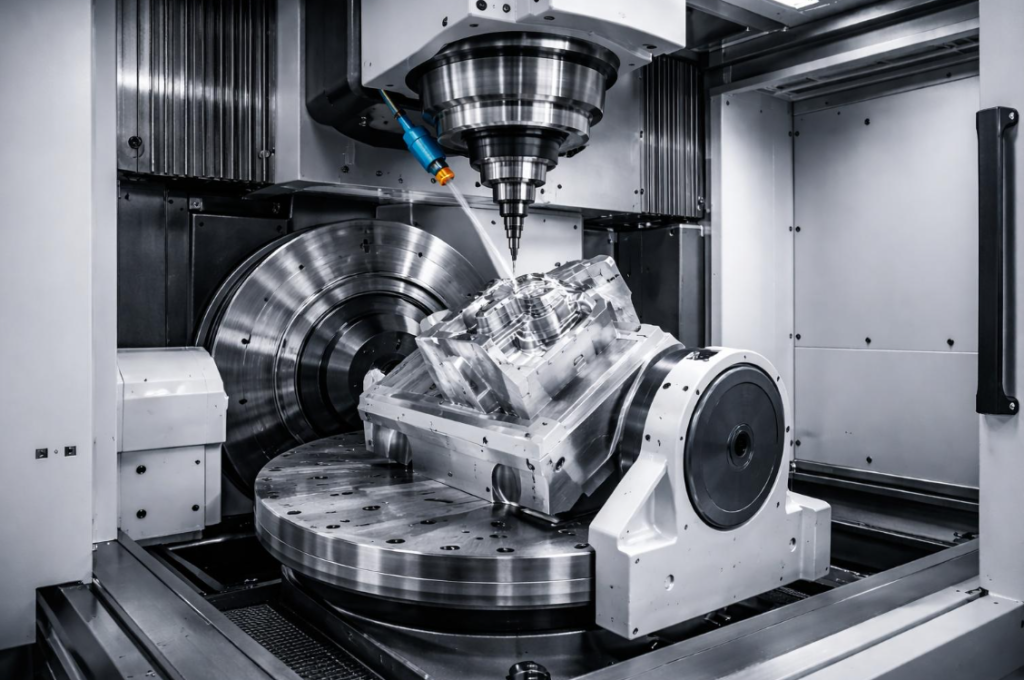
How to Choose the Right 5-Axis CNC Machine for Your Production Needs
If your production requirements do not justify a specialized six-axis system, a five-axis CNC machining center may provide a more practical balance of flexibility, accuracy, and investment.
When comparing five-axis machines, pay attention to the following areas.
Match the Machine Structure to Your Workpiece
Different five-axis machine architectures move the tool and workpiece in different ways.
A trunnion-style rotary-table machine can tilt and rotate the workpiece, while a swivel-head configuration changes the tool orientation. Each arrangement has advantages and limitations depending on part dimensions, weight, and machining access.
For large or heavy components, workpiece support and table load capacity are especially important. For parts requiring access to multiple angled surfaces, rotary travel and collision clearance deserve close attention.
Evaluate the Spindle and Machine Rigidity
The spindle should match your materials, cutting tools, and production requirements. Consider spindle speed, torque, power, taper, and cooling options.
The machine structure also needs sufficient rigidity for the intended cutting loads. This is particularly important when machining hard materials or removing significant amounts of material.
Check the Complete Manufacturing Solution
A machine’s performance depends on more than its mechanical structure. The CNC controller, CAM software, postprocessor, tooling, workholding, and operator expertise all contribute to the result.
Ask the supplier to explain how these elements work together and how they will support your actual production process.
Evaluate the Manufacturer’s Engineering and Support Capabilities
When purchasing high-value CNC equipment, you are also choosing a long-term technical partner.
Review the manufacturer’s engineering experience, production capabilities, quality-management documentation, technical support, and service arrangements. Ask for documentation relevant to the machine you are purchasing rather than relying only on general company claims.
DEPU focuses on the development and manufacturing of high-end five-axis CNC machine tools. According to company-provided information, its R&D work involves engineers from Germany and Taiwan, and many of its R&D engineers have more than 20 years of experience. The company also reports technical cooperation with organizations including the Southern Industrial Technology Research Institute, the School of Mechanical Engineering at Chongqing University, and the Southern Institute of Space Technology.
DEPU has also provided information about its ISO and CE certificates, High-Tech Enterprise certificate, and utility model and design patents. If you are evaluating a machine supplier, review the relevant certificates and technical documentation to confirm their scope and applicability to your purchasing requirements.
These company credentials provide background on the manufacturer’s experience and development activities. They should be considered alongside the machine’s actual specifications, inspection records, machining demonstrations, and service capabilities.
The most important step is to match the machine to your parts. Ask for a technical discussion or machining evaluation based on your actual workpieces, materials, and tolerances.
Final Thoughts
Six-axis CNC machines do exist, but more axes do not automatically mean better machining. The real value of a sixth axis depends on the movement it provides and whether that movement solves a specific production challenge.
For many manufacturers, a well-selected five-axis CNC machining center is already capable of producing complex aerospace, medical, automotive, and mold components with fewer setups and flexible tool access. A specialized six-axis system may be justified when your part geometry or machining process requires additional coordinated movement.
Before investing, compare the machine’s actual kinematics, cutting capabilities, accuracy, CAM compatibility, and total cost of ownership. Most importantly, evaluate it against your real workpieces—not just the number of axes listed in the brochure.
FAQ
Is a 6-axis CNC machine real?
Yes. Six-axis CNC machines and specialized six-axis machining configurations exist. However, the term can describe different machine architectures. Verify the six controlled axes and determine which ones can move simultaneously during cutting.
What are the six axes of a CNC machine?
In a common coordinate convention, the axes are X, Y, and Z for linear movement, and A, B, and C for rotation around the X, Y, and Z directions. Not every six-axis machine uses this exact physical arrangement.
Is a 6-axis CNC machine better than a 5-axis machine?
Not necessarily. A six-axis machine offers an additional controlled movement, but that movement is only valuable if it improves your machining process. A five-axis machine can already handle many complex parts and may be more practical for your production needs.
Can a 6-axis CNC machine cut titanium and stainless steel?
A properly equipped six-axis machine may be capable of machining titanium and stainless steel, but material capability does not come from axis count alone. You need to evaluate spindle torque and power, machine rigidity, tooling, cooling, cutting parameters, and workholding.
The same principle applies to five-axis machines. A suitable five-axis machining center can also cut these materials when its specifications and process setup support the required cutting loads.
Is a 6-axis CNC machine the same as a robotic arm?
No. A six-axis industrial robot usually has six rotary joints and is designed for flexible movement. A CNC machining center is a machine tool designed around controlled material removal. Robots can perform machining with suitable tooling, but their stiffness and cutting performance must be evaluated separately.
How many axes do most CNC machining centers have?
Three-axis and five-axis machining centers are common configurations in milling. Four-axis machines are also widely used for parts that benefit from rotary positioning. Six-axis and higher-axis systems are more specialized, and their configurations vary by application and machine type.
Does a 6-axis CNC machine always perform simultaneous six-axis machining?
Originally published by DEPU on 17 Nov 2026.