
What Is a High-Speed Vertical Machining Center?
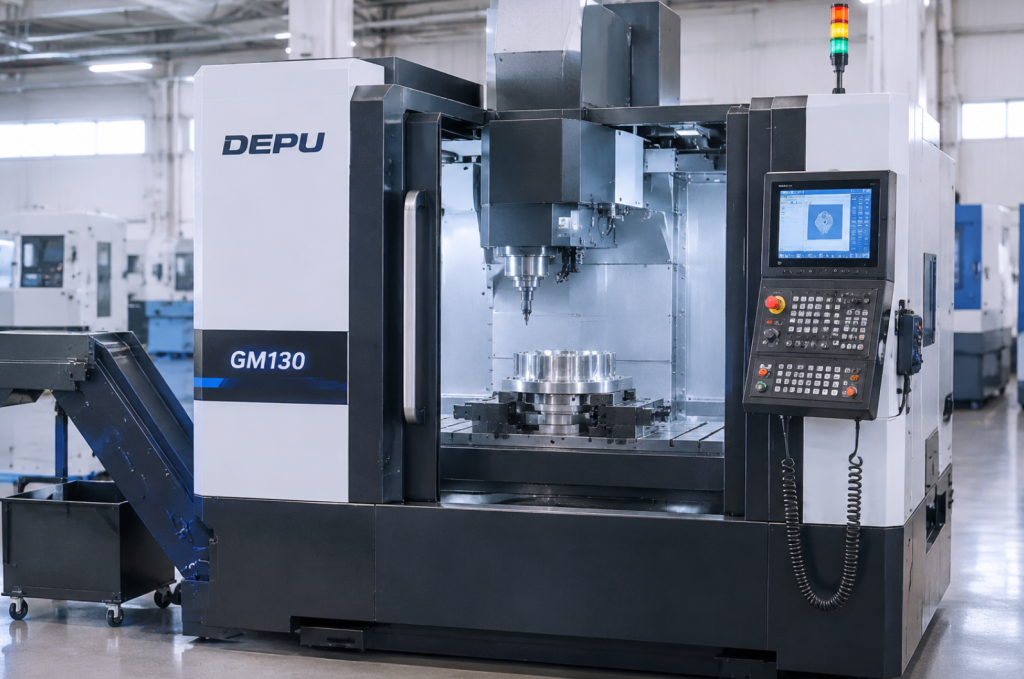
A vertical machining center is a CNC machine tool with a vertically oriented spindle. The cutting tool rotates in the spindle and removes material from a workpiece secured to the machine table. The CNC controller coordinates machine movements to produce features such as holes, pockets, slots, contours, and finished surfaces.
A high-speed vertical machining center is configured to support high-speed machining operations. Depending on its design, this may involve a high-speed spindle, responsive feed drives, a rigid machine structure, effective cooling, and efficient chip removal.
There is no single spindle-speed threshold that universally defines a high-speed VMC. Different manufacturers and applications use the term differently. A machine with a high maximum RPM is not automatically suitable for every high-speed machining operation. You need to evaluate its complete performance against your workpiece material, cutting tools, geometry, and production targets.
How Does a Vertical Machining Center Work?
A conventional 3-axis VMC uses three linear axes:
-
X-axis: Controls left-to-right movement.
-
Y-axis: Controls front-to-back movement.
-
Z-axis: Controls vertical movement.
The spindle rotates the cutting tool while the CNC controller follows a programmed toolpath. Depending on the machine design, the worktable, spindle head, or both may move to create the required relative motion between the tool and workpiece.
A typical production process includes:
-
Part design: Create a CAD model or engineering drawing that defines the required dimensions, geometry, and tolerances.
-
Toolpath programming: Use CAM software to select machining operations, cutting tools, speeds, feeds, and toolpaths.
-
Workholding: Secure the workpiece using a vise, fixture, clamps, or a suitable rotary table.
-
Machine setup: Install the tools, establish work coordinates, and verify the program and setup.
-
Machining and inspection: Run the machining cycle, then inspect critical dimensions and surface features.
For parts with angled surfaces or features on several sides, a 4-axis or 5-axis configuration can provide additional positioning options and reduce the need for manual repositioning.
Key Features That Define a High-Speed VMC
When comparing high-speed vertical machining centers, don’t make your decision based on spindle RPM alone. The machine needs to maintain stable cutting conditions while moving the tool through the required toolpath.
1. Spindle Speed, Power, and Torque
The spindle is one of the most important components in a high-speed machining center. Its speed, power, and torque influence which cutting tools and materials the machine can handle effectively.
-
Spindle speed (RPM): Indicates how fast the spindle rotates. Higher speeds can be useful with smaller-diameter tools and certain finishing operations.
-
Spindle power (kW): Indicates the power available to drive the cutting process.
-
Spindle torque (N·m): Describes the spindle’s ability to deliver rotational force, which matters in demanding cutting operations.
These specifications work together. A spindle with a high maximum RPM may be suitable for small tools and high-speed finishing, but heavy cutting in steel or other demanding materials may require substantial torque and power.
Check the spindle’s power and torque characteristics across its operating range, not just its maximum values. Also confirm whether the published figures are continuous ratings or short-duration ratings, such as S1 and S6.
2. Feed Rate and Acceleration
Spindle speed describes how quickly the tool rotates, while feed rate describes how quickly the cutting tool advances relative to the workpiece.
A machine may have a high-speed spindle but still struggle to maintain efficient machining if its axis drives cannot follow the programmed toolpath smoothly.
When comparing machines, review:
-
Cutting feed rate
-
Rapid traverse speed
-
Axis acceleration and deceleration
-
Servo response
-
Motion control performance
These factors become particularly important when you’re machining parts with many short toolpath segments, tight curves, or frequent direction changes.
Remember that rapid traverse speed is not the same as cutting feed rate. A high rapid traverse specification does not guarantee that the machine can maintain the same speed while cutting.
3. Machine Rigidity and Structural Stability
High-speed machining requires a machine structure that can resist vibration and maintain stable tool-to-workpiece positioning.
The base, column, spindle support, guideways, drive system, and worktable all contribute to machine behavior under cutting loads.
Insufficient rigidity can lead to chatter, poor surface finish, dimensional variation, and accelerated tool wear. These problems can affect productivity even when the spindle has a high maximum speed.
If you plan to machine steel, stainless steel, or other demanding materials, pay particular attention to structural design and cutting stability. A machine optimized for light, high-speed aluminum machining may not be the right choice for heavy material removal.
4. Thermal Stability and Cooling
Heat is an important consideration in high-speed machining. Spindle rotation, cutting forces, friction, and environmental temperature changes can affect machine geometry and dimensional consistency.
Depending on the machine design, thermal management may involve:
-
Spindle cooling
-
Temperature monitoring
-
Thermal compensation
-
Coolant delivery
-
Stable machine operating conditions
If your parts require tight tolerances or long production cycles, ask the manufacturer how the machine manages thermal changes and how its accuracy specifications are measured.
5. Tooling and Automatic Tool Changing
Your cutting tools and toolholders need to match the spindle and machining process.
For high-speed operations, toolholder balance, clamping reliability, tool geometry, and tool condition all matter. An unsuitable tool assembly can introduce vibration and limit the spindle speed you can use safely.
An automatic tool changer (ATC) can also reduce manual intervention when a part requires multiple tools. When evaluating the system, check:
-
Tool magazine capacity
-
Maximum tool diameter and length
-
Maximum tool weight
-
Tool-change time, where specified
-
Compatibility with your toolholders
A larger tool magazine is not automatically better. Choose a capacity that matches the variety of tools used in your production process.
6. Chip Evacuation and Coolant Delivery
Chips can accumulate around the cutting area, interfere with the toolpath, damage finished surfaces, or affect machining stability.
Effective chip evacuation becomes especially important when you’re machining deep pockets, enclosed features, or materials that produce long or difficult-to-manage chips.
Review the machine’s coolant delivery, chip conveyor options, filtration requirements, and enclosure design. Your choice should reflect the materials and operations you expect to run.
What Materials Can a High-Speed Vertical Machining Center Machine?
A high-speed VMC can be configured for different materials, but the appropriate machine depends on more than the spindle’s maximum speed. You need to match the spindle, machine structure, cutting tools, workholding, and machining parameters to the material.
| Material | Key machining considerations |
|---|---|
| Aluminum alloys | High spindle speeds, suitable feed rates, chip evacuation, and surface finish |
| Carbon and alloy steel | Spindle torque, structural rigidity, tool selection, and cutting stability |
| Stainless steel | Heat management, cutting conditions, and tool wear |
| Titanium alloys | Torque, rigidity, thermal control, and carefully selected cutting parameters |
| Copper and brass | Tool geometry, cutting speed, chip control, and surface quality |
| Engineering plastics | Heat generation, workholding, tool geometry, and dimensional stability |
Swipe to compare →
Is a High-Speed VMC Suitable for Titanium?
Some VMCs can machine titanium alloys when their spindle, torque, rigidity, tooling, cooling, and cutting parameters are appropriate. However, you should not assume that a machine with a high-RPM spindle is automatically suitable for titanium machining.
Titanium alloys can generate significant heat at the cutting edge and place demanding requirements on tooling, cutting conditions, and machine stability. Depending on the operation, spindle torque and rigidity may be more important than maximum spindle speed.
Before purchasing, provide the manufacturer with your material grade, part geometry, stock dimensions, and machining requirements. Ask for a machine and tooling recommendation based on those details.
The same principle applies to aerospace and medical manufacturing: evaluate the actual machining process rather than relying on broad material-capability claims.
High-Speed 3-Axis vs. 5-Axis Vertical Machining Centers
High-speed machining and multi-axis machining describe different aspects of a machine.
High-speed machining focuses on the machine’s ability to perform cutting operations at suitable speeds and feeds while maintaining stability and the required quality.
5-axis machining adds two rotary axes to the three linear axes, allowing the tool or workpiece to be positioned in more directions. Depending on the machine and operation, this can improve access to multiple faces and complex surfaces.
A machine can combine high-speed and 5-axis capabilities, but one does not automatically imply the other.
3-Axis High-Speed VMC
A 3-axis VMC uses X, Y, and Z movements. It is often a practical choice when your parts have features that can be reached from a fixed tool direction.
Typical applications include:
-
Aluminum plates and brackets
-
Industrial housings
-
Fixtures and tooling components
-
Mold bases
-
Parts with conventional pockets, holes, and contours
Advantages:
-
Generally simpler programming
-
Straightforward workholding for many parts
-
Suitable for a broad range of conventional milling operations
-
May offer a lower equipment and programming investment than a comparable 5-axis setup
Limitations:
-
Multiple faces may require additional setups.
-
Angled features can require special fixtures.
-
Complex surfaces may need longer tools or alternative machining strategies.
5-Axis High-Speed Machining Center
A 5-axis machining center combines three linear axes with two rotary axes. Depending on its kinematic design, the rotary axes move the workpiece, the tool, or both.
This configuration can provide access to more workpiece surfaces and allow the machine to maintain more suitable tool orientations.
Typical applications include:
-
Aerospace components with compound angles
-
Complex medical and precision components
-
Impellers and other contoured parts
-
Multi-face housings
-
Complex mold surfaces
Advantages:
-
Greater access to angled and multiple workpiece surfaces
-
Potentially fewer setups and less manual repositioning
-
More flexibility for complex tool orientations
-
Can support simultaneous machining of certain freeform surfaces
Limitations:
-
Higher equipment investment may be required.
-
CAM programming and post-processing can be more demanding.
-
Rotary-axis travel, workpiece clearance, and collision avoidance need careful evaluation.
-
Operators and programmers may require additional training.
3+2 Machining vs. Simultaneous 5-Axis Machining
Not every 5-axis job requires all five axes to move continuously during cutting.
In 3+2 machining, the rotary axes position the workpiece or tool at a selected angle and remain stationary during the cutting operation. The machine then uses the three linear axes to perform the programmed machining.
In simultaneous 5-axis machining, the three linear axes and two rotary axes can move together while the tool follows the programmed path. This is useful for surfaces that require continuous changes in tool orientation.
If your parts mainly have several fixed angled faces, 3+2 machining may be sufficient. If you need continuous tool-orientation changes across complex surfaces, simultaneous 5-axis machining may be necessary.
The right configuration depends on your part geometry, tolerances, production volume, and machining strategy.
Industrial Applications of High-Speed Vertical Machining Centers
High-speed vertical machining centers are used across industries that need accurate, repeatable milling operations. The ideal machine configuration varies with part size, material, geometry, and production volume.
Aerospace Manufacturing
Aerospace manufacturers produce structural components, housings, brackets, and other parts from materials such as aluminum alloys and titanium alloys.
Depending on the part, you may need a large working envelope, suitable spindle torque, stable cutting performance, and access to angled or multiple surfaces.
For complex aerospace components, a 5-axis machining center can reduce the need for repeated workpiece repositioning and support more flexible tool orientation.
Medical Device Manufacturing
Medical manufacturing includes a broad range of parts, from small precision components to larger equipment structures.
Your machine selection should reflect the material, geometry, dimensional requirements, surface finish, and production process. Some components may be suitable for high-speed 3-axis machining, while complex shapes or multiple angled features may benefit from 5-axis capability.
If you’re manufacturing regulated medical products, remember that machine capability is only one part of the quality system. Process validation, inspection, documentation, and applicable regulatory requirements also matter.
Mold and Die Manufacturing
Mold and die production often involves cavities, curved surfaces, detailed contours, and finishing operations.
High-speed machining can be useful for suitable finishing strategies, especially when tool geometry and cutting conditions are properly matched to the workpiece.
A 5-axis configuration may also help when the mold geometry includes steep walls, angled surfaces, or features that are difficult to reach with a fixed tool orientation.
Automotive Manufacturing
Automotive suppliers produce a wide variety of machined components, including housings, brackets, tooling, and precision structural parts.
If your production involves repeatable parts with accessible features, a 3-axis VMC may be sufficient. For complex components requiring multiple machining orientations, a 5-axis machine may help consolidate operations.
The most suitable choice depends on production volume, cycle-time targets, part variation, and workholding strategy.
Precision and General Manufacturing
Industrial equipment manufacturers and precision engineering companies may need to machine parts with different materials, sizes, and geometries.
If your product range changes frequently, consider how much flexibility you need from the machine. A suitable 5-axis machining center may handle a wider range of part orientations, while a dedicated 3-axis machine may be more economical for repeatable, conventional operations.
How to Choose the Right High-Speed Vertical Machining Center
Choosing a machine is a production decision, not just a specification comparison. Start with the parts you need to manufacture and work backward to the machine configuration.
Step 1: Define Your Part and Production Requirements
Before contacting manufacturers, prepare representative part drawings or 3D models.
Identify:
-
Maximum part dimensions and weight
-
Material types and stock sizes
-
Required tolerances and surface finishes
-
Features that need angled or multi-face access
-
Production volume and expected cycle times
-
Current setup and workholding requirements
If you manufacture several part families, use examples that represent both your typical work and your most demanding jobs.
Step 2: Check the Working Envelope
Review the machine’s X, Y, and Z travel, table dimensions, maximum workpiece size, and load capacity.
For 5-axis machines, check the usable working envelope with the rotary axes tilted or rotated. A workpiece that fits on the table in a horizontal position may interfere with the machine structure or enclosure when the rotary table moves.
Also consider fixture dimensions, tool length, spindle clearance, and loading access.
Step 3: Match Spindle Performance to Your Materials
Compare spindle speed, power, torque, and tool interface against your actual machining requirements.
For example:
-
Small tools and certain aluminum finishing operations may benefit from higher spindle speeds.
-
Larger tools and demanding steel operations may need more torque.
-
Difficult-to-machine materials may require a balance of torque, rigidity, cooling, and controlled cutting conditions.
Ask the manufacturer for the spindle’s power and torque curves if available. These provide more useful information than a maximum RPM figure alone.
Step 4: Evaluate Accuracy and Machine Stability
Do not rely on a single advertised accuracy number.
Ask how the machine’s positioning accuracy and repeatability are measured, under what environmental conditions, and whether the figures apply across the full working range.
For 5-axis equipment, also review rotary-axis accuracy, calibration procedures, kinematic compensation, and the method used to verify the machine’s performance.
If your production requires consistent results over long machining cycles, ask how the manufacturer addresses thermal effects and machine maintenance.
Step 5: Check the Controller and CAM Workflow
A suitable CNC controller and CAM workflow are essential, especially when you’re considering 5-axis machining.
Confirm:
-
Compatibility with your CAM software
-
Availability of the required post-processor
-
Support for the machining modes you plan to use
-
Tool-center-point control, where required
-
Simulation and collision-checking workflow
-
Training and technical support
A machine with advanced axis capability will not deliver its full value if your programming workflow cannot use it effectively.
Step 6: Compare Automation and Operating Costs
Consider how the machine will fit into your production environment.
Depending on your operation, useful options may include an automatic tool changer, workpiece probing, tool measurement, chip conveyors, coolant filtration, and automation interfaces.
Then calculate the total cost of ownership, including:
-
Machine purchase and installation
-
Fixtures, workholding, and toolholders
-
Cutting tools and consumables
-
CAM software and post-processors
-
Operator and programmer training
-
Maintenance and spare parts
-
Downtime and production support
A 5-axis machine may have a higher initial cost but could reduce handling and setup time for suitable parts. A 3-axis machine may remain more economical if your production does not need additional rotary-axis capability.
Step 7: Request a Part-Based Machining Evaluation
Before making a purchase decision, ask the manufacturer to evaluate your actual parts.
A useful evaluation should address:
-
Which machine configuration is suitable for the part?
-
Can the part be completed in one setup, or will additional setups be required?
-
Is 3+2 machining sufficient, or is simultaneous 5-axis machining necessary?
-
What spindle, tooling, and workholding configuration is recommended?
-
Can the machine accommodate the part’s size and weight?
-
What inspection and verification process is appropriate?
-
What training and technical support will be available?
If possible, arrange a machining demonstration or sample-part evaluation using representative material and geometry. Ask for the inspection results and clarify the conditions under which they were obtained.
This gives you a more meaningful basis for comparison than a brochure or headline specification.
Considering a 5-Axis CNC Machining Center from DEPU?
If your production requires more than conventional vertical milling, a 5-axis machining center may provide the positioning flexibility and workpiece access you need.
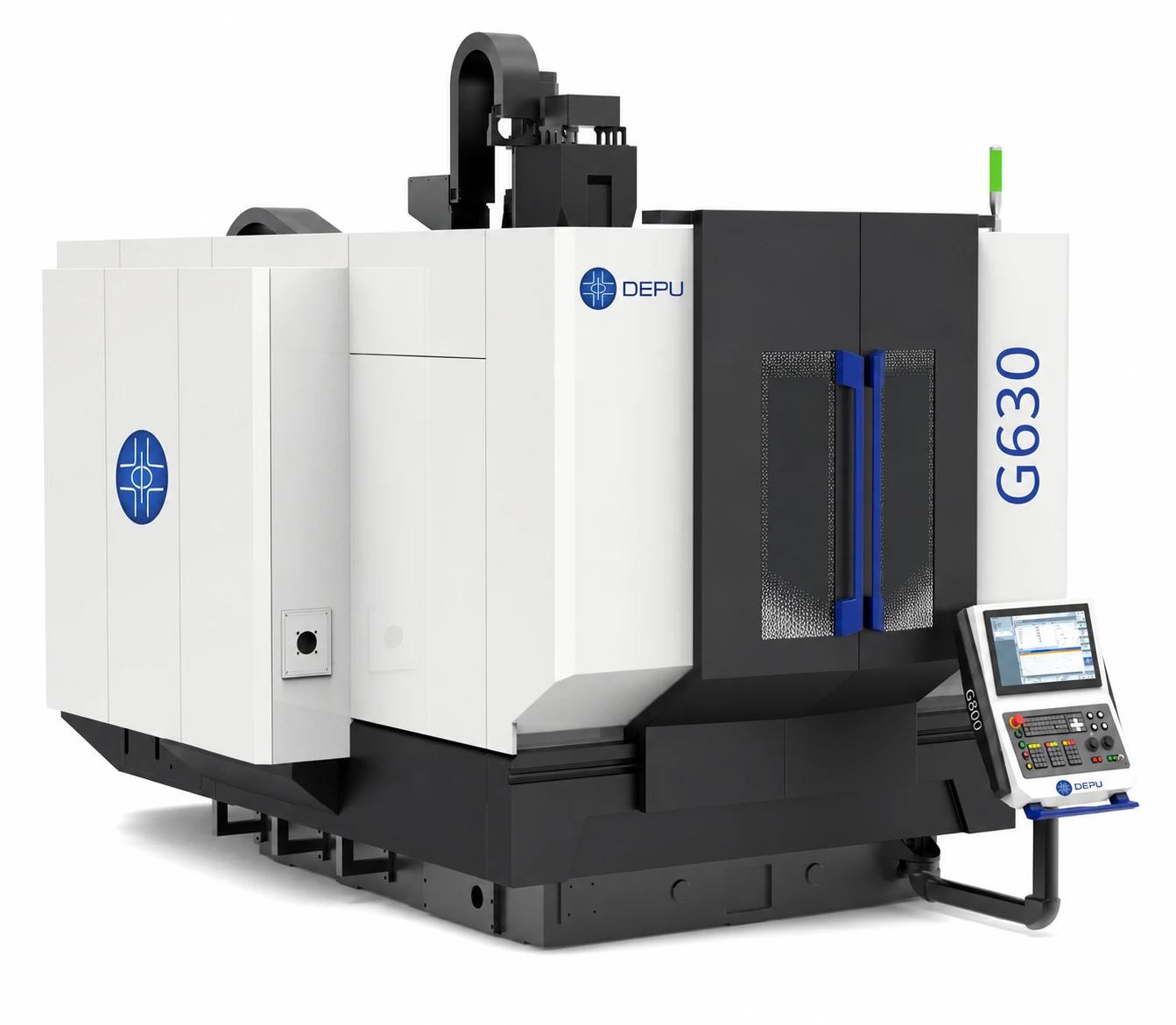
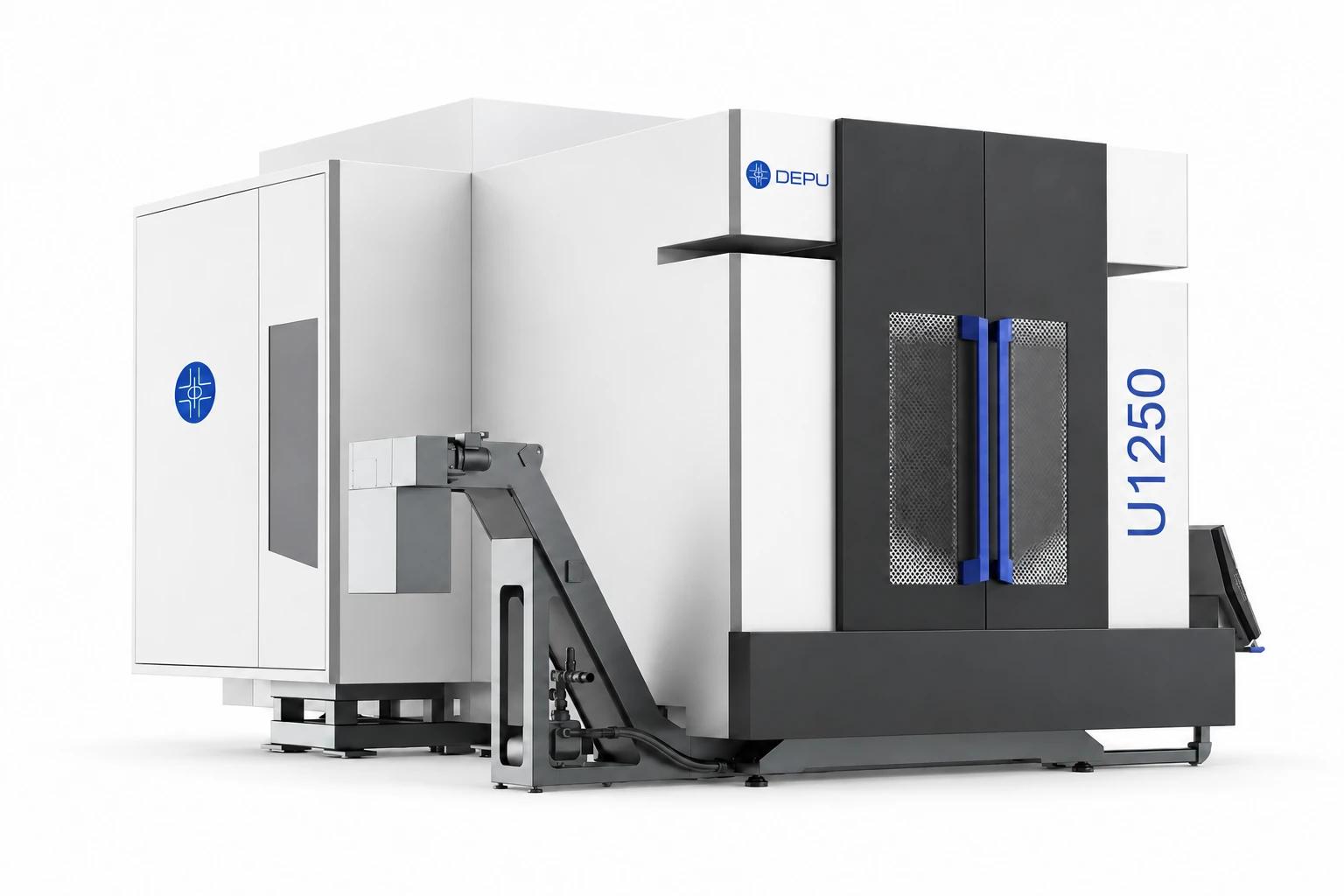
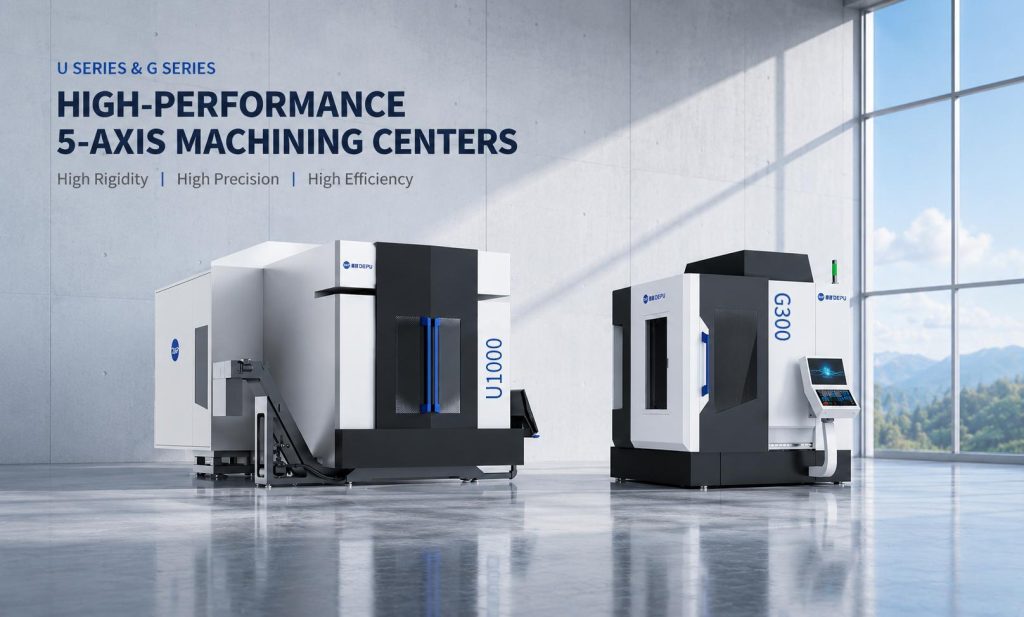
DEPU focuses on the development and manufacture of 5-axis CNC machine tools. Its G Series includes cradle-type vertical machining centers designed for precision molds, complex components, and applications in industries such as aerospace, automotive, and mechanical engineering.
Two models illustrate how machine size and spindle configuration can address different production requirements.
DEPU G300: Compact 5-Axis Machining
The DEPU G300 is a compact 5-axis vertical machining center designed for smaller, complex components and precision applications.
Its published reference configuration includes:
-
X/Y/Z travel: 300/580/300 mm
-
Maximum workpiece size: Ø390 × 250 mm
-
Uniform table load: 50 kg
-
HSK-E50 spindle
-
Maximum spindle speed: 24,000 rpm
-
Spindle power: 13/19.5 kW (S1/S6)
-
Spindle torque: 20/30 N·m (S1/S6)
-
24- or 32-tool magazine options
The G300 also features a gantry structure, a dual-supported direct-drive trunnion rotary table, and closed-loop feedback on its linear and rotary axes. These features support applications involving multi-sided machining, precision molds, and complex surfaces.
DEPU G630: Larger Workpieces and Higher Capacity
For larger components, the DEPU G630 offers a larger working envelope and higher workpiece load capacity.
Its published specifications include:
-
X/Y/Z travel: 650/650/500 mm
-
Maximum workpiece dimensions: Ø700 × 400 mm
-
Uniform table load: 850 kg
-
HSK-E63 spindle interface
-
Maximum spindle speed: 24,000 rpm
-
Rated spindle power: 40 kW
-
Published spindle torque: 72/94 N·m (S1/S6)
-
40-tool magazine
The G630 also uses a gantry structure and dual-supported cradle rotary table. Its published configuration includes a Siemens CNC system with RTCP functionality, full closed-loop feedback, and spindle cooling.
These specifications provide a starting point for comparing the two machines, not a guarantee that either model is suitable for every high-speed machining application. Spindle options and machine configurations may vary, so confirm the exact specification and performance curve with DEPU before making a purchasing decision.
You can explore the DEPU 5-axis CNC machining center range and share your part drawings, material information, and production requirements with the team to discuss a suitable configuration.
Final Thoughts
A high-speed vertical machining center can improve your manufacturing process when its spindle, feed system, structure, tooling, and thermal management are properly matched to the work you need to produce. Maximum spindle speed is useful information, but it should never be the only factor in your decision.
If you’re machining conventional parts with accessible features, a 3-axis VMC may be the most practical solution. If your components require multiple machining orientations, compound angles, or complex surfaces, a 5-axis machining center may offer greater flexibility and fewer setups.
Before you invest, compare machines using your actual part geometry and production requirements. Evaluate the complete machining process—not just the specifications on the brochure—and choose a configuration that supports the quality, productivity, and operating costs your business needs.
FAQ
1. What Is Considered a High-Speed Vertical Machining Center?
There is no single spindle-speed threshold that defines every high-speed VMC. The term generally describes a vertical machining center configured for high-speed machining through a combination of spindle performance, feed capability, machine rigidity, thermal management, and suitable tooling. Evaluate the complete machine configuration rather than relying on maximum RPM alone.
2. Does a Higher Spindle Speed Always Mean Faster Machining?
No. Spindle speed is only one part of machining performance. Feed rate, spindle power and torque, acceleration, tool selection, material properties, rigidity, and chip evacuation all affect machining time. A higher spindle speed may help in certain operations, but it does not guarantee a shorter cycle time or better surface quality.
3. Can a High-Speed VMC Machine Titanium?
Some VMCs can machine titanium alloys when their spindle, torque, rigidity, tooling, cooling, and cutting parameters are appropriate. However, titanium machining can place demanding requirements on the machine and cutting process. Ask the manufacturer to evaluate your specific alloy, part geometry, and machining operations before choosing a machine.
4. What Is the Difference Between a High-Speed VMC and a 5-Axis CNC Machine?
A high-speed VMC is designed to support high-speed machining operations. A 5-axis CNC machine adds two rotary axes to the three linear axes, allowing the tool or workpiece to be positioned in more directions. These are different capabilities, and a machine can combine both. Your choice should depend on whether your priority is cutting performance, access to complex features, or both.
5. How Do I Choose the Right High-Speed Vertical Machining Center?
Start with your part drawings, materials, dimensions, tolerances, and production volume. Then compare spindle speed, power and torque, feed performance, rigidity, working envelope, tooling, controller, and automation options. If your parts require multiple angled surfaces or complex contours, also evaluate whether a 5-axis configuration would reduce setups or improve tool access. A part-based machining evaluation is one of the most useful steps before purchasing.
Originally published by DEPU on 11 Nov 2026.