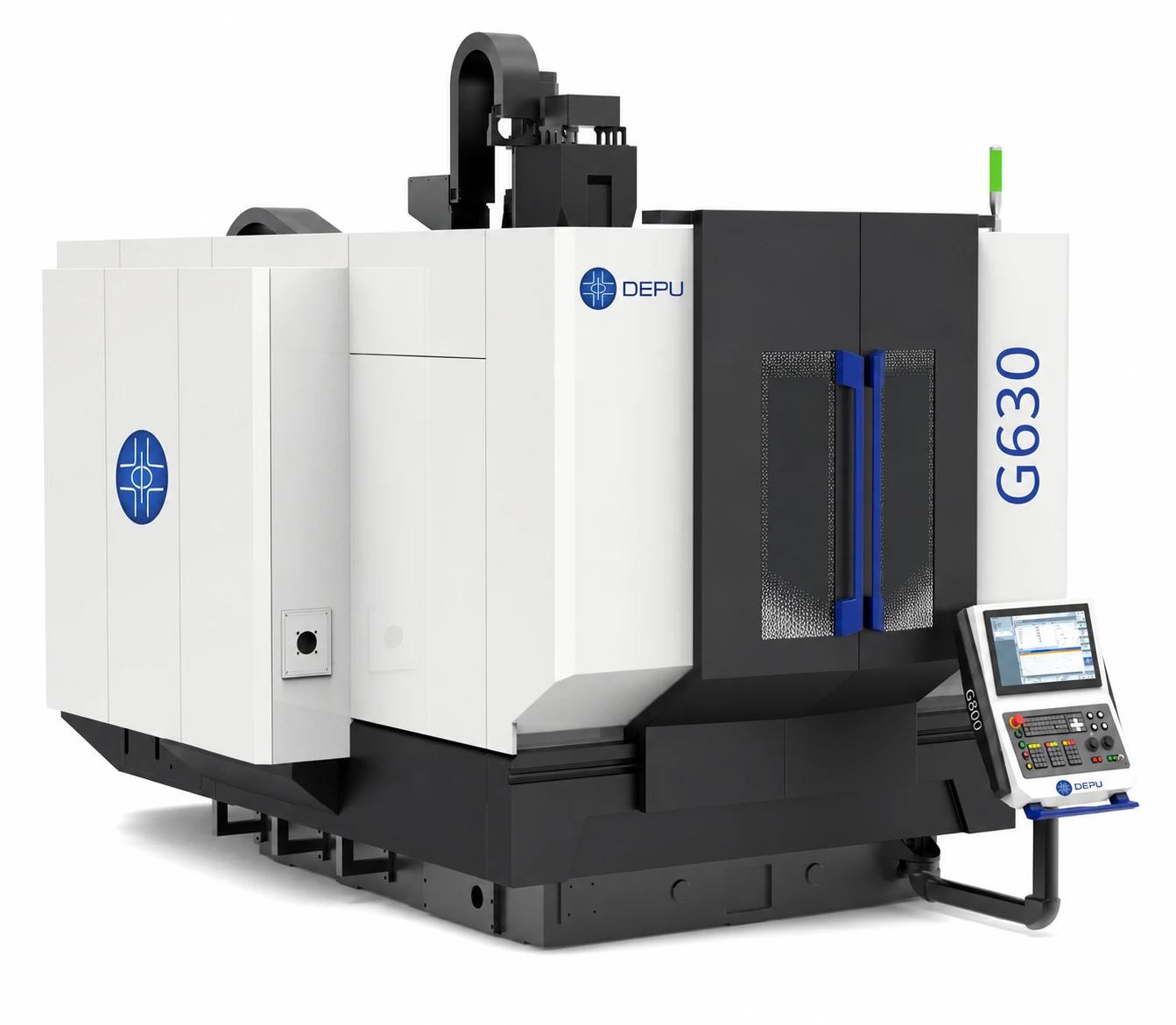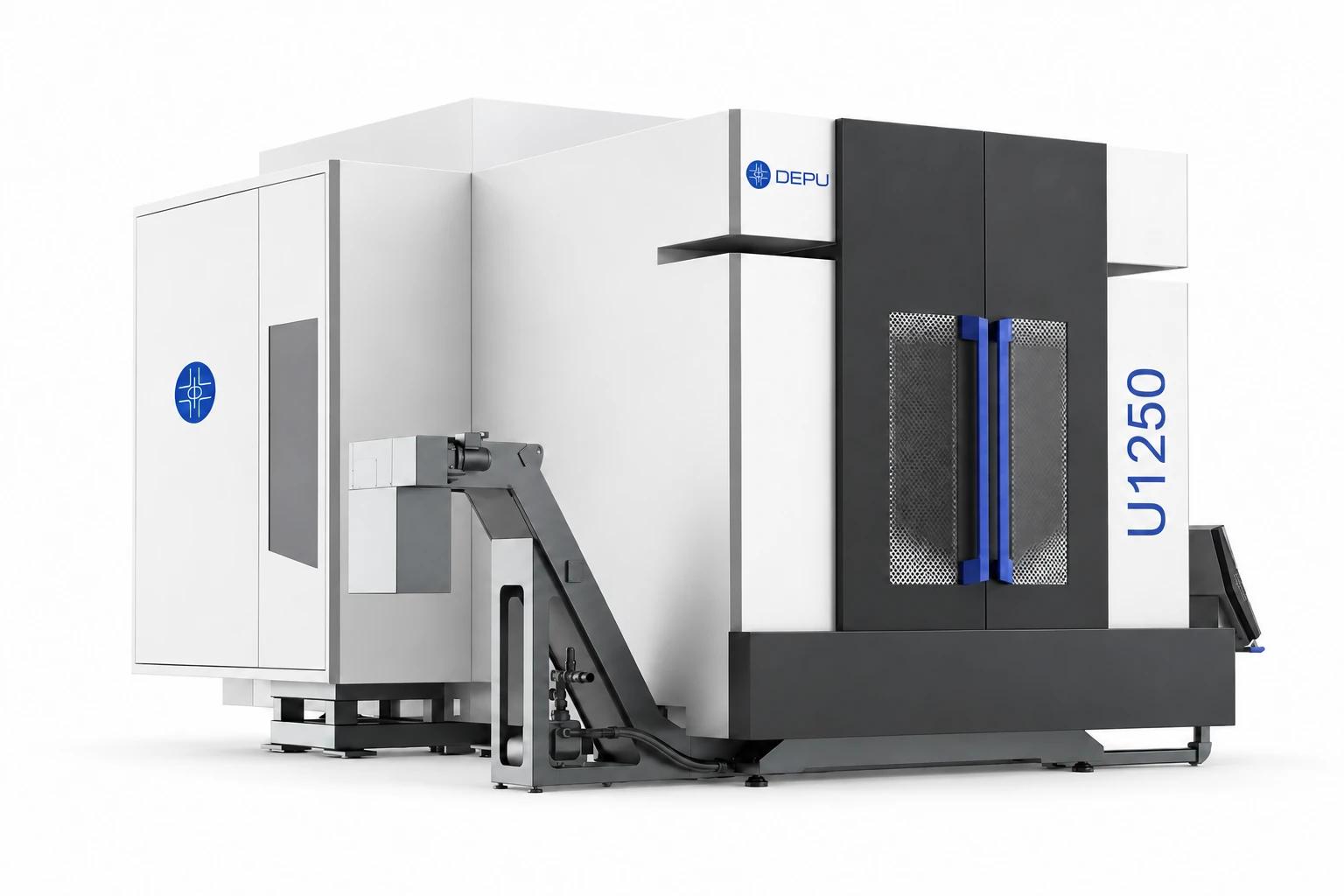

bed CNC machine generally refers to a CNC bed-type milling machine, which uses a fixed-height worktable mounted directly on the machine bed. Unlike a knee-type milling machine, where the table moves vertically on an adjustable knee, a bed-type machine typically uses a vertically moving spindle head. This structural arrangement can provide stable workpiece support and is commonly used in production milling applications.
However, bed-type construction and 5-axis machining describe two different aspects of a CNC machine. The first refers to the machine’s structural design; the second describes its movement capabilities. A bed-type machine can have multiple controlled axes, including rotary axes, depending on its configuration.
If you’re comparing CNC equipment for a manufacturing operation, understanding this distinction is important. This guide explains how bed-type CNC milling machines work, their advantages and limitations, how they compare with other milling machines, and when a 5-axis machining center may be a better investment.
What Is a Bed CNC Milling Machine?
A bed CNC milling machine is a milling machine in which the worktable is mounted directly on the machine bed rather than supported by a vertically adjustable knee.
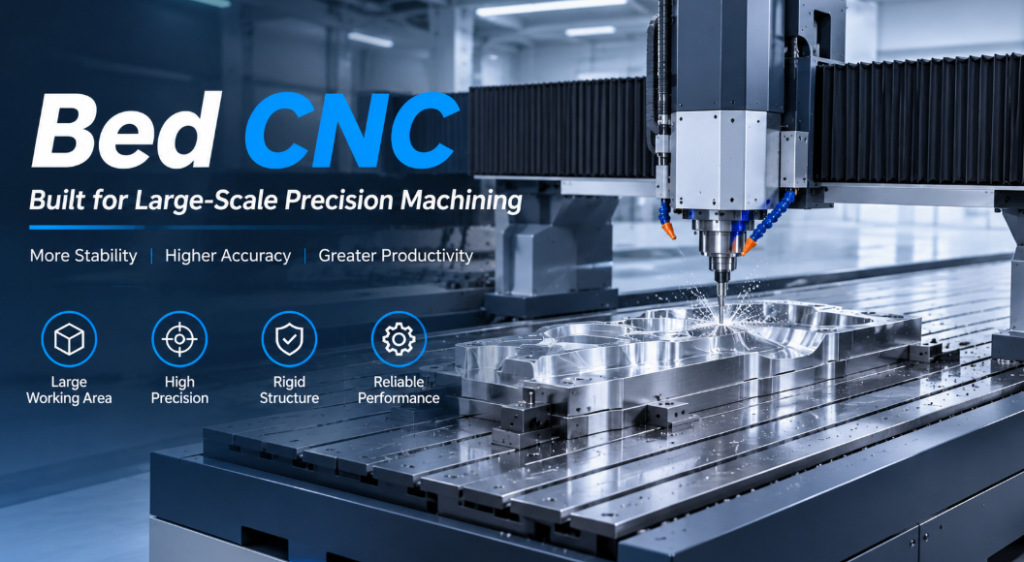
The machine bed forms the main structural foundation. It supports the worktable and helps maintain the alignment of the machine’s moving components. In a typical bed-type design, the table moves horizontally while the spindle head provides vertical movement.
This arrangement is often used for production milling and applications where workpiece support and structural stability are important.
Main Components of a Bed-Type CNC Milling Machine
Although the layout varies by manufacturer and model, a typical bed-type milling machine includes:
-
Machine bed: The main structural base that supports the worktable and other machine components.
-
Worktable: Holds the workpiece or fixture and provides the required positioning movement.
-
Column: Supports the spindle assembly and its movement.
-
Spindle head: Holds and rotates the cutting tool.
-
Guideways and drive systems: Control the movement of the table and spindle assembly.
-
CNC controller: Coordinates axis movement, spindle operation, and machining programs.
The arrangement and specifications of these components determine the machine’s working envelope, rigidity, accessibility, and machining capabilities.
Bed Mill vs. Knee Mill: What’s the Difference?
The main difference is how each machine supports and moves the worktable.
On a knee-type milling machine, the table is mounted on a saddle and a vertically adjustable knee. The knee moves up and down along the column, allowing the operator to change the table height.
On a bed-type milling machine, the table is mounted directly on the bed, generally at a fixed height. Vertical movement is typically handled by the spindle head.
| Feature | Bed-Type Milling Machine | Knee-Type Milling Machine |
|---|---|---|
| Table support | Mounted directly on the bed | Supported by a knee and saddle |
| Vertical movement | Usually handled by the spindle head | Usually handled by the knee |
| Structural layout | Fixed-height table arrangement | Vertically adjustable table assembly |
| Typical applications | Production and heavier milling operations, depending on design | General-purpose and toolroom work |
| Flexibility | Depends on machine travel and head configuration | Convenient manual table-height adjustment |
A bed-type design may be worth considering when workpiece support and production stability are priorities. A knee mill may be more practical for general-purpose work, smaller jobs, or operations that benefit from manual adjustment.
Neither design is automatically better for every application. Workpiece dimensions, cutting forces, required accuracy, and production volume should guide the decision.
How Does a Bed-Type CNC Milling Machine Work?
A bed-type CNC milling machine removes material with a rotating cutting tool while the machine controls the relative movement between the tool and workpiece.
The machining process generally follows these steps:
-
Secure the workpiece. Mount the material on the worktable using a suitable fixture, vise, or clamping system.
-
Prepare the machining program. Use CAD and CAM software to define the part geometry, toolpaths, cutting operations, and machining parameters.
-
Set the tools and work coordinates. Install the required cutting tools and establish the workpiece reference position.
-
Run the CNC program. The controller coordinates the machine axes and spindle according to the programmed instructions.
-
Machine the part. The rotating tool removes material through controlled movements along the available axes.
-
Inspect the finished component. Check critical dimensions and surface features against the engineering requirements.
Understanding the Machine’s Axes
A conventional 3-axis milling machine uses three linear axes:
-
X-axis: Left-to-right movement.
-
Y-axis: Front-to-back movement.
-
Z-axis: Up-and-down movement.
The specific component that moves along each axis depends on the machine’s mechanical design. Some machines move the table along certain axes, while others move the spindle assembly.
Additional rotary axes allow the machine to position the workpiece or cutting tool at different angles. This is useful when a part has angled surfaces, curved features, or machining requirements on multiple sides.
The number of axes should be evaluated separately from the machine’s bed design. A bed-type machine is not necessarily limited to three axes.
Why Is Machine Bed Design Important in CNC Machining?
The machine bed is more than a base that holds the equipment together. It forms part of the structural system that supports machining forces and maintains the relationship between the workpiece, spindle, and moving components.
For demanding production work, buyers should pay attention to several factors.
1. Structural Rigidity
During milling, the cutting tool generates forces that act on the spindle, workpiece, table, and machine structure.
The bed and supporting structure need sufficient rigidity to resist unwanted deflection under the intended cutting conditions. This is particularly important when machining hard materials, removing large amounts of material, or working with heavy components.
A rigid structure can help maintain the relative position of the tool and workpiece. However, the bed alone does not determine overall machine performance. The column, spindle, guideways, joints, and foundation also matter.
2. Vibration Resistance
Cutting vibration can affect surface finish, dimensional consistency, and tool life.
Machine mass, structural geometry, joint design, spindle characteristics, tooling, and cutting parameters all influence vibration behavior. A heavier machine is not necessarily better if its structural design or dynamic performance is unsuitable for the application.
When comparing machines, ask the manufacturer how the machine is designed to handle the cutting forces and materials involved in your production work.
3. Thermal Stability
Heat generated by the spindle, motors, cutting process, and surrounding environment can cause machine components to expand.
Uneven thermal changes may affect positioning and dimensional accuracy, especially during long production cycles or when machining parts with tight tolerances.
Look for information about thermal management, machine warm-up procedures, compensation functions, and the conditions under which the manufacturer specifies accuracy.
4. Long-Term Accuracy
A machine needs to maintain its performance over time, not just meet specifications when new.
Guideway design, mechanical components, lubrication, installation quality, maintenance, and operating conditions all contribute to long-term accuracy.
For production equipment, ask about maintenance requirements, inspection procedures, and available technical support.
Bed Mill vs. Knee Mill vs. 3-Axis vs. 5-Axis CNC Machine
These terms describe different aspects of milling machine design, so they should not be treated as interchangeable categories.
A bed-type machine describes the structural arrangement of the table and bed. A 3-axis or 5-axis machine describes the number of controlled movement axes.
| Machine Type | What Defines It | Typical Strengths | Considerations |
|---|---|---|---|
| Bed-type mill | Worktable mounted directly on the bed | Stable workpiece support and production-oriented configurations | Capabilities depend on travel, spindle design, and axis configuration |
| Knee-type mill | Table supported by a vertically adjustable knee | General-purpose flexibility and manual adjustment | May be less suitable for some heavy production applications |
| 3-axis CNC mill | X, Y, and Z linear movement | Conventional milling, drilling, and pocketing operations | Complex multi-face parts may require additional setups |
| 5-axis CNC machining center | Three linear axes and two rotary axes | Multi-face machining, compound angles, and complex contours | Higher equipment, programming, and operator requirements |
Can a Bed-Type Machine Also Be a 5-Axis Machine?
Yes. Bed-type construction and 5-axis capability are not mutually exclusive.
A bed-type machine describes how the machine is structurally arranged. A 5-axis machine has three linear axes and two rotary axes. A machine can combine a bed-type structure with a 5-axis configuration, depending on its design.
For example, a 5-axis machining center may use a rotary table, a tilting spindle head, or a combination of both. The configuration affects how the machine positions the tool and workpiece.
When evaluating a machine, consider:
-
How is the workpiece supported?
-
Which components move along the linear axes?
-
Where are the rotary axes located?
-
Does the machine support 3+2 positioning, simultaneous 5-axis machining, or both?
-
Can it reach the required surfaces without excessive repositioning?
The axis count alone does not guarantee that a machine can produce a particular part. Its kinematics, working envelope, spindle, tooling, controller, and programming capabilities must also match the application.
Common Applications of Bed-Type CNC Milling Machines
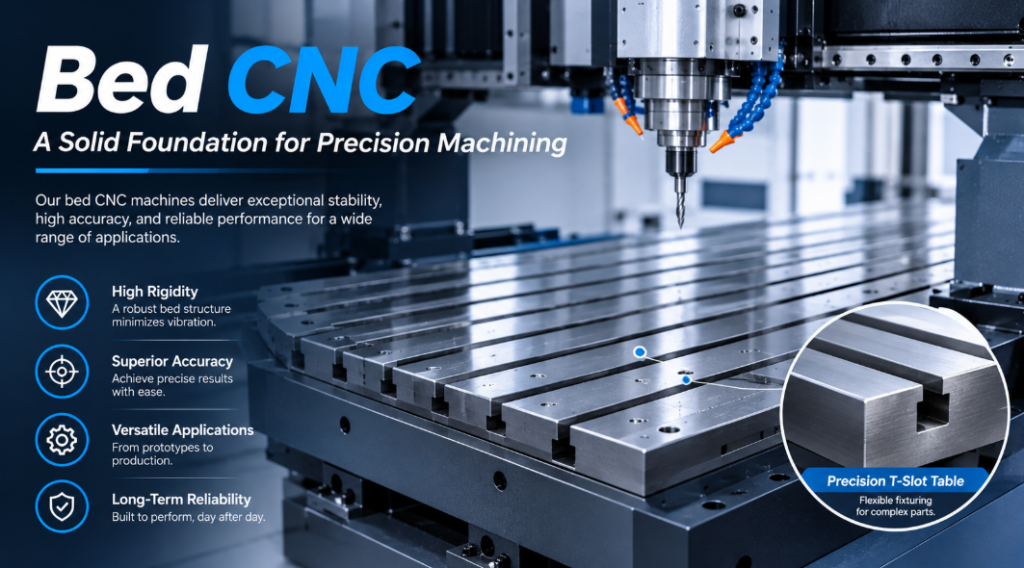
Bed-type milling machines are used in manufacturing environments where their worktable arrangement, working envelope, and structural design suit the parts being produced.
Typical applications include:
Aerospace Components
Aerospace manufacturing involves a wide range of parts, from structural components to precision housings and brackets.
Some components require large work envelopes, stable workpiece support, and machining operations across multiple surfaces. The appropriate machine depends on the material, part geometry, dimensional requirements, and production process.
For parts with complex contours or angled features, a 5-axis machining center may be more suitable than a conventional 3-axis bed mill.
Automotive and Industrial Equipment
Automotive and industrial manufacturers produce housings, brackets, fixtures, tooling components, and other machined parts.
A bed-type machine may be appropriate for components that fit its work envelope and require repeated milling operations. Production volume, cycle time, tool access, and workholding requirements should all be considered.
Mold and Die Manufacturing
Mold and die components can include deep cavities, angled surfaces, and complex contours.
A conventional bed mill may handle certain large or relatively straightforward milling operations. More complicated mold geometries may benefit from a 5-axis machining center, which can approach multiple surfaces at different angles and reduce the need for repeated setups.
Heavy-Duty Precision Machining
Large components and demanding cutting operations place additional requirements on machine structure, spindle performance, and workpiece support.
The machine should be selected according to the actual workpiece weight, cutting forces, material, tool dimensions, and required accuracy—not simply its advertised table size or machine weight.
How to Choose the Right Bed CNC Machine
Choosing a CNC bed-type milling machine is not just a matter of comparing prices or spindle power. The machine needs to match the parts you produce, the materials you cut, and your production requirements.
Use these factors to narrow down your options.
1. Check Workpiece Size and Table Capacity
Start with the actual dimensions and weight of your parts.
Check:
-
Table dimensions and usable working area
-
Maximum workpiece weight
-
X, Y, and Z-axis travel
-
Clearance between the spindle, table, and fixtures
-
Space required for tool changes and workpiece loading
A machine may have sufficient nominal table dimensions but still lack the clearance needed for a particular fixture or machining operation.
2. Match Spindle Power and Torque to the Material
Spindle power and torque affect the machine’s ability to perform different cutting operations.
However, higher power does not automatically mean better machining performance. The required spindle characteristics depend on the material, tool diameter, cutting depth, cutting speed, and type of operation.
For example, roughing operations with larger tools may require substantial torque, while smaller tools used for detailed machining may need a different spindle speed range.
Ask the manufacturer for spindle performance information across the operating speed range, rather than relying on a single maximum-power figure.
3. Evaluate the Machine’s Structural Design
Review the bed, column, guideways, spindle support, and overall mechanical layout.
For demanding applications, ask how the machine is designed to manage cutting forces, vibration, and thermal changes.
If possible, request technical documentation that explains the machine’s accuracy specifications, measurement conditions, and inspection methods.
4. Consider the Axis Configuration
Determine whether your parts can be completed efficiently with three linear axes or whether additional rotary movement is necessary.
A 3-axis machine may be sufficient for parts with straightforward geometry and machining requirements concentrated on accessible surfaces.
A 5-axis machine may be a better choice when parts include:
-
Multiple angled surfaces
-
Compound-angle features
-
Complex curved or contoured geometry
-
Deep cavities or difficult-to-reach areas
-
Several faces that need accurate machining in a single setup
Do not choose a 5-axis machine simply because it has more axes. The additional capability should solve a real production problem.
5. Review the CNC Controller and Programming Requirements
The CNC controller affects how operators program, monitor, and manage machining operations.
For 5-axis applications, controller capabilities are particularly important. Confirm that the machine supports the required rotary-axis functions, tool-center-point control where needed, and the intended machining modes.
Also consider CAM compatibility, post-processor availability, operator training, and the manufacturer’s technical support.
6. Compare Maintenance and After-Sales Support
The purchase price is only one part of the total cost of owning a CNC machine.
Before making a decision, ask about:
-
Preventive maintenance requirements
-
Spare parts availability
-
Service response and technical support
-
Installation and commissioning
-
Operator training
-
Warranty coverage
-
Long-term service arrangements
A machine that fits your production needs but lacks reliable support can create avoidable downtime and operating costs.
7. Request a Part-Based Technical Evaluation
One of the most useful ways to compare machines is to provide the manufacturer with representative part drawings or 3D models.
Ask for an evaluation based on:
-
Workpiece dimensions and material
-
Required tolerances and surface finish
-
Machining operations and tool access
-
Expected production volume
-
Required setups
-
Available floor space and installation conditions
This helps move the discussion beyond general machine specifications and toward whether a particular configuration can meet your production requirements.
When Should You Choose a 5-Axis CNC Machining Center?
A bed-type milling machine may be suitable for many conventional milling operations. However, when a part requires machining across multiple faces, compound angles, or complex surfaces, a 5-axis CNC machining center may offer a more efficient approach.
A 5-axis machine controls three linear axes and two rotary axes. Depending on its configuration, it can rotate the workpiece, tilt the spindle head, or use a combination of both to position the cutting tool at different angles.
This additional movement can reduce the need to remove and reposition a part between operations.
Key Benefits of 5-Axis Machining
Fewer setups for multi-face parts
A 5-axis machine can access multiple sides of a workpiece without requiring the same level of manual repositioning as a conventional 3-axis process. Fewer setups can reduce handling time and help limit errors introduced during repeated clamping.
Better access to complex geometry
Rotary movement allows the tool to approach angled surfaces, compound features, and certain deep or difficult-to-reach areas.
More efficient machining strategies
Depending on the part and toolpath, 5-axis machining can allow shorter tools or more favorable tool orientations. This may help reduce tool deflection and improve machining conditions.
Greater process flexibility
A 5-axis machining center can handle a broader range of complex geometries than a basic 3-axis machine, provided its working envelope, spindle, tooling, and kinematics are suitable.
What Are the Limitations of 5-Axis CNC Machining?
Five-axis machining also involves trade-offs:
-
Higher initial investment: The machine and its supporting systems can cost more than a conventional 3-axis setup.
-
More demanding programming: CAM strategies, post-processors, and collision checks require appropriate expertise.
-
Operator training: Successful production depends on understanding the machine’s kinematics, workholding, and machining modes.
-
Application-specific limitations: Rotary-axis travel, workpiece size, tool access, and machine configuration can restrict what can be machined.
For simple parts that can be completed efficiently on a 3-axis machine, moving to 5-axis equipment may not provide enough value to justify the added investment.
How DEPU Fits into 5-Axis CNC Manufacturing
For manufacturers evaluating equipment for complex multi-face machining, DEPU focuses on the research, development, and production of 5-axis CNC machine tools and core components.
The company reports that its R&D team includes engineers from Germany and Taiwan, with several engineers bringing more than 30 years of development experience. DEPU also reports working with approximately 3,800 active customers in Europe.
When comparing a DEPU machine with other equipment, buyers should evaluate the specific model’s working envelope, workpiece capacity, spindle performance, rotary-axis configuration, controller, and accuracy specifications against their own part requirements.
The most suitable machine is the one that can reliably produce your parts within the required quality, production, and operating-cost targets.
Final Thoughts
A bed CNC machine is defined by its structural arrangement, not simply by the number of axes it controls. Bed-type milling machines can be practical for production milling, while 5-axis machining centers provide additional flexibility for parts with complex geometry and multi-face machining requirements.
For manufacturers choosing new CNC equipment, start with the parts they need to produce. Evaluate workpiece size, material, cutting requirements, accuracy, axis configuration, programming needs, and long-term support before comparing individual machines.
A machine that matches the actual production process is usually a better investment than one selected solely for its specifications or advertised capabilities.
FAQ
1. What Does Bed CNC Mean?
Bed CNC usually refers to a CNC bed-type milling machine. Its worktable is mounted directly on the machine bed, while vertical movement is generally provided by the spindle head. The design differs from a knee-type mill, where the table assembly moves vertically on a knee.
2. What Is the Difference Between a Bed Mill and a Knee Mill?
The main difference is the table support and movement arrangement. A bed mill has a worktable mounted directly on the bed, typically at a fixed height. A knee mill supports its table on a vertically adjustable knee. Bed mills are often considered for production and heavier milling work, while knee mills are commonly used for general-purpose and toolroom applications.
3. Is a Bed-Type CNC Machine More Rigid?
A bed-type design can provide a stable workpiece support arrangement, but rigidity depends on the complete machine structure. The bed, column, spindle, guideways, joints, and foundation all influence how the machine responds to cutting forces. Buyers should evaluate the machine’s overall design and performance rather than assuming that the bed configuration alone guarantees rigidity.
4. Can a Bed-Type CNC Machine Have 5 Axes?
Yes. Bed-type describes the machine’s structural arrangement, while 5-axis describes its controlled movement capabilities. A machine can combine a bed-type structure with three linear axes and two rotary axes. The actual configuration depends on the manufacturer’s design.
5. Should I Buy a Bed Mill or a 5-Axis CNC Machining Center?
Originally published by DEPU on 9 Nov 2026.