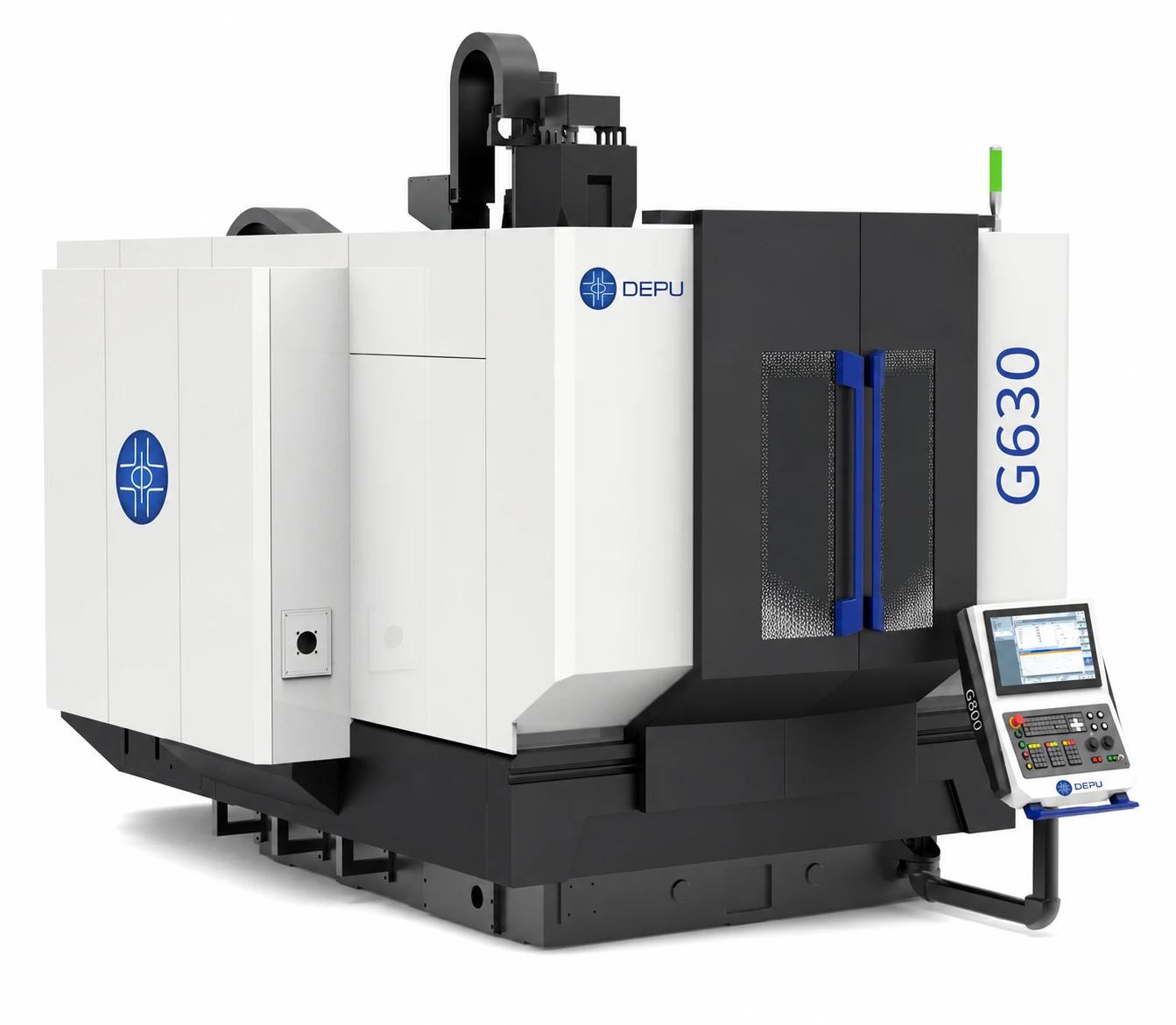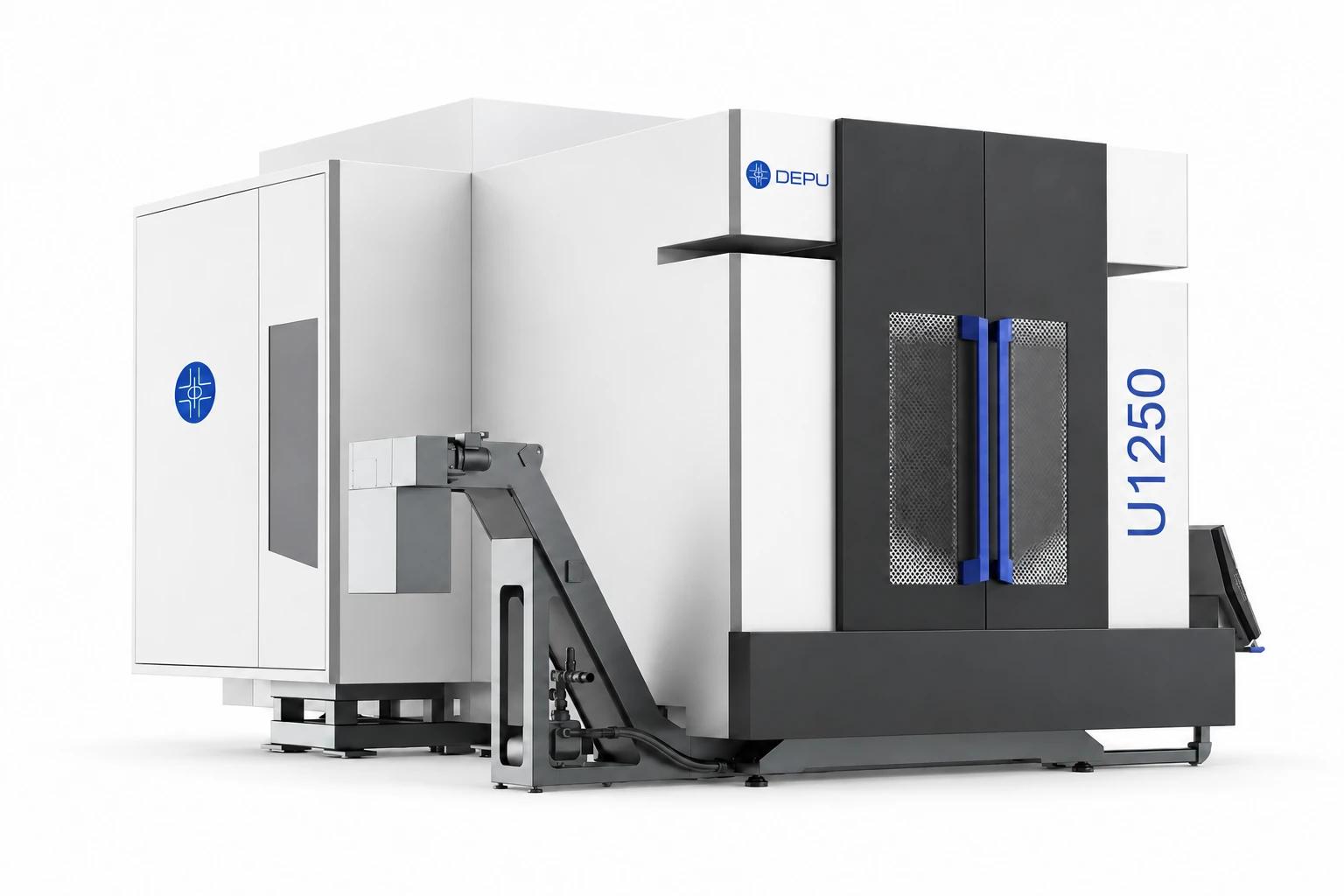

A live tooling CNC lathe is particularly useful for producing rotational components that also require holes, slots, flats, or other milled features. For parts involving complex geometries, multiple machined surfaces, or extensive milling, a mill-turn machine or 5-axis CNC machining center may be a better fit.
The best choice depends on your part geometry, material, machining requirements, production volume, and overall manufacturing process.
This guide explains how live tooling works, what these machines can do, how they compare with other CNC equipment, and what to consider before investing in one.
What Is a CNC Lathe with Live Tooling?
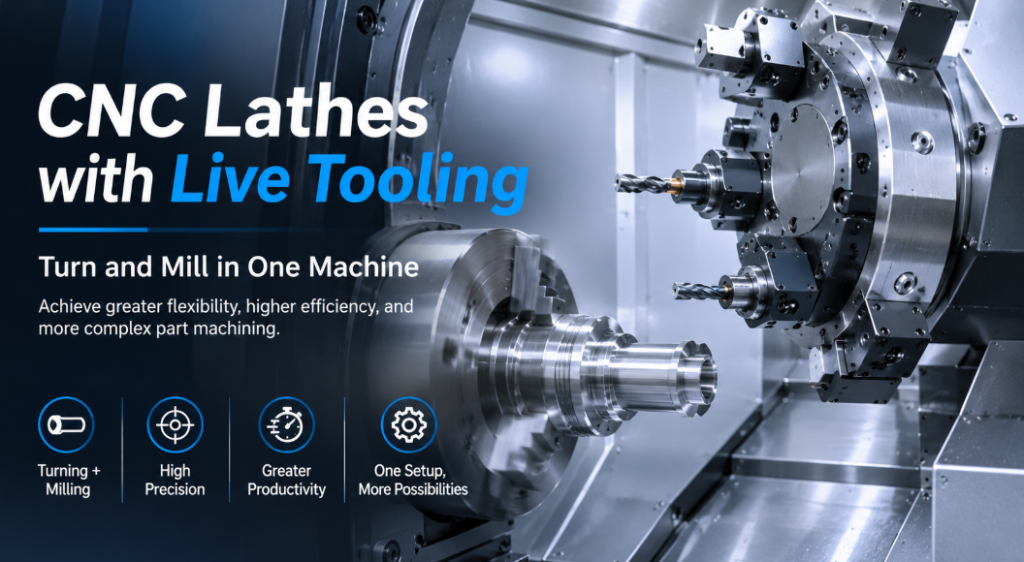
A CNC lathe with live tooling is a turning machine equipped with powered cutting tools that rotate independently of the workpiece spindle. Unlike conventional lathe tools, which remain stationary while the workpiece rotates, live tooling allows the machine to perform additional operations such as milling, drilling, tapping, and slotting.
This capability gives manufacturers greater flexibility when producing components that combine rotational and non-rotational features.
For example, consider a metal shaft that requires:
-
A turned outer diameter
-
A flat surface on one side
-
Cross-drilled holes
-
Milled slots
-
Threaded holes
A conventional CNC lathe can perform the turning operations, but the additional features may require transferring the part to a separate milling machine. A live tooling lathe can perform many of these operations without removing the workpiece from the machine.
This can reduce secondary setups, minimize workpiece handling, and help maintain the positional relationship between machined features.
Live Tooling vs. Static Tooling
The main difference is whether the cutting tool is powered.
Static tooling uses stationary cutting tools to remove material as the workpiece rotates. It is primarily used for turning operations such as facing, boring, grooving, and threading.
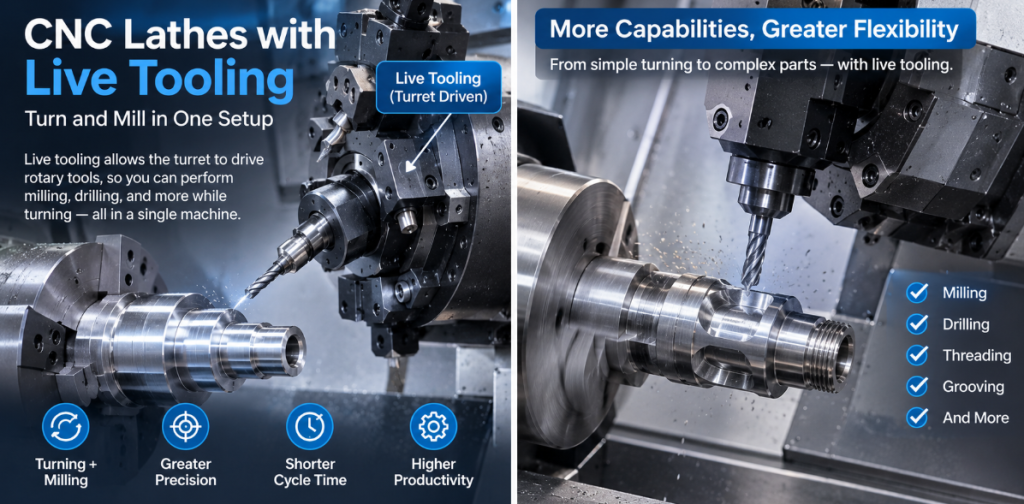
Live tooling uses powered tool holders to rotate cutting tools such as end mills, drills, and taps. The machine can position the workpiece at specific angles while the driven tool performs the required operation.
Most live tooling systems are integrated into the machine’s turret, allowing operators to switch between turning and secondary machining operations within the same production cycle.
Axial vs. Radial Live Tooling
Live tooling generally comes in two configurations, based on the orientation of the cutting tool.
Axial live tooling
The cutting tool is oriented parallel to the spindle axis. This arrangement is commonly used for drilling and milling features on the end face of a workpiece.
Radial live tooling
The cutting tool is oriented perpendicular to the spindle axis. It is commonly used for machining features on the side of a workpiece, including cross holes, flats, and slots.
The appropriate configuration depends on where the features are located and how they need to be machined.
How Does Live Tooling Work on a CNC Lathe?
A live tooling CNC lathe combines the positioning capabilities of a CNC turning center with powered cutting tools. Several machine components work together to perform different machining operations.
1. Live Tooling Turret
The turret holds multiple turning and driven tools. When the machining program calls for a milling or drilling operation, the turret indexes to the required position and activates the corresponding powered tool.
This allows the machine to switch between turning and secondary machining operations without requiring a separate machine for every feature.
2. C-Axis Control
The C-axis controls the angular position of the workpiece spindle. Instead of rotating continuously as it does during conventional turning, the spindle can position the workpiece at a specified angle.
This is important when machining features at specific angular locations, such as cross holes, flats, and bolt patterns.
When combined with live tooling, C-axis positioning allows the cutting tool to machine features at controlled positions around the workpiece.
3. Y-Axis Capability
A Y-axis allows the cutting tool to move perpendicular to the spindle axis and off its centerline. This provides additional flexibility when machining features that are not aligned with the center of the workpiece.
For example, Y-axis movement can help produce offset holes, pockets, and more complex milled features.
Not every live tooling CNC lathe includes a Y-axis. If your parts require off-center milling, check whether the machine offers this capability and whether its travel range meets your requirements.
4. Main Spindle and Sub-Spindle
Some advanced turning centers include both a main spindle and a sub-spindle.
The main spindle performs the initial machining operations. The sub-spindle can then take over the workpiece to machine the opposite end, depending on the machine configuration.
This arrangement can reduce manual repositioning and support more complete machining within a single production cycle.
However, a sub-spindle is not a standard feature on every live tooling lathe. Its value depends on whether your components require machining on both ends.
What Are the Benefits of CNC Lathes with Live Tooling?
Live tooling offers several advantages for manufacturers producing components that combine turning with secondary machining operations.
1. Fewer Secondary Setups
One of the biggest advantages is the ability to perform multiple operations on the same machine.
Without live tooling, a turned component may need to be transferred to a milling machine for additional features. Each transfer can involve additional setup time, workpiece handling, and alignment.
By completing more operations in one setup, manufacturers can simplify production workflows and reduce unnecessary movement between machines.
2. Better Feature-to-Feature Consistency
Every time a workpiece is removed and repositioned, there is a possibility of introducing alignment variation.
Live tooling reduces the need for certain secondary setups, helping maintain the positional relationship between turned and milled features.
This is particularly important for components with cross holes, flats, and other features that must align accurately with the turned geometry.
Actual machining accuracy still depends on machine condition, tooling, workholding, programming, and process control.
3. Improved Production Efficiency
Combining turning and secondary operations can reduce work-in-process movement and simplify production scheduling.
For manufacturers producing medium-complexity components, this may help streamline production workflows and reduce the number of machines required for certain jobs.
However, the actual productivity benefit depends on part geometry, machining time, tool changes, and production volume. A live tooling lathe is not automatically faster than using separate turning and milling machines.
4. Greater Machining Flexibility
A live tooling turret can accommodate different types of driven tools, allowing manufacturers to handle a wider range of part features.
Depending on the machine configuration, these operations may include:
-
Face milling
-
Cross drilling
-
Axial drilling
-
Tapping
-
Slot milling
-
Flat milling
-
Certain contouring operations
This flexibility makes live tooling useful for manufacturers handling multiple part designs or products with varying machining requirements.
5. Reduced Workpiece Handling
Fewer transfers between machines can reduce manual handling and simplify production operations.
This can be especially beneficial in automated manufacturing environments where consistent part movement and predictable production cycles are important.
CNC Lathe vs. Live Tooling Lathe vs. Mill-Turn vs. 5-Axis CNC Machining Center
These machine types serve related but different manufacturing needs. Understanding their differences is essential before making an equipment investment.
| Machine Type | Main Capabilities | Typical Applications |
|---|---|---|
| Conventional CNC Lathe | Turning, facing, boring, threading | Shafts, bushings, cylindrical components |
| Live Tooling CNC Lathe | Turning, milling, drilling, tapping | Turned parts with additional machined features |
| Mill-Turn Machine | Integrated turning and milling | Complex rotational components |
| 5-Axis CNC Machining Center | Multi-directional milling and complex surface machining | Aerospace, medical, precision, and complex components |
When Should You Choose a Conventional CNC Lathe?
A conventional CNC lathe is a practical choice when most of your machining work involves rotational geometry.
Typical parts include shafts, bushings, pins, sleeves, and other cylindrical components.
If additional milling or drilling operations are limited, investing in a more complex live tooling configuration may not provide enough value to justify the additional cost.
When Is a Live Tooling CNC Lathe the Better Choice?
A live tooling lathe is worth considering when your parts are primarily rotational but also require secondary machining features.
Examples include:
-
Shafts with cross holes
-
Turned components with milled flats
-
Fittings with threaded side holes
-
Cylindrical parts with slots or grooves
-
Components requiring machining at multiple angular positions
For these applications, live tooling can reduce transfers between turning and milling equipment.
When Should You Consider a Mill-Turn Machine?
A mill-turn machine is designed for more integrated turning and milling operations.
It may be a better choice when a part requires extensive milling in addition to turning, particularly when multiple spindles, turrets, or advanced axis configurations are needed.
However, mill-turn machines come in different configurations. Buyers should compare actual spindle arrangements, axis configurations, tool capacity, and machining envelopes rather than relying on the machine category alone.
When Is a 5-Axis CNC Machining Center More Suitable?
A 5-axis CNC machining center is often a better choice when a component requires complex milling, multi-angle machining, or access to multiple surfaces.
Unlike a typical live tooling lathe, a 5-axis machining center coordinates three linear axes with two rotary axes.
This makes it suitable for parts with:
-
Complex curved surfaces
-
Multiple angled features
-
Deep or difficult-to-access geometries
-
Multiple machined faces
-
Complex contours and precision features
Industries such as aerospace, medical device manufacturing, and precision engineering may require this type of machining capability for specific components.
The key distinction is part geometry. If your component is primarily rotational with a few additional milled features, a live tooling lathe may be the more practical option. If it requires extensive multi-angle milling or complex surface machining, a 5-axis CNC machining center deserves serious consideration.
Common Applications of CNC Lathes with Live Tooling
Live tooling is used across industries where components combine turned geometry with additional machined features.
Aerospace and Aviation
Aerospace manufacturing involves a wide range of precision components, including fittings, connectors, shafts, and other mechanical parts.
Some of these components combine cylindrical features with cross holes, flats, grooves, or threaded sections.
Live tooling can help consolidate turning and secondary machining operations. More complex aerospace components may require dedicated 5-axis machining capabilities, depending on their geometry and material requirements.
Medical Device Manufacturing
Medical manufacturing includes components such as surgical instrument parts, precision fittings, shafts, and other specialized hardware.
Some components require a combination of turning and milling operations, making live tooling a useful option.
For more complex medical components with multiple angled surfaces or intricate geometries, a 5-axis machining center may provide greater flexibility.
Material compatibility, surface finish, dimensional requirements, and applicable manufacturing controls should all be considered when selecting equipment.
Automotive Manufacturing
Automotive production uses many turned components, including shafts, connectors, fittings, and precision mechanical parts.
When these components also require drilled holes, milled flats, or slots, live tooling can help reduce the number of machining stages.
For high-volume manufacturing, buyers should also evaluate cycle time, tool life, automation compatibility, and production consistency.
Industrial Equipment Manufacturing
Industrial machinery often contains shafts, couplings, hydraulic fittings, and other components with combined turning and milling requirements.
Live tooling can be useful when manufacturers need to produce several different features without repeatedly transferring parts between machines.
The best configuration depends on component dimensions, material, tolerances, and production requirements.
Precision Component Manufacturing
Precision manufacturers frequently work with custom components that have a combination of cylindrical and non-cylindrical features.
Live tooling offers a practical way to consolidate operations for many of these parts.
For components with complex contours or demanding multi-face machining requirements, a 5-axis CNC machining center may offer a more appropriate solution.
How to Choose the Right CNC Lathe with Live Tooling
Buying a CNC lathe with live tooling involves more than comparing prices or counting the number of axes. The machine must match your actual production requirements.
Here are seven factors worth evaluating before making a decision.
1. Workpiece Size and Machining Diameter
Start by identifying the largest and most demanding components you plan to produce.
Check the machine’s maximum turning diameter, turning length, bar capacity, and chuck size where applicable.
Also consider the workpiece dimensions required for secondary milling operations. A machine that can turn a component does not necessarily have enough clearance to complete every additional feature.
2. Spindle Power and Torque
Spindle power and torque influence the machine’s ability to handle different materials and cutting conditions.
For demanding applications, evaluate the spindle’s power and torque characteristics across its operating speed range.
Do not compare machines using maximum spindle speed alone. A high-speed spindle is not necessarily the best option for heavy cutting or large-diameter workpieces.
3. Live Tooling Speed and Capability
Check the specifications of the driven tools, including:
-
Maximum live tooling speed
-
Available torque and power
-
Tool holder compatibility
-
Axial and radial tooling options
-
Supported cutting operations
The machine should provide sufficient capability for the milling, drilling, and tapping operations required by your parts.
4. C-Axis and Y-Axis Configuration
C-axis capability is important when machining features at specific angular positions around the workpiece.
Y-axis capability becomes more important when the part requires off-center milling or more complex feature positioning.
Do not assume that every machine marketed as a live tooling lathe includes both axes. Verify the actual machine configuration and available travel.
5. Tool Turret Capacity
The number of available tool positions affects how many operations can be configured without frequent manual tool changes.
Consider the number of turning and driven tools required for your typical components.
A larger turret is not automatically better. The important question is whether the available tool positions support your actual machining process.
6. Machine Rigidity and Accuracy
Machine rigidity influences cutting stability, vibration control, and the ability to maintain consistent machining performance.
Evaluate the machine structure, spindle design, turret stability, guideway configuration, and thermal management.
For demanding applications, request relevant accuracy specifications and clarify the conditions under which those specifications are measured.
7. CNC Controller, Technical Support, and Maintenance
The CNC controller affects programming, machine operation, and integration into your existing production environment.
Consider whether the controller supports the functions your machining processes require and whether your operators are familiar with it.
You should also evaluate:
-
Availability of technical support
-
Spare parts supply
-
Maintenance requirements
-
Operator training
-
Software and programming compatibility
-
Long-term service arrangements
A machine’s purchase price is only one part of its total ownership cost.
Why Consider a 5-Axis CNC Machining Center for Complex Parts?
Live tooling is an effective solution for many turned components, but it is not designed to replace every milling machine.
When a workpiece requires extensive milling, complex contours, or machining across multiple angled surfaces, a 5-axis CNC machining center may be a more suitable investment.
Multi-Angle Machining for Complex Geometries
A 5-axis CNC machining center coordinates three linear axes with two rotary axes.
This allows the cutting tool and workpiece to move relative to each other in multiple directions, providing access to different surfaces and machining angles.
Depending on the machine configuration and workholding setup, this can reduce the need to reposition a part between operations.
Greater Flexibility for Precision Manufacturing
Five-axis machining is particularly useful for components with complex geometries that are difficult to machine efficiently using conventional three-axis equipment.
Typical applications may include:
-
Aerospace structural components
-
Complex medical device components
-
Precision molds and dies
-
Industrial impellers and turbine-related parts
-
Components with compound-angle surfaces
The suitability of a machine still depends on its working envelope, spindle performance, rotary-axis design, rigidity, and material requirements.
How DEPU Supports Advanced 5-Axis CNC Manufacturing
For manufacturers evaluating equipment for complex machining applications, DEPU focuses on the research, development, production, and sales of high-end 5-axis CNC machine tools and core components.
DEPU’s R&D team includes engineers from Germany and Taiwan, and many of its R&D engineers have more than 30 years of development experience.
The company reports more than 3,800 active customer relationships in Europe and collaborates with research and academic institutions, including the Southern Industrial Technology Research Institute, the School of Mechanical Engineering at Chongqing University, and the Southern Institute of Space Technology.
Its credentials include ISO and CE certifications, recognition as a High and New Technology Enterprise, and utility model and design patents.
For manufacturers considering a 5-axis CNC machining center, the next step is to evaluate whether the machine’s actual specifications and configuration match their workpieces, materials, tolerances, and production goals.
Rather than choosing equipment based on the number of axes alone, compare the machining envelope, spindle configuration, workpiece capacity, CNC controller, and technical support available for your intended applications.
Frequently Asked Questions
1. Can a CNC Lathe with Live Tooling Replace a Milling Machine?
Not completely. A live tooling CNC lathe can perform many secondary milling, drilling, tapping, and slotting operations. However, its cutting capacity, tool orientation, working envelope, and rigidity may limit more demanding milling applications.
For parts requiring extensive material removal, complex contours, or multi-angle machining, a dedicated milling machine or 5-axis CNC machining center may be more appropriate.
2. Does a Live Tooling CNC Lathe Need a Y-Axis?
Not necessarily. A live tooling lathe can perform many operations using C-axis positioning and axial or radial driven tools without a Y-axis.
However, a Y-axis provides additional flexibility for off-center milling and more complex feature positioning. Whether it is necessary depends on the geometry of your parts and the machining operations involved.
3. What Is the Difference Between Live Tooling and a Mill-Turn Machine?
Live tooling refers to powered cutting tools integrated into a CNC lathe, allowing it to perform certain milling and drilling operations in addition to turning.
A mill-turn machine generally offers a broader level of integration between turning and milling. Depending on its configuration, it may include additional spindles, turrets, and coordinated axes for more complex machining processes.
The distinction depends on the actual machine architecture and capabilities, not just the product name.
4. Are CNC Lathes with Live Tooling Suitable for Aerospace and Medical Parts?
Yes, for suitable components. Both industries use turned parts that may require additional holes, slots, flats, and other machined features.
However, not every aerospace or medical component is suitable for a live tooling lathe. Complex geometries, material requirements, tight tolerances, and production specifications may call for a mill-turn machine or 5-axis CNC machining center.
Equipment selection should be based on the specific component and its manufacturing requirements.
5. When Should a Manufacturer Choose a 5-Axis CNC Machining Center Instead of a Live Tooling Lathe?
A 5-axis CNC machining center is worth considering when the component requires extensive milling, multiple angled surfaces, complex contours, or machining access from several directions.
A live tooling lathe is generally more suitable when the part is primarily rotational and requires a limited number of additional milling or drilling operations.
The best choice depends on part geometry, machining complexity, material, production volume, and the overall manufacturing process.
Final Thoughts
CNC lathes with live tooling provide an effective way to combine turning and secondary machining operations in a single setup. They are particularly valuable for manufacturers producing rotational components that also require milling, drilling, tapping, or slotting.
However, they are not a universal replacement for milling machines or more advanced multi-axis equipment.
Before purchasing, evaluate the geometry of your parts, the amount of milling required, machine rigidity, spindle performance, axis configuration, and long-term production needs.
If your manufacturing requirements extend beyond conventional turning and involve complex surfaces or multi-angle machining, a 5-axis CNC machining center may offer the flexibility your production process needs.
Originally published by DEPU on 6 Nov 2026.