Ask any seasoned machinist or prototyping engineer if a small-footprint CNC can handle production-grade titanium or hardened tool steel, and the reaction is almost always unanimous: “It’s going to chatter itself to death.”
And they are right to be skeptical. Over the last few years, the market has been flooded with “desktop” multi-axis machines. Promoted with slick videos cutting soft modeling wax, floral foam, or light aluminum face-passes, these machines fold the moment they encounter tough engineering alloys. Constructed from bolted aluminum extrusions, driven by stepper belts, and powered by 300-watt router motors, they simply lack the structural physics required for real metal removal.
This has created a widespread myth: If you want to cut steel and titanium, you must buy a 5-ton industrial monster, pour a reinforced concrete foundation, and wire high-voltage three-phase power.
At DEPU, we set out to prove that footprint does not dictate physics. However, doing so required stepping completely outside the “desktop” hobbyist sandbox. The DEPU GM130 is not an oversized desktop gadget. It is a genuine compact 5-axis machining center designed from the casting up for serious metal cutting. Here is the engineering reality behind how it conquers the forces of titanium and steel.
1. The Physics of Hard Alloys: Why Machine Mass Is Non-Negotiable
Cutting aerospace-grade alloys like Grade 5 Titanium (Ti-6Al-4V) or 316 stainless steel is a brutal dynamic challenge. Titanium possesses exceptional tensile strength combined with low thermal conductivity. When a solid carbide endmill bites into the stock, cutting resistance pushes back against the tool with immense lateral force. If the structural loop of the machine tool cannot resist this load, the tool deflects, creating harmonic resonance—commonly known as regenerative chatter.
In lightweight aluminum-frame machines, chatter is unavoidable because aluminum cannot dampen vibration. The frame acts like a tuning fork, amplifying chatter until the tool snaps.
This explains why the GM130 was deliberately engineered to be heavier and more substantial than the consumer market expected. Tipping the scales at approximately 230 kg, the GM130’s mass is its primary defense against vibration. Cast iron possesses up to 10 times the vibration-damping capacity of aluminum. Its heavy, stress-relieved cast base absorbs dynamic cutting energy directly at the foundation, ensuring the cutting edge remains seated firmly in the material without micro-chipping.
2. Spindle Dynamics: Why 3.0 kW and ISO20 Tapers Matter
A common trap in small CNC design is relying on high-speed engravers running at 24,000 RPM with negligible low-end torque. While adequate for engraving plastics, hard metals require sustained cutting torque at moderate surface footage to maintain a healthy chip load. Run an endmill too fast without sufficient torque, and the tool merely rubs against the metal, work-hardening the workpiece and burning the carbide.
- 3.0 kW Continuous Water-Cooled Spindle: Delivering sustained torque across its operating range up to 24,000 RPM, this industrial spindle provides the sheer muscle needed to actively shear tough chips rather than glaze the surface.
- ISO20 Taper with 6.0 kN Pull Force: In miniature machines, tiny collet systems (like ER11) experience tool pull-out under heavy axial loads. The GM130 employs an industrial ISO20 taper clamped with 6.0 kN of mechanical tool retention force. That rigid lock eliminates micro-movement between the toolholder and spindle taper.
- Closed-Loop Liquid Chilling: Thermal expansion along the Z-axis is the silent killer of precision during long machining cycles. Liquid cooling keeps the spindle shaft thermally neutral throughout 8-hour continuous runs.
3. Coolant and Lubrication: Industrial Wet-Machining Plumbing
Look inside any production machine shop cutting titanium or stainless steel, and you will see two universal features that desktop machines universally omit: flood coolant chemistry and engineered guideway lubrication.
- Flood Coolant with Master Fluid Solutions: Dry machining or rudimentary air-blast misting cannot evacuate chips or control temperatures in deep 316 stainless pockets. The GM130 integrates a fully enclosed, corrosion-resistant wet-machining environment running industrial Master Fluid Solutions coolant. High-flow coolant nozzles blast directly at the cutting zone, providing extreme lubricity and thermal evacuation.
- Integrated Internal Oil Circuit: On consumer machines, linear rails rely on manual grease packs that quickly wash away. The GM130 incorporates a dedicated internal oil lubrication circuit. Metered lubrication is distributed continuously to the precision linear guides and ground ballscrews, preserving the machine’s 0.005 mm (5 µm) repeatability over years of production.
4. Kinematic Stability: The Φ130 Dual-Supported Trunnion
In simultaneous 5-axis milling, rigidity is only as strong as your rotary axes. Many small machines mount their rotary table on a single cantilevered arm. Under heavy side-milling forces, this unsupported design acts like a diving board, flexing visibly under load.
The GM130 houses a rigid, dual-supported trunnion table (Φ130 mm platter):
- A-Axis (±90°) and C-Axis (360° Infinite Continuous Rotation): Both rotary axes are anchored in heavy-duty bearing blocks, capable of carrying up to a 10 kg uniform part load without kinematic deflection.
- 17-Bit Optical Absolute Feedback: Paired with 0.05 µm linear displacement resolution, the kinematics deliver a verified positioning accuracy of 0.008 mm and an angular precision of ±20 arc-seconds.
5. The Two Foundation Pillars: DEPU Pedigree & Chuix AI
Building a machine capable of cutting titanium requires more than just assembling good parts—it requires industrial machine tool culture. The GM130 succeeds because of two distinct pillars:
Pillar 1: Engineered by DEPU
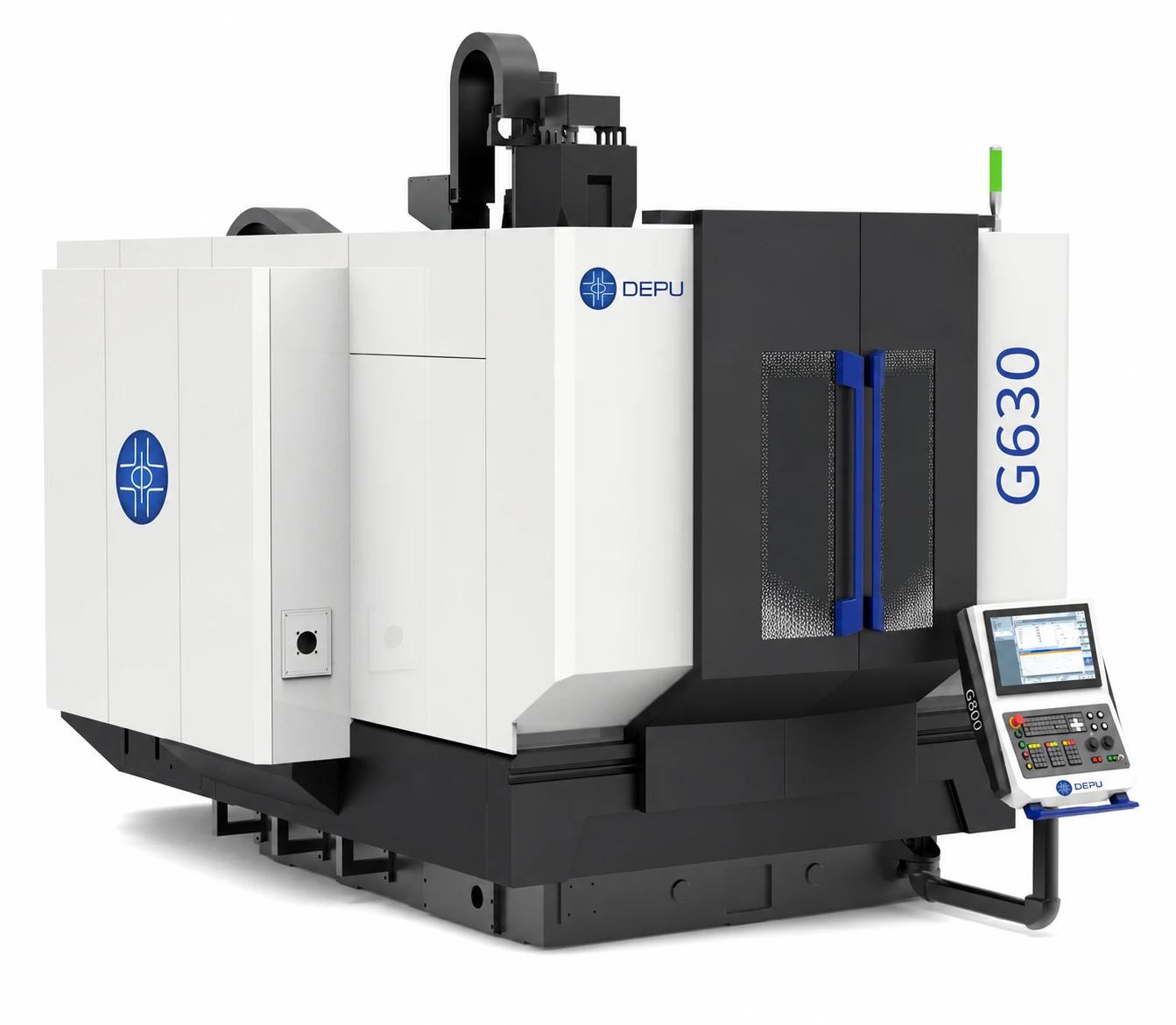
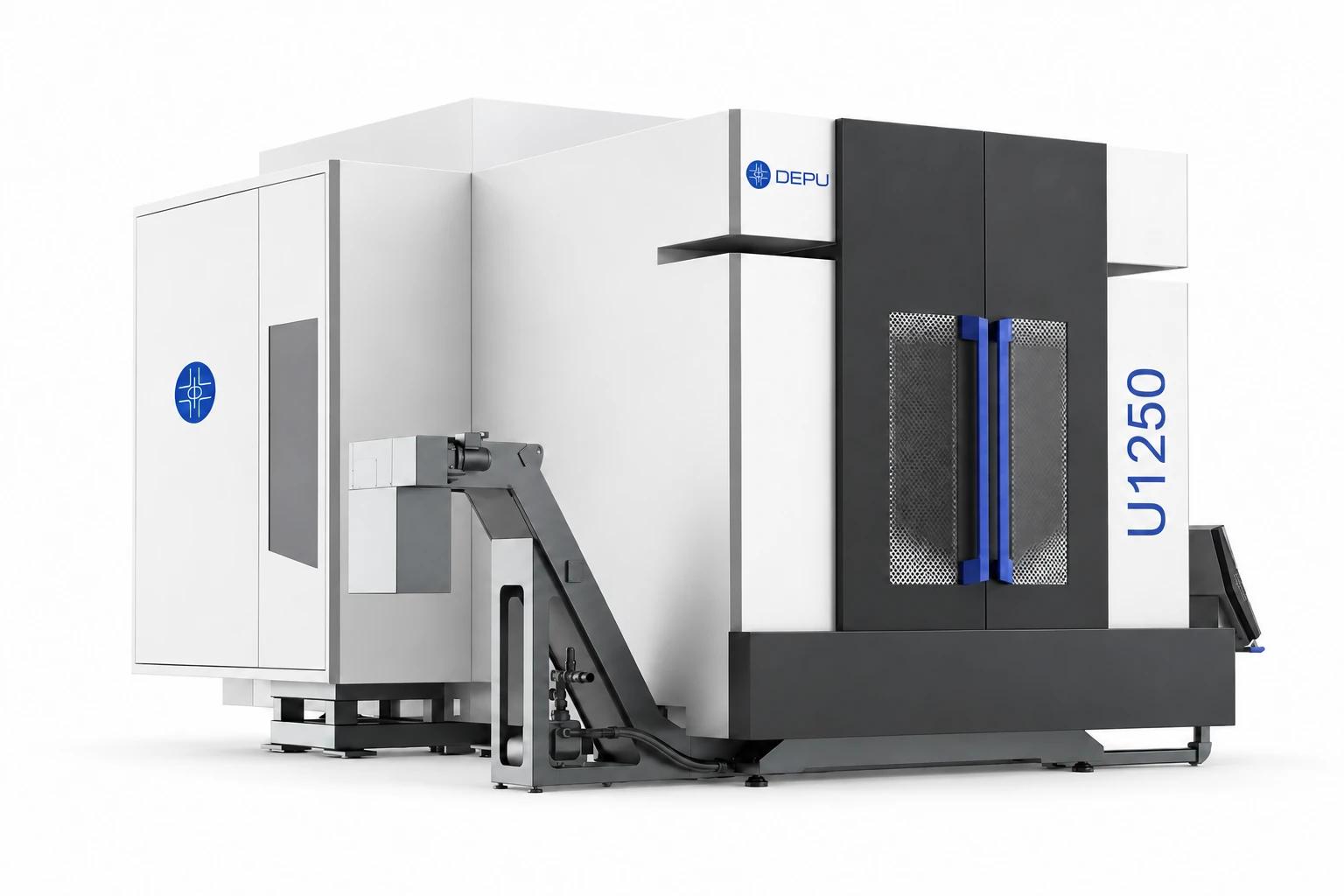
As a proven builder of industrial-scale 5-axis gantry and tilting-head machining centers (U-Series and G-Series), DEPU brings decades of kinematic calibration, laser interferometer verification, and industrial assembly standards to the GM130. You are investing in a condensed industrial machine tool, not a crowdfunding trial.
Pillar 2: Powered by Chuix AI
Traditional 5-axis CAM programming takes years to master, carrying the constant fear of crashing the spindle. Chuix AI evaluates your CAD model, generates optimized multi-axis toolpaths with dynamic chip-load regulation, and runs a 100% collision-free digital twin simulation in the cloud before cutting begins.
The Verdict: Physics Doesn’t Lie
Can a compact 5-axis CNC truly cut steel and titanium?
If the machine is a 40 kg aluminum desktop router driven by belts and hobby motors: Absolutely not.
If the machine is built like the DEPU GM130—anchored by 230 kg of cast-iron mass, driven by a 3.0 kW water-cooled ISO20 spindle, supplied with Master Fluid coolant and automated oil circuits, and guided by Chuix AI—the answer is an unequivocal yes.
The GM130 proves that you do not need a factory-scale footprint or a six-figure capital budget to machine high-precision aerospace alloys. It brings the full muscle of industrial 5-axis machining directly to your workshop bench.
Put the GM130 to the Test on Your Toughest Part: Doubt that a compact machine can cut your titanium, stainless steel, or brass components? Send us your STEP/CAD file for a free sample cut and cycle time analysis.
Originally published by DEPU on 4 Nov 2026.