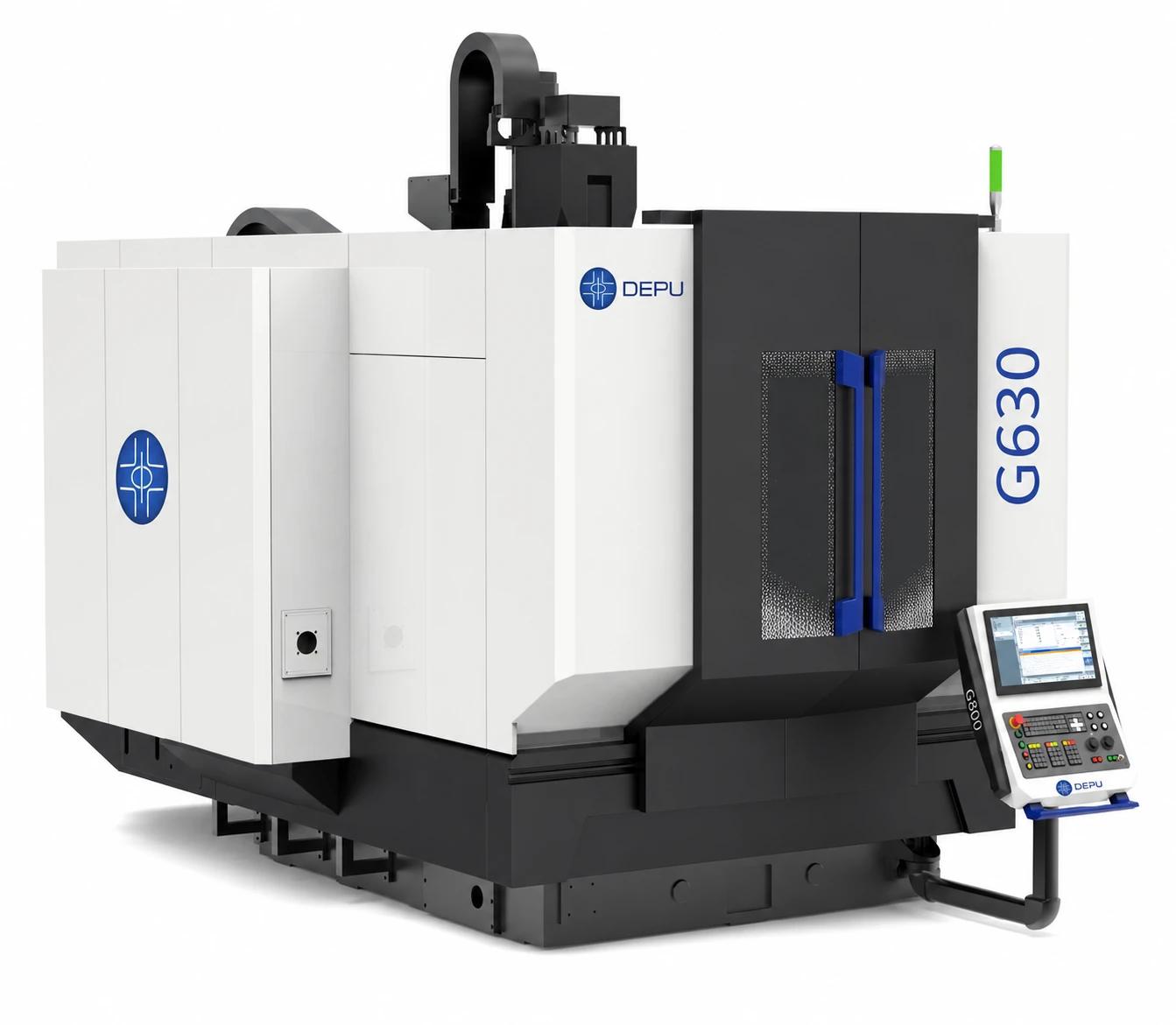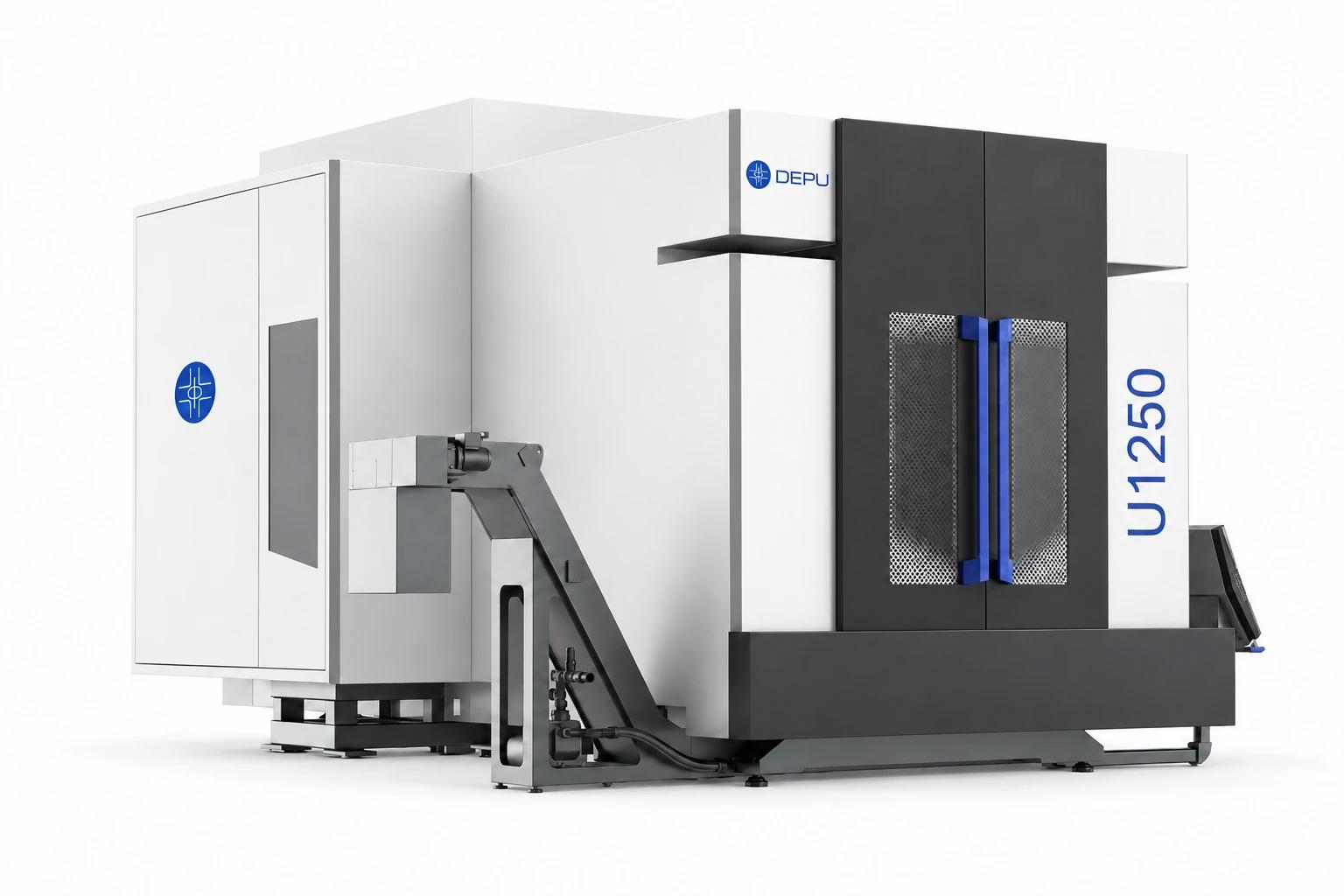
The U series is not a larger G series – the spindle swings while the workpiece stays put. How to size DEPU U1000D, U1250, U1600 and U2000 by part envelope, table load, spindle torque, foundation and connected power.
The U series is not a larger G series. It is a different kinematic answer to a different problem, and reading it as “the same machine, scaled up” leads to the wrong purchase for two reasons.
First, the moving element changes. On a trunnion or cradle machine the workpiece rotates; on the U series the spindle swings while the workpiece stays on a fixed table. That single difference is what lets the series carry parts weighing tonnes, and it is also why the accuracy specification is expressed differently.
Second, and less obviously, the four machines are not points on one line. They are different design points, and the ladder is not monotonic in the way buyers expect. U1000 is the heaviest and most powerful of the four in torque terms; U1250 is the fastest and lightest of the large-envelope machines. If you assume “U2000 is a bigger U1000,” you will misread the whole series.
Here is how to size it.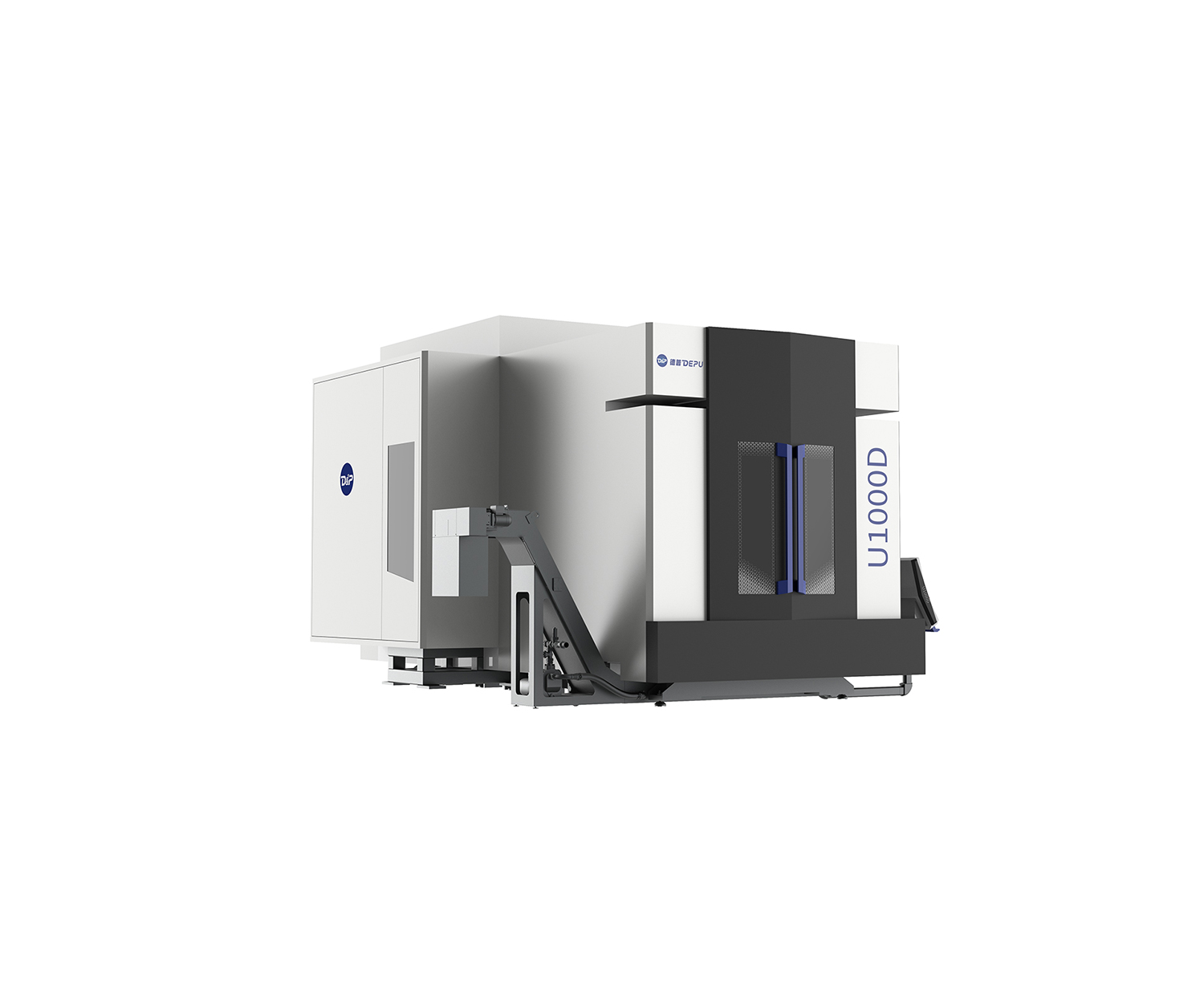
The four machines
|
|
U1000 |
U1250 |
U1600 |
U2000 |
|
Travels X/Y/Z |
1000 / 1000 / 1000 mm |
1300 / 1250 / 1000 mm |
1600 / 1600 / 1400 mm |
2100 / 2100 / 1700 mm |
|
Table diameter |
Ø1000 |
Ø1250 |
Ø1600 |
Ø1600 |
|
Max workpiece |
Ø1000 × H1000 mm |
Ø1250 × 1100 mm |
Ø1600 × 1250 mm |
Ø1580 × 1650 mm |
|
Max table load |
1,800 kg |
2,500 kg |
4,000 kg |
8,000 kg |
|
Spindle nose to table |
200–1200 mm |
200–1200 mm |
50–1250 mm |
200–2000 mm |
|
Spindle centre to table (horizontal) |
80–1080 mm |
80–1080 mm |
150–1350 mm |
— |
|
Spindle interface |
HSK-A100 |
HSK-A100 |
HSK-A100 |
HSK-A100 |
|
Spindle speed |
10,000 rpm |
10,000 / 12,000 rpm |
10,000 / 12,000 rpm |
10,000 / 12,000 rpm |
|
Power S1/S6 |
50 / 70 kW |
40 / 25 kW |
40 / 25 kW |
40 / 25 kW |
|
Torque S1/S6 |
400 / 560 N·m |
200 / 300 N·m |
200 / 300 N·m |
200 / 300 N·m |
|
Rapid traverse |
30 m/min |
48 m/min |
24 m/min |
18 m/min |
|
Tool magazine |
40 |
40 / 60 |
40 / 60 |
40 / 60 |
|
Machine weight |
26,000 kg |
20,000 kg |
40,000 kg |
50,000 kg |
|
Footprint (W × D × H) |
5,300 × 5,200 × 3,600 mm |
5,500 × 6,300 × 3,700 mm |
7,000 × 6,800 × 4,000 mm |
9,600 × 8,000 × 5,300 mm |
Swipe to compare →
Configuration detail is on the U series page (https://www.depu.com/products/u-series).
Size from the part, in this order
Work down the list rather than across it.
Step 1 — geometry. What is the largest swept diameter and the tallest part you will run? The ladder reads Ø1000 × H1000 mm, Ø1250 × 1100 mm, Ø1600 × 1250 mm, Ø1580 × 1650 mm. Note that U2000 does not simply scale up U1600 in every dimension: its maximum part diameter is listed slightly smaller while the height is greater. The taller part is what U2000 is for.
Step 2 — mass. 1,800 kg, 2,500 kg, 4,000 kg, 8,000 kg. As with any machine, workholding counts against the figure, and heavy fixtures on this scale are not light. A tombstone or a large angle plate can weigh several hundred kilograms.
Step 3 — then, and only then, the required accuracy. U1000 is specified at 0.006 mm positioning and 0.005 mm repeat, under constant temperature and humidity. U1250 is listed at 0.008 mm positioning with 0.005 mm repeat. U1600 and U2000 are stated at 0.012 mm positioning and 0.008 mm repeat over the full travel range. All of the larger figures are conditional on the thermal environment — more on that below.
If the process needs accuracy beyond this class, no amount of size will fix it, and a trunnion machine is the correct answer instead.
The tilting axis is the reason to buy a U series
On a machine where the workpiece stays put, the value of the tilting axis is that it reaches places a cradle cannot. The spindle swings through a range of roughly 210° on the U1000 and about 195° on the larger frames, which puts the spindle below the horizontal plane and lets it invert.
That combination does two things for heavy parts:
● Below-horizontal access. Undercuts, downward-facing bores and the underside of a flange can be reached without a second setup or a special fixture.
● Inversion. The part can be machined from both ends without being turned. On a tonne-class component, not turning the part is not a convenience — it is the difference between holding a datum and re-establishing it.
One caution that costs real money when it is missed: rotary axis ranges are quoted against a datum, and the zero position is not universal. Two documents can state the same physical range with different start points and look contradictory when they are not. Before you program, confirm the axis convention, the direction of positive rotation, and the datum with DEPU and in your post-processor. It is a five-minute confirmation that prevents a first-article crash.
For five-sided work on a heavy part, this combination is the core justification for the series. How the U series structure achieves micron-level accuracy (https://www.depu.com/blog/depu-u-series-machine-structure-micron-accuracy) explains how the T-slot base and integrated column support those motions.
The ladder is not what you expect
Read the weight, power and rapid traverse rows together, because they invert a natural assumption about capital equipment:
|
|
U1000 |
U1250 |
U1600 |
U2000 |
|
Machine weight |
26,000 kg |
20,000 kg |
40,000 kg |
50,000 kg |
|
Torque S1/S6 |
400 / 560 N·m |
200 / 300 N·m |
200 / 300 N·m |
200 / 300 N·m |
|
Rapid traverse |
30 m/min |
48 m/min |
24 m/min |
18 m/min |
Swipe to compare →
Three things follow, and none of them are obvious from the model numbers.
U1000 is the torque machine, not the entry model. At 400 / 560 N·m and 50 / 70 kW it carries more cutting power than any other machine in the series, including U2000. If your work is heavy roughing in difficult alloys with large cutters, U1000 — the smallest envelope of the four — is the strongest choice, not the weakest.
U1250 is lighter and faster than U1000. It weighs 20,000 kg against U1000’s 26,000 kg, and it traverses at 48 m/min against 30 m/min, while offering a longer X and Y travel and a higher table load. It is not “a U1000 with more travel.” It is a different structural design point, optimised for reach and cycle time rather than for the deepest possible cut.
Rapid traverse falls as the machine grows. From U1250’s 48 m/min the figure halves to U1600’s 24 m/min, then drops again to U2000’s 18 m/min. This is not an engineering shortfall.Moving a 40 or 50 tonne structure, with comparable mass onboard the table, means accelerating and stopping that mass without exciting vibration. Accuracy and rigidity are bought with speed.
The practical consequence: if your cycle is dominated by many short, closely spaced features, a large-format machine will lose time on non-cutting motion no matter how capable its spindle is. Size for the part, not for the expectation that more money buys more speed.
What the spindle gives you
Every U series machine ships with an HSK-A100 spindle. On U1250, U1600 and U2000 the standard build is 10,000 rpm, with a 12,000 rpm option, 40 / 25 kW and 200 / 300 N·m. U1000 is configured differently: 10,000 rpm with 50 / 70 kW and 400 / 560 N·m, which is the torque figure discussed above.
The tooling envelope is generous and consistent: tool magazine 40 pockets on U1000 and 40 or 60 on the larger frames, maximum tool diameter 110 / 200 mm, maximum tool weight 20 kg on U1000 and 15 kg on the larger machines, and maximum tool length 350 mm on U1000 rising to 400 mm on U1250 and above.
Check the tool weight limit early on a machine of this class, because large-diameter face mills and long boring bars get heavy quickly.Note too that U1000 accepts a heavier tool (20 kg) than the larger machines — another consequence of the different design emphasis.
U1600 and U2000 are also available with a turning-capable spindle option that pairs with the C-axis turning function, which puts milling and turning in one setup on a part that is expensive to move between machines. The power and torque figures differ from the standard build, so ask for the option sheet rather than assuming the standard numbers carry across.
The cost ladder is mostly not the machine
|
|
U1000 |
U1250 |
U1600 |
U2000 |
|
Machine weight |
26 t |
20 t |
40 t |
50 t |
|
Footprint |
5.3 × 5.2 m |
5.5 × 6.3 m |
7.0 × 6.8 m |
9.6 × 8.0 m |
|
Height |
3.6 m |
3.7 m |
4.0 m |
5.3 m |
Swipe to compare →
Every row drives site cost rather than machine cost:
● Foundation. A 40 or 50 tonne machine carrying a multi-tonne workpiece imposes a floor loading that usually requires a designed foundation, not a slab. This is engineered work with a lead time.
● Rigging and installation. Machines of this class need crane capacity and an access route plan. Verify the route before you verify the price.
● Height. U2000 stands 5,300 mm. That exceeds the clear height of many industrial buildings and affects crane coverage.
● Power and thermal control. The 50 / 70 kW spindle on U1000, plus the temperature control implied by the accuracy figures, means an electrical and thermal plan rather than a socket.
On accuracy, the qualifier matters more than the number. U1000’s 0.006 mm is stated under constant temperature and humidity, and the figures for the larger machines are stated over full travel. A machine of this class asked to hold its specification in an uncontrolled shop will not hold it, and no datasheet changes that. If you need the full decision framing on mass and envelope, how workpiece size and weight drive machine selection (https://www.depu.com/blog/workpiece-size-weight-5-axis-machine-selection) covers it in detail.
Which one
● Heavy roughing with large cutters, parts to Ø1000 × H1000 mm and 1,800 kg → U1000
● Parts to Ø1250 × 1100 mm and 2,500 kg, where reach and cycle time matter more than maximum cut depth → U1250
● Parts to 1250 mm and 4,000 kg, or mill-turn work → U1600
● Tall heavy parts to 1,650 mm and up to 8,000 kg → U2000
first. They will save you from comparing machines across two different kinematic families.
What to send with a quote request
7. Largest part envelope in mm, including fixture
8. Maximum combined part and fixture weight
9. Materials, including the hardest alloy you will run
10. Whether five-sided or single-setup multi-face access is required, and at what angles
11. Whether turning operations are part of the process plan
12. Building clear height, door opening, crane capacity and available floor area
Send them through the DEPU inquiry page (https://www.depu.com/inquiry) and the machine can be matched to the part.Model details: U1000D (https://www.depu.com/product/u1000), U1250 (https://www.depu.com/product/u1250), U1600 (https://www.depu.com/product/u1600),
(https://www.depu.com/product/u2000)
U2000
—————————————— ————————————————
*Specifications shown are for configuration guidance and may vary by option package. Confirm the final datasheet for your build before quoting. Foundation design, rigging and thermal control are project-specific and should be assessed on site.*
Originally published by DEPU on 9 Sep 2026.