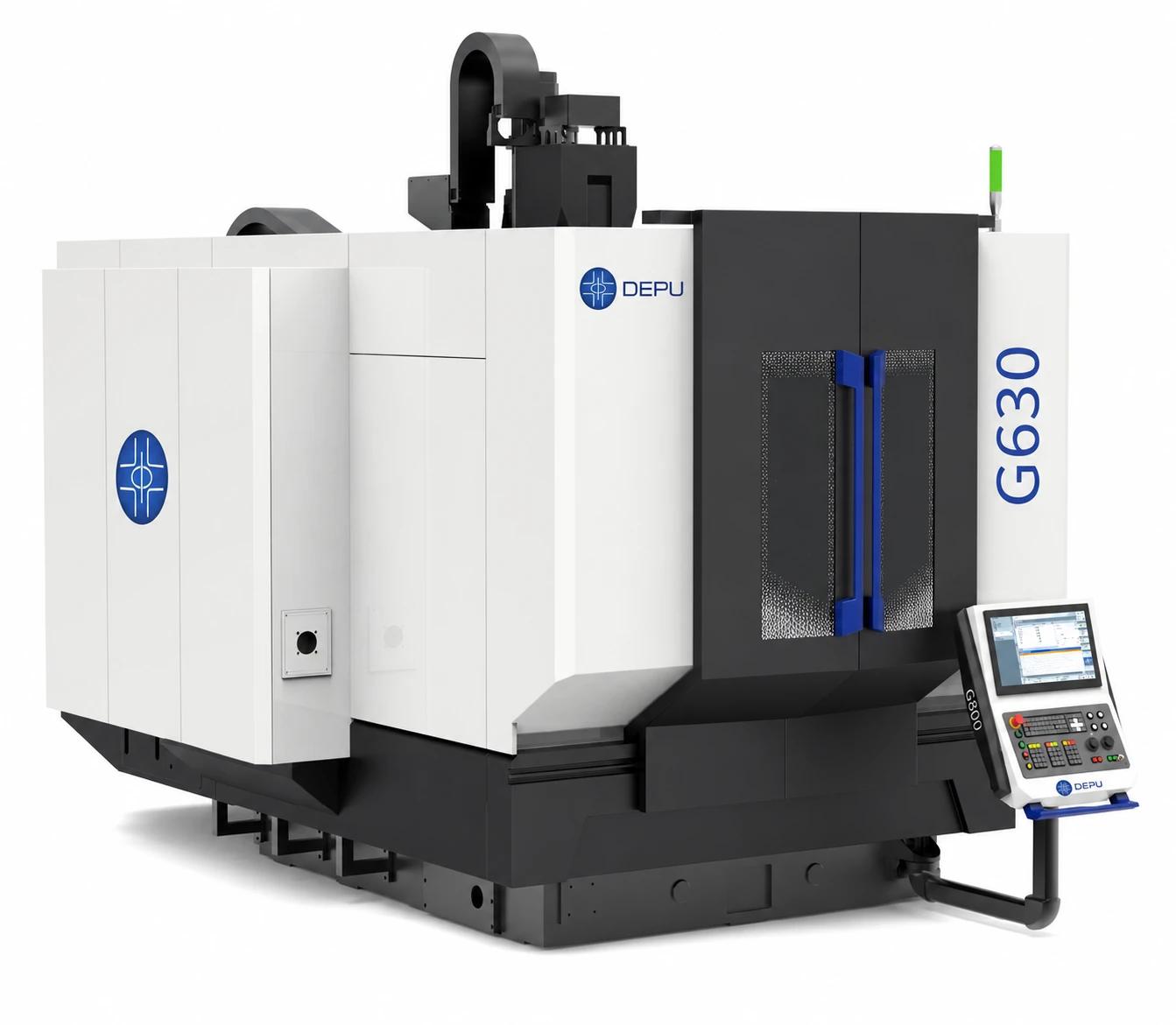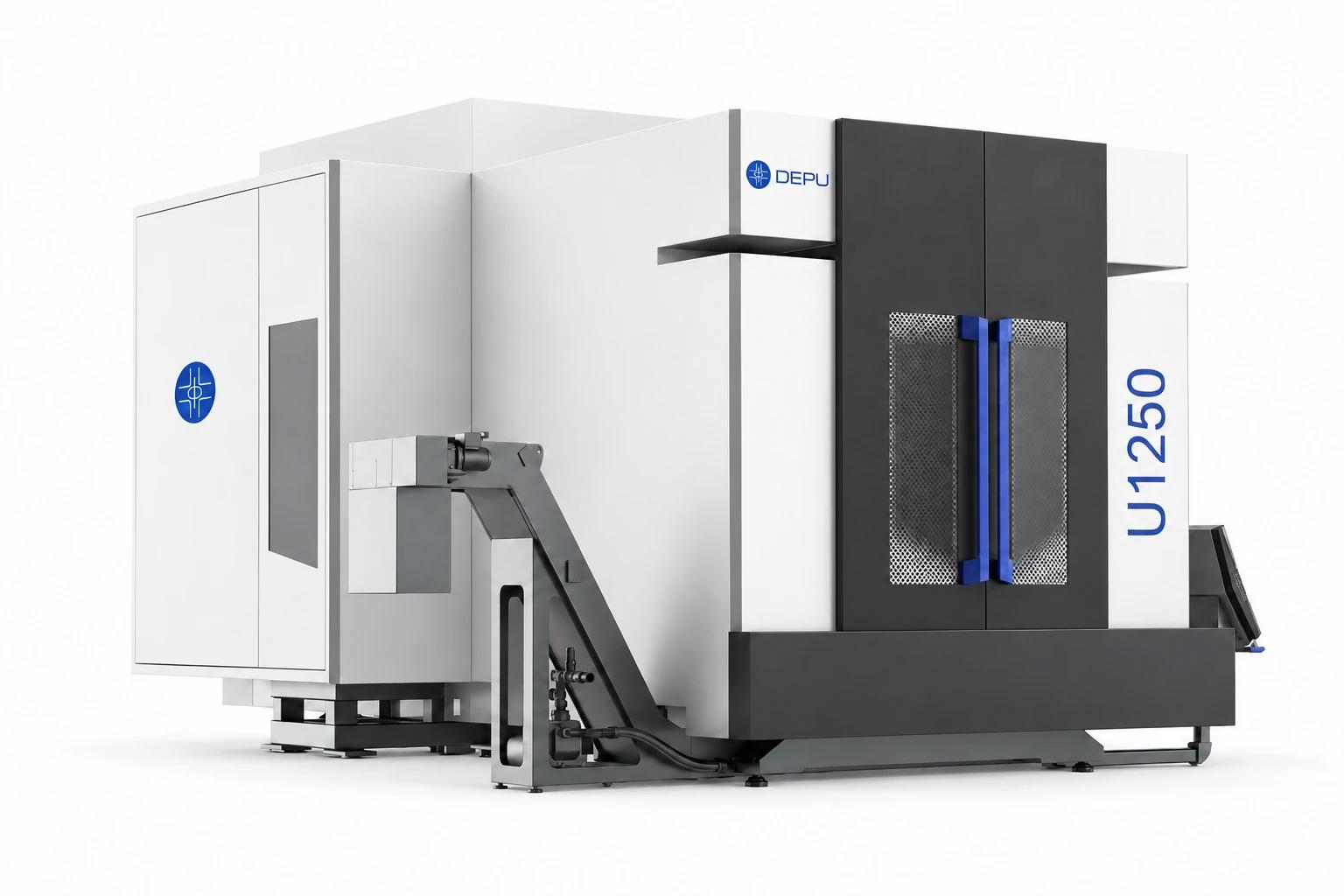
Table diameter is the least useful number in a trunnion 5-axis comparison. Size the DEPU G300, G630 and G800 from swept envelope, table load, spindle class, installed footprint and tool magazine instead.
Most trunnion 5-axis comparisons open with table diameter. It is the least useful number on the datasheet. Table diameter tells you what you can bolt down. It says nothing about whether the part clears the cradle at sixty degrees of tilt, whether the A axis can hold it without chatter, or whether the machine will fit through your door.
The three machines in DEPU’s G series share one architecture. A gantry structure carries the spindle. A dual-support cradle rotates the workpiece on A and C, driven by direct-drive motors on large YRT bearings. Position feedback closes the loop on every axis. SIEMENS ONE runs the kinematics with RTCP. What changes across G300, G630 and G800 is scale — and scale changes the physics of the cut.
This article walks the six numbers that actually decide the machine.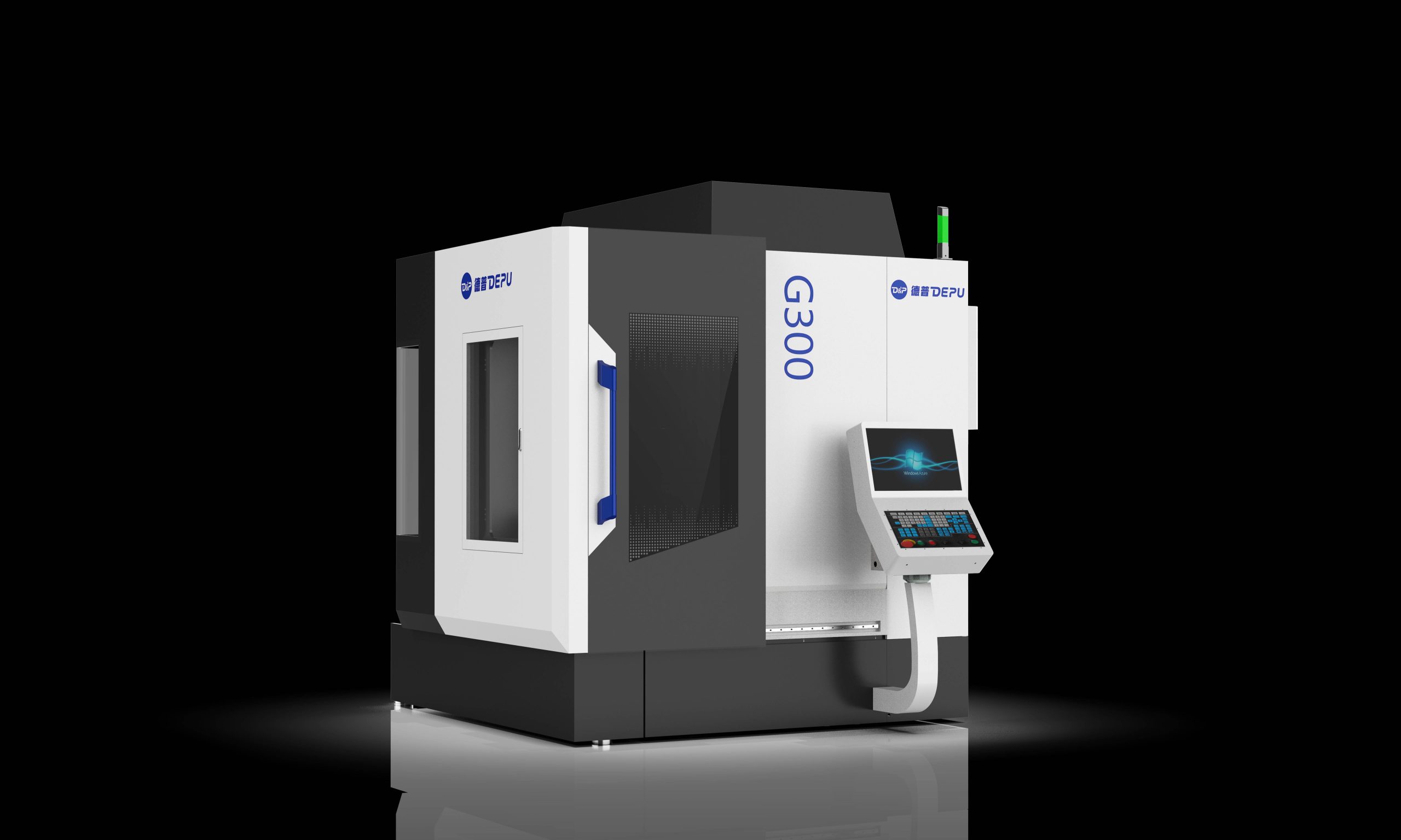
The three machines, side by side
|
|
G300 |
G630 |
G800 |
|
Travels X/Y/Z |
300 / 580 / 300 mm |
650 / 650 / 500 mm |
800 / 900 / 600 mm |
|
Table diameter |
Ø280 / Ø300 |
Ø630 |
Ø800 |
|
Max workpiece |
Ø390 × 250 mm |
Ø700 × 400 mm |
Ø900 × 500 mm |
|
Max table load |
50 kg |
850 kg |
1,200 kg |
|
A-axis range |
±120° |
+30° to −130° |
+30° to −130° |
|
C-axis speed |
100 rpm |
100 rpm |
50 rpm |
|
Rapid traverse |
36 m/min |
45 m/min |
36 m/min |
|
Tool magazine |
24 / 32 |
40 |
32 / 40 |
|
Machine weight |
≈5,500 kg |
12,000 kg |
16,000 kg |
Swipe to compare →
Full configuration detail sits on the series page: G series machining centres (G300 Compact 5 Axis CNC Machining Center | DEPU).
1. Size from the swept envelope, not the table
Look at the G300 row again. Maximum workpiece Ø390 mm on a Ø300 mm table. The workpiece is larger than the surface it sits on, because the cradle swings it through the A axis. Every number you need is the swept envelope, not the clamping area.
The honest way to use this table is to size for the largest part you expect to run in the next three years, not the largest part on your bench today. Moving from Ø390 to Ø700 is not a spindle upgrade — it is a different machine on a different foundation.
2. Table load is a stiffness statement
At 50 kg for the G300, 850 kg for the G630 and 1,200 kg for the G800, these figures are often read as lifting capacity. They are not. They describe how much rotating mass the A and C axes can carry while still holding position under cutting load.
The detail that catches buyers is the fixture. A zero-point or hydraulic clamping system can add 8 to 15 kg before you mount a single workpiece, and that mass counts against the rating. If your part weighs 45 kg and your fixture weighs 12 kg, the G300 is already out of specification. Budget 20 to 30 percent of the load rating for workholding when you size the machine.
3. Speed and torque do not come together
The clearest fork in the G series follows directly from the relationship between power, speed and torque:
Torque (N·m) = 9,550 × Power (kW) / Speed (rpm)
At a given spindle power, torque and speed trade off inversely. That single equation explains the whole product ladder. The G300’s HSK-E50 spindle turns at 24,000 rpm with 13 / 19.5 kW and 20 / 30 N·m. The G800’s HSK-A100 spindle turns at 10,000 rpm with 40 kW and 170 / 224 N·m — roughly eight times the torque, at less than half the speed.
So the question is not which spindle is better. It is which removal strategy your work requires:
● Small tools, high surface speed, light passes. Small cutters need rpm to reach correct surface speed. A 6 mm tool at 20,000 rpm cuts aluminium and hardened steel the way it should. The G300 is built for this, and can be specified with an IBAG spindle for higher speed still.
● Large tools, heavy passes, deep pockets. A 63 mm face mill or a 25 mm carbide end mill in tool steel needs torque, not rpm. Feed rates scale with torque. The G800 is built for this.
The G630 sits between the two on travel, table and load. Its spindle, however, is the one item in this series that is genuinely configured per order — DEPU offers more than one spindle build for this frame, and the standard figure on the product page is not the only one available. If spindle behaviour is central to your decision, ask for the option list and the torque curve in writing before comparing the G630 against either end of the range.
4. The A-axis ranges are not equivalent
The G300 tilts A from −120° to +120°. The G630 and G800 tilt from +30° to −130°.
That asymmetry is deliberate and it matters. The larger cradle machines trade symmetric tilt for deeper reach below horizontal, which suits parts where the critical features sit under the workpiece or on steep downward faces. If your process plan needs the part rotated far upward — a face that points skyward relative to the datum at a steep angle — verify the number against your actual setup before you sign. It is a five-minute check that is expensive to discover later.
C-axis speed also separates them. The G300 and G630 spin C at 100 rpm; the G800 at 50 rpm. If you are considering contouring operations that behave like turning, C-axis speed becomes a cycle-time line item.
5. Plan the installed footprint, not the shipping footprint
The G300’s machine body measures 2,539 × 2,168 mm. With chip conveyor, coolant system and electrical cabinet in place, the installed footprint grows to 4,370 × 4,231 mm.
Read that against the G630’s 2,650 × 4,550 mm and the counterintuitive conclusion lands: the smallest machine in the series can occupy more floor than the middle one, once accessories are fitted. Always plan from the installed drawing, and check three more things while you are there:
● Weight. 5,500 kg, 12,000 kg, 16,000 kg. Foundation design and rigging cost scale with this, and they are not in the machine price. The G800’s installed envelope including accessories runs considerably larger again, so request the layout drawing rather than scaling from the table above.
● Rapid traverse. 36, 45, 36 m/min. The G630 is the fastest of the three — position-to-position time matters most on parts with many short features.
● Height. Ask for the overall height with the enclosure, plus the crane clearance required for the largest machine on your shortlist.
6. Precision grades must be compared on the same standard
The G630 is rated at 0.008 mm positioning accuracy and 0.005 mm repeat on the linear axes, with A and C at 10 and 5 arc-seconds. The G800 carries the same linear figures. Both are full closed-loop: linear axes use absolute encoders, and the rotary axes use high-precision scales. Every machine is verified on a Zeiss CMM before shipment.
Note that the G300’s published positioning figure is not stated on the same basis across DEPU’s own documents — the product page and the build agreement give different numbers for the same machine. That is not a reason to avoid the machine; it is a reason to ask for the accuracy specification as it applies to your build, with the measurement standard named.
The useful question is never “which number is smaller” but “measured how, in what environment, and over what period.” Temperature-controlled rooms and holding tolerance through a full shift cost more than the accuracy difference between these grades in most shops.
7. Match the tool magazine to your longest program
Magazine capacity runs 24 or 32 tools on the G300, 40 on the G630, and 32 or 40 on the G800. Four further limits sit alongside those numbers and are easy to overlook:
|
|
G300 |
G630 |
G800 |
|
Tool diameter |
Ø75 / Ø100 mm * |
Ø75 / Ø120 mm * |
Ø125 / Ø150 mm * |
|
Max tool diameter |
— |
300 mm |
400 mm |
|
Max tool length |
200 mm |
300 mm |
300 mm |
|
Max tool weight |
5 kg |
8 kg |
14 kg |
Swipe to compare →
\* The larger figure applies with the adjacent pocket left empty.
The operator rule that works: capacity should cover every distinct tool in your longest program plus four spares for wear and breakage. Tool weight and length limits matter more than capacity on trunnion machines, because long tools at extreme tilt angles are where interference appears first.
Which one
● Max part within Ø390 × 250 mm and 50 kg, with a high-speed finishing strategy → G300.
● Parts spanning Ø390 to Ø700 mm, up to 850 kg, mixed roughing and finishing → G630.
● Parts to Ø900 × 500 mm, or genuine heavy roughing in the cycle → G800.
If you are still weighing cradle kinematics against tilting-head kinematics rather than choosing within the G series, start with choosing between trunnion and tilting-head 5-axis machining centres (https://www.depu.com/blog/choosing-between-trunnion-and-tilting-head-5-axis-machining-centers). If the question is whether a gantry structure earns its footprint, why gantry structures improve 5-axis stability (https://www.depu.com/blog/gantry-structure-5-axis-stability) covers the structural argument, and how the G series gantry structure sustains 5-axis precision (https://www.depu.com/blog/depu-g-series-gantry-structure-5-axis-precision) goes deeper on this specific architecture.
Two more pieces of context worth reading before you decide: rotary table versus trunnion configurations (https://www.depu.com/blog/rotary-table-vs-trunnion-5-axis) and how workpiece size and weight should drive machine selection (https://www.depu.com/blog/workpiece-size-weight-5-axis-machine-selection).
What to send with a quote request
A specification sheet cannot be matched to a machine without six inputs. Have these ready:
1. Maximum part envelope, in mm, including the fixture
2. Maximum combined part and fixture weight
3. Materials, with the hardest one you will actually run
4. Largest cutting tool diameter and length you intend to mount
5. Required tolerance and surface finish on the critical feature
6. Available floor space, ceiling height and door opening
Send them through the DEPU inquiry page (https://www.depu.com/inquiry) and the configuration can be matched to the part rather than to the price bracket. Machine details by model: G300 (https://www.depu.com/product/g300), G630 (https://www.depu.com/product/g630), G800 (https://www.depu.com/product/g800).
——————————————————————————————
*Specifications shown are for configuration guidance and may vary by option package. Confirm the final datasheet for your build before quoting. Machine selection also depends on tooling, fixturing and thermal conditions that a datasheet cannot capture.*
Originally published by DEPU on 7 Sep 2026.