
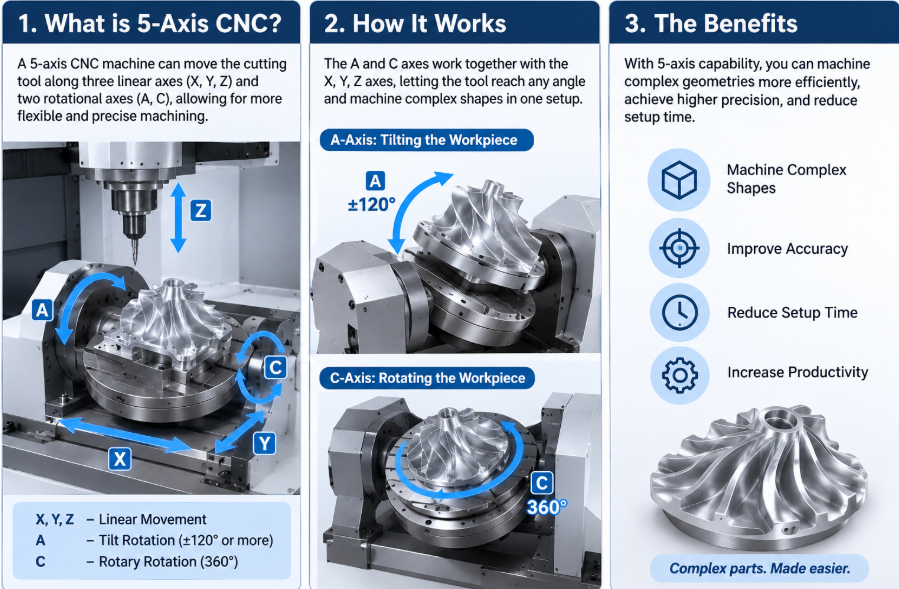
CNC machining is the computer-controlled version of machining. A 5-axis CNC machine adds two rotary axes to the three linear X, Y, and Z axes, allowing manufacturers to approach complex features from multiple directions and, when appropriate, coordinate all five axes during cutting.
For manufacturers considering CNC equipment, understanding the difference between machining, CNC machining, and 5-axis machining is important because each term describes a different part of the manufacturing process.
What Is Machining?
In simple terms, machining starts with a larger piece of material and removes selected portions until the workpiece matches the required design.
The process normally involves a workpiece, cutting tool, machine tool, and workholding system. Depending on the machining method, material can be removed by a cutting edge, abrasive action, or another controlled process.
A basic machining operation might look like this:
Raw material → Workholding → Toolpath → Material removal → Inspection → Finished part
Machining is widely used for metal components, but specific machining processes can also be applied to plastics, composites, and other engineering materials.
The basic definition is straightforward, but the actual manufacturing process can be highly sophisticated. The final result depends on machine rigidity, tooling, cutting conditions, programming, workholding, material properties, thermal behavior, and inspection.
The Cambridge English Dictionary similarly defines machining as the activity of cutting or shaping metal on a machine.
Why Is Machining Called Subtractive Manufacturing?
Machining is called subtractive manufacturing because the finished component is produced by removing material from a starting workpiece.
This is different from additive manufacturing, such as 3D printing, where material is progressively added to create the component.
For example, suppose a manufacturer needs to produce a complex aluminum housing. The starting material may be a block that is considerably larger than the final component. Milling removes material around the outside, creates pockets and holes, and machines the required surfaces until the part reaches its specified geometry.
The amount of material removed can range from relatively small finishing cuts to substantial roughing operations.
This distinction is useful when comparing manufacturing technologies because the starting material, tooling requirements, waste, cycle time, and achievable geometry can differ significantly between subtractive and additive processes.
How Does Machining Work?
Although machining processes vary, most CNC machining workflows follow a similar sequence.
1. Define the Part
The process begins with a CAD model, engineering drawing, or other product definition.
The manufacturer needs to understand:
-
Part dimensions
-
Material
-
Dimensional tolerances
-
Surface requirements
-
Hole and feature locations
-
Critical geometric requirements
-
Production quantity
-
Inspection requirements
For complex components, the geometry itself may determine whether 3-axis, 4-axis, 5-axis, turning, grinding, or a combination of processes is appropriate.
2. Select the Material
Material selection directly affects machining strategy.
Aluminum, stainless steel, titanium, tool steel, plastics, and other materials have different cutting characteristics. Tool selection, spindle requirements, cutting conditions, coolant strategy, and workholding may all need to change accordingly.
For this reason, a machine that performs well for one material is not automatically the ideal machine for another.
3. Secure the Workpiece
The workpiece must be positioned and held securely.
Common workholding methods include:
-
Vises
-
Chucks
-
Fixtures
-
Collets
-
Hydraulic or pneumatic systems
-
Dedicated production fixtures
Workholding is especially important in multi-axis machining. The fixture must hold the part securely while also providing enough clearance for the cutting tool and machine axes.
4. Select the Cutting Tools
Different machining operations require different tools.
A milling operation might use:
-
End mills
-
Ball-nose cutters
-
Face mills
-
Chamfer tools
-
Specialty form cutters
Drilling, boring, reaming, and finishing operations require their own tooling approaches.
Tool diameter, length, material, coating, geometry, and rigidity all affect the machining process.
5. Create and Verify the Toolpath
In CNC production, CAM software is commonly used to generate toolpaths from CAD geometry.
The programmer determines how the tool approaches the workpiece, which areas are rough-machined, how finishing passes are performed, and how the machine moves between operations.
For complex 5-axis machining, simulation and collision checking become particularly important. The programmer must consider not only the cutting tool but also the tool holder, spindle, workpiece, fixture, and machine structure.
6. Machine the Part
The CNC controller executes the programmed movements.
Depending on the component, the process may include roughing, semi-finishing, finishing, drilling, boring, threading, or other operations.
Good machining is not simply about removing material as quickly as possible. Manufacturers must balance material-removal rate with tool life, cutting stability, dimensional requirements, surface quality, and production cost.
7. Inspect the Finished Component
Inspection determines whether the finished part meets its engineering requirements.
Depending on the application, inspection can involve dimensional measurement, gauges, probing systems, optical equipment, or coordinate measuring machines.
For aerospace, medical, precision tooling, and other demanding applications, inspection is an integral part of the manufacturing process rather than simply a final visual check.
What Are the Main Types of Machining?
Machining is a broad category that includes several different processes.
| Machining Process | How It Works | Typical Applications |
|---|---|---|
| Milling | A rotating cutter removes material from the workpiece | Pockets, slots, faces, contours, complex surfaces |
| Turning | The workpiece rotates while a cutting tool removes material | Shafts, cylinders, threads, turned profiles |
| Drilling | A rotating tool creates a hole | Through holes and blind holes |
| Boring | A cutting tool enlarges or improves an existing hole | Precision internal diameters |
| Grinding | An abrasive wheel removes small amounts of material | Precision finishing and surface requirements |
| Reaming | A specialized tool finishes an existing hole | Accurate hole size and finish |
A single component can require several of these processes.
For example, a precision mechanical component might be turned to establish its primary cylindrical geometry, drilled for holes, milled for flats or pockets, and ground to achieve a specific surface or dimensional requirement.
What Is CNC Machining?
CNC machining is machining controlled by a computer numerical control system.
This distinction is worth understanding because machining and CNC machining are not synonymous.
Machining describes what the manufacturing process does: material is removed to produce a component.
CNC describes how the machine’s movements are controlled.
A typical CNC workflow is:
CAD → CAM → Toolpath → CNC Controller → Machine Movement → Finished Part
The CNC controller coordinates programmed machine movements, spindle operation, feed motion, tool changes, and other functions depending on the equipment and control system.
Compared with manually controlled machining, CNC technology is particularly useful for:
-
Repeatable production
-
Complex geometries
-
Automated tool changes
-
Consistent tool movement
-
Multi-operation machining
-
Production of multiple identical components
However, CNC control alone does not guarantee a particular level of accuracy. Machine structure, calibration, tooling, programming, fixturing, thermal conditions, and inspection all contribute to the finished result.
What Is 5-Axis CNC Machining?
A standard 3-axis CNC machine primarily moves along three linear axes:
-
X
-
Y
-
Z
A 5-axis CNC machine adds two rotary axes. Depending on the machine architecture, these may be configured as A/C, B/C, or another combination.
The key advantage is the ability to change the orientation between the cutting tool and workpiece.
This matters when a component contains surfaces or features that cannot be reached efficiently from a single fixed tool orientation.
A 5-axis machine can potentially access several sides of a component while maintaining the workpiece in a single primary setup. This can reduce repositioning and provide more flexibility in tool orientation.
The practical benefit therefore isn’t simply “two more axes.” It is greater access and control over tool orientation.
3+2 vs. Simultaneous 5-Axis Machining
A common misunderstanding is that every 5-axis job uses all five axes simultaneously.
It does not.
3+2 Machining
In 3+2 machining, the two rotary axes position the workpiece or cutting tool at a selected angle. The machine then performs the cutting operation using the three linear axes while the rotary axes remain fixed during that operation.
This approach can be useful for:
-
Angled holes
-
Multiple faces
-
Prismatic components
-
Deep pockets
-
Features requiring different tool orientations
Simultaneous 5-Axis Machining
In simultaneous 5-axis machining, the linear and rotary axes coordinate during the cutting motion.
This is particularly useful for complex three-dimensional surfaces where the cutting-tool orientation needs to change continuously.
Potential applications include:
-
Impellers
-
Blades
-
Turbine components
-
Complex molds
-
Freeform surfaces
-
Difficult-to-access geometries
Simultaneous 5-axis machining also places greater demands on CAM programming, post-processing, machine kinematics, collision avoidance, and CNC control.
So when evaluating a 5-axis machine, the important question is not simply: “Does it have five axes?”
A better question is: “How will the five axes be used on the parts we actually manufacture?”
DEPU similarly distinguishes 3+2 positioning from simultaneous five-axis machining in its technical guidance.
What Are the Benefits of 5-Axis Machining?
The value of 5-axis machining depends on the part and manufacturing strategy. It is not automatically the right choice for every application.
Fewer Setups for Complex Parts
A complicated component may require several setups on a 3-axis machine to reach different surfaces.
Every additional setup introduces another opportunity for repositioning error and requires additional workholding and setup time.
A 5-axis machine can often reach more features without completely repositioning the workpiece.
Better Tool Access
Changing the tool orientation can allow the cutter to approach a surface from a more suitable direction.
This can be useful for deep cavities, angled surfaces, and complex contours where a fixed tool orientation creates clearance or cutting problems.
Improved Tool Orientation
For complex surfaces, the angle between the cutting tool and workpiece can significantly affect the cutting process.
5-axis motion gives programmers greater control over that orientation, which can be valuable for both roughing and finishing strategies.
More Efficient Processing of Complex Geometry
When a component requires multiple orientations, reducing unnecessary setups can simplify the overall manufacturing workflow.
However, the actual benefit depends on programming, workholding, machine configuration, tooling, and the geometry of the part. A 5-axis machine does not automatically reduce cycle time or manufacturing cost for every component.
When Should You Use a 5-Axis CNC Machine?
A 5-axis CNC machine is worth considering when the geometry or production process creates limitations for conventional machining.
Typical candidates include parts with:
-
Complex multi-sided geometry
-
Freeform surfaces
-
Deep cavities
-
Multiple angled features
-
Difficult tool access
-
Blades or impellers
-
Complex molds and dies
-
Aerospace components
-
Medical components
-
Precision mechanical components
On the other hand, a relatively simple component with accessible pockets, holes, and flat surfaces may not require five axes.
A 3-axis machine can be entirely appropriate when the part can be efficiently machined without additional tool orientations.
The right question is therefore not whether 5-axis is universally “better.” It is whether its additional capability solves a real manufacturing problem in your production environment.
What Industries Use 5-Axis CNC Machining?
Aerospace
Aerospace manufacturing includes components with complex contours, multiple surfaces, and demanding production requirements. Multi-axis machining can provide the tool access needed for these geometries.
Medical Manufacturing
Medical components can contain intricate features and complex surfaces. The appropriate machining strategy depends on the specific device, material, geometry, and applicable manufacturing requirements.
Automotive
5-axis machining can be used for complex mechanical components, molds, dies, and tooling where multiple machining orientations are required.
Mold and Die Manufacturing
Complex mold cavities and freeform surfaces can benefit from continuously controlled tool orientation.
Energy and Industrial Equipment
Some industrial components contain complex internal or external surfaces that require specialized multi-axis machining strategies.
Precision Engineering
Manufacturers producing high-value, low-volume, or geometrically complex components may use 5-axis equipment to simplify setups and improve tool access.
The correct machine configuration still depends on the specific component rather than the industry name alone.
How to Choose a 5-Axis CNC Machine
Buying a 5-axis CNC machine is a major capital-equipment decision. Comparing machines only by spindle speed, table diameter, or advertised accuracy can give you an incomplete picture.
Start With Your Actual Parts
Before comparing machines, review the parts you expect to manufacture.
Consider:
-
Maximum part dimensions
-
Part weight
-
Material
-
Required tolerances
-
Surface requirements
-
Deep cavities
-
Tool-access requirements
-
Production volume
-
Fixture requirements
The machine should be sized around the real manufacturing envelope you need, including clearance for the fixture, tool holder, and rotary motion.
Evaluate the Machine Architecture
5-axis machines can use different configurations, including trunnion-table and tilting-head designs.
The architecture affects:
-
Workpiece accessibility
-
Available workspace
-
Rotary-axis behavior
-
Part loading
-
Fixture clearance
-
Machine footprint
-
Maximum workpiece size and weight
Do not assume that two machines with the same number of axes will perform identically on the same part.
Look at Rigidity and Thermal Stability
During cutting, forces act on the spindle, tool, workpiece, rotary axes, and machine structure.
A rigid structure helps the machine maintain stable cutting conditions, while thermal behavior can influence dimensional consistency as the machine operates.
This is why published positioning accuracy should not be evaluated in isolation. Kinematics, structure, thermal management, feedback systems, calibration, and the actual machining process all matter.
Evaluate the Spindle for Your Application
Spindle speed is only one specification.
The right spindle depends on the tools, materials, cutting strategy, and type of work you plan to perform.
High-speed machining with small cutters can place different demands on the spindle than heavy roughing with larger tools.
Ask for the information that matters to your application, including the available spindle configurations, power and torque characteristics, tool interface, cooling system, and applicable operating range.
Check the CNC and CAM Environment
A 5-axis machine is part of a larger digital manufacturing workflow.
Before purchasing, confirm compatibility with your:
-
CAD/CAM software
-
Post processor
-
CNC control
-
Toolpath simulation system
-
Collision-checking workflow
-
Probing system
-
Tool measurement system
For simultaneous 5-axis machining, post-processing and machine kinematics deserve particular attention.
Consider Workholding and Loading
The workholding system must support the part while leaving enough clearance for rotary movement.
A machine can have sufficient nominal table capacity while still being unsuitable for a particular part because of fixture height, interference, or rotary-axis clearance.
Always verify the complete setup rather than looking at table diameter alone.
Evaluate Service and Engineering Support
A sophisticated machine requires more than a purchase order.
Consider the manufacturer’s ability to support:
-
Installation
-
Machine commissioning
-
Operator training
-
Programming
-
Troubleshooting
-
Maintenance
-
Spare parts
-
Application engineering
For a production facility, technical support can have a significant impact on how effectively the equipment is integrated into the shop.
What to Look for in a 5-Axis CNC Machine Manufacturer
When evaluating a machine builder, look beyond the product brochure.
Useful questions include:
-
What machine architectures does the manufacturer build?
-
Can the machine configuration be matched to your parts?
-
What engineering and application support is available?
-
How are machine accuracy and geometry verified?
-
What CNC and CAM environments are supported?
-
What training is provided after installation?
-
How are maintenance and spare parts handled?
-
Can the manufacturer provide appropriate documentation and certification for your market?
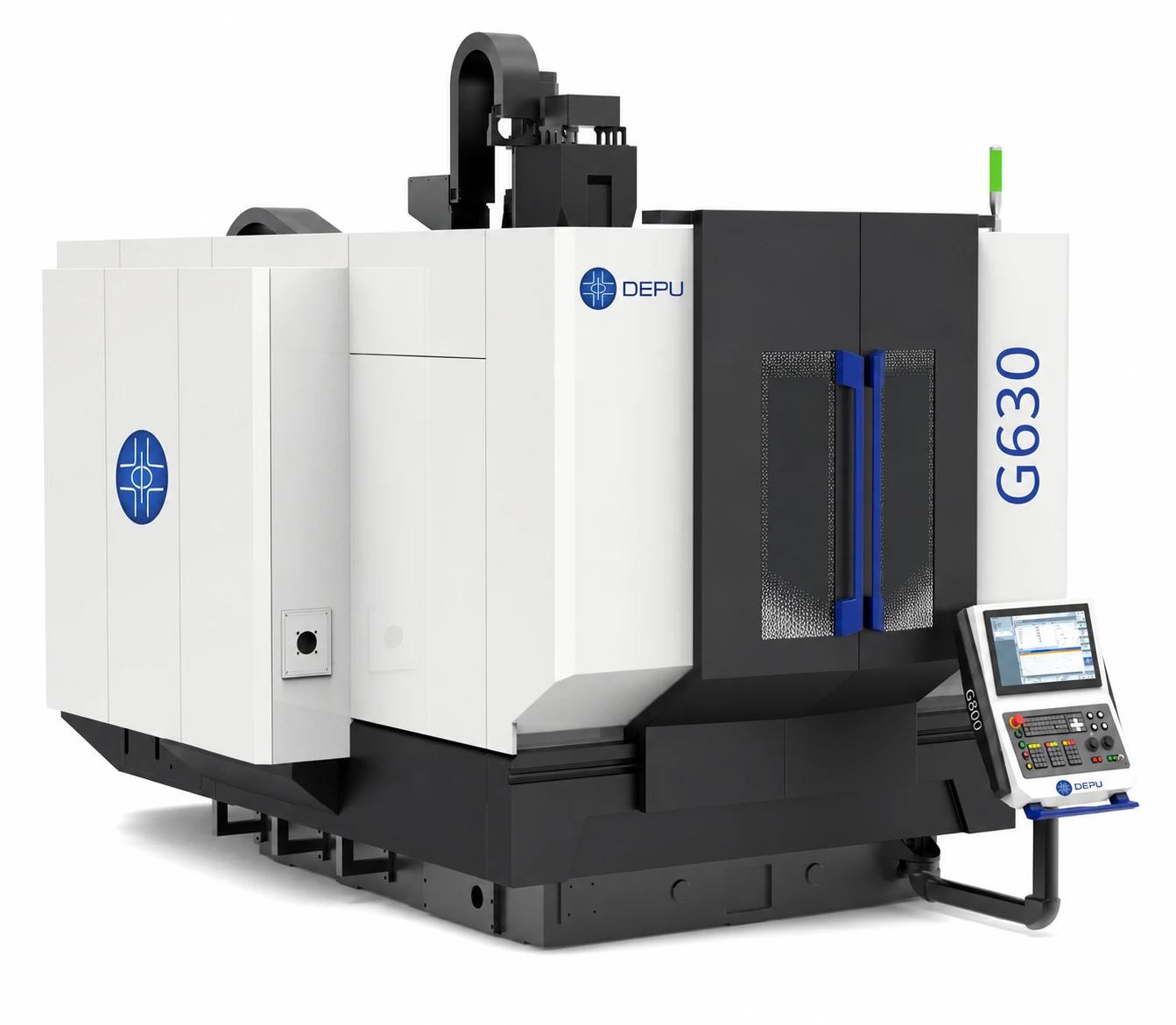
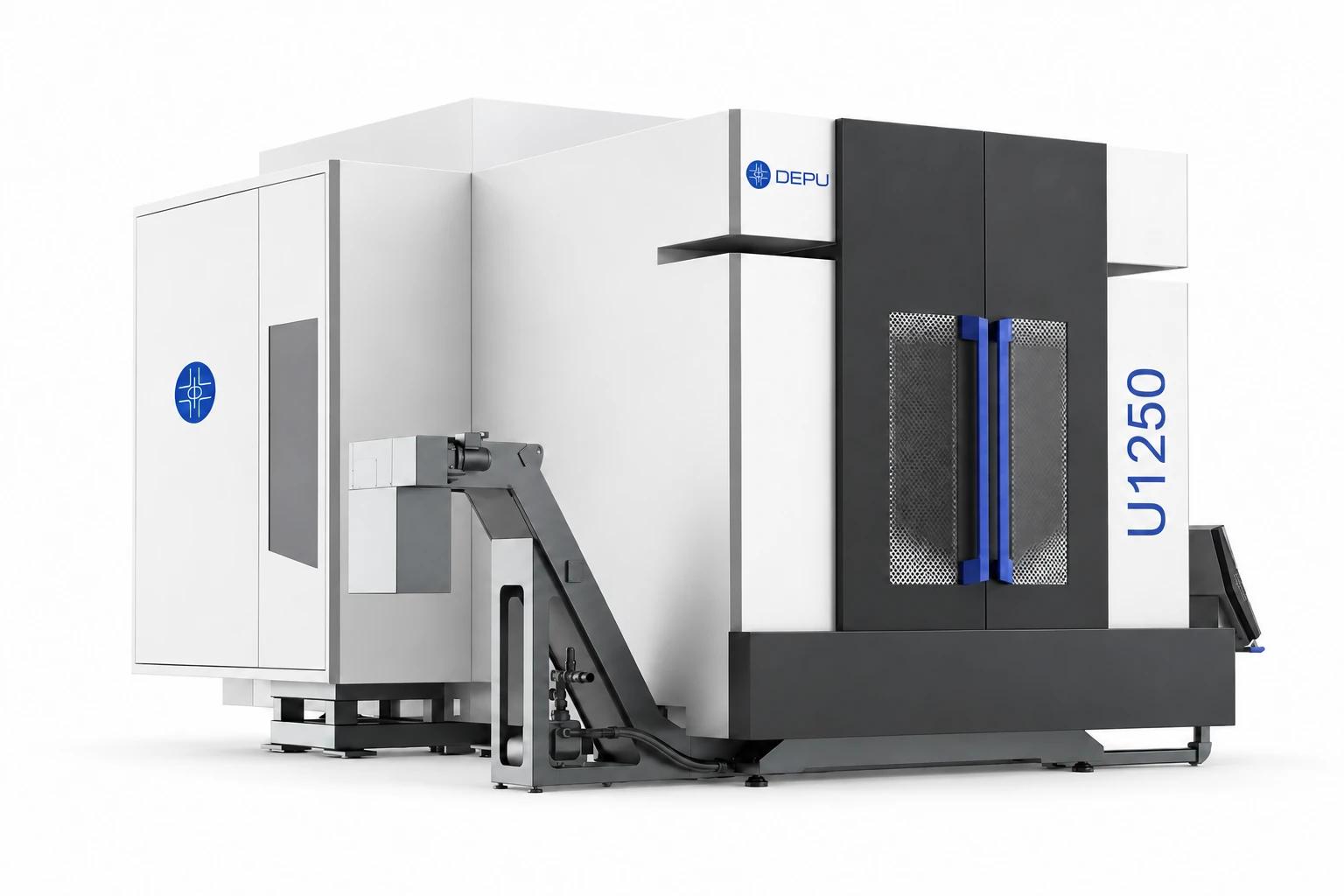
DEPU is a manufacturer of high-end 5-axis CNC machining centers, with product families including the G Series and U Series. Its current G Series includes the compact G300 and larger G630 and G800 configurations.
For example, DEPU’s published G300 specifications include 300/580/300 mm X/Y/Z travel, an A/C rotary configuration of ±120°/360°, a maximum workpiece size of Ø390 × 250 mm, and a uniform workpiece load rating of 50 kg. The published configuration uses an HSK-E50 spindle with a maximum speed of 24,000 rpm, while optional spindle configurations are also available.
The G630 is a substantially larger machine, with published X/Y/Z travel of 650/650/500 mm, a maximum workpiece size of Ø700 × 400 mm, and a uniform load capacity of 850 kg. Its published configuration includes an HSK-E63 spindle with a maximum speed of 24,000 rpm and a 40-tool magazine.
These specifications illustrate an important purchasing principle: machine size and configuration should be matched to the parts you need to manufacture rather than selected simply because a machine has more capability.
DEPU also states that its G Series uses a gantry structure and dual-supported cradle rotary table, with closed-loop axis feedback and RTCP functionality in its published configurations.
Machining vs. CNC Machining vs. 5-Axis CNC Machining
The three terms describe related but different concepts:
| Term | What It Means | Main Question |
|---|---|---|
| Machining | A material-removal manufacturing process | How is the part made? |
| CNC machining | Machining controlled by a computer numerical control system | How are machine movements controlled? |
| 5-axis CNC machining | CNC machining using three linear and two rotary axes | How can the tool or workpiece be oriented during machining? |
This distinction is useful when researching manufacturing technologies or comparing CNC equipment.
A 5-axis machine is not simply a “faster” version of a 3-axis machine. Its primary advantage is the additional freedom to orient the tool and workpiece, which can change how complex components are fixtured, programmed, and machined.
Is 5-Axis CNC Always the Right Choice?
No.
A 5-axis machine introduces additional capability, but that capability has to solve an actual manufacturing requirement.
For simple components, a 3-axis machine may provide everything the production process needs. For complex parts with multiple surfaces, difficult tool access, freeform geometry, or frequent repositioning requirements, 5-axis machining may offer a substantially different workflow.
The decision should be based on:
-
Part geometry
-
Number of setups
-
Tool access
-
Material
-
Production volume
-
Required accuracy
-
Surface requirements
-
Workholding
-
CAM capability
-
Total cost of ownership
In other words, buy the capability your parts require, not simply the largest number of axes available.
Frequently Asked Questions About Machining
What is machining in simple terms?
Machining is the controlled removal of material from a workpiece to produce a component with the required shape, dimensions, and surface characteristics.
Is machining the same as CNC machining?
No. Machining is the manufacturing process, while CNC describes the computer-controlled method used to operate the machine. CNC machining is therefore one form of machining.
What are the main types of machining?
Common machining processes include milling, turning, drilling, boring, grinding, and reaming. A single component may require several different operations.
What is the difference between 3-axis and 5-axis machining?
A 3-axis CNC machine primarily moves along X, Y, and Z. A 5-axis machine adds two rotary axes, giving the machine additional freedom to orient the cutting tool or workpiece.
Does a 5-axis machine always use all five axes at once?
No. Many 5-axis machines are used for 3+2 machining, where the rotary axes position the part or tool before a three-axis cutting operation. Simultaneous 5-axis machining coordinates the linear and rotary axes during cutting and is particularly useful for certain complex surfaces.
When should a manufacturer consider buying a 5-axis CNC machine?
A manufacturer should consider 5-axis equipment when its parts require multiple machining orientations, complex surfaces, difficult tool access, deep cavities, or frequent repositioning on conventional equipment. If most parts are simple and easily accessible from three axes, a 5-axis machine may not provide enough additional value to justify the investment.
What should I evaluate before buying a 5-axis CNC machine?
Start with your actual parts and production requirements. Evaluate machine architecture, work envelope, rotary-axis range, rigidity, spindle characteristics, CNC control, CAM compatibility, workholding, thermal behavior, inspection requirements, service support, and the manufacturer’s engineering capabilities.
Originally published by DEPU on 5 Nov 2026.