
7075-T6 aluminum is the benchmark alloy for aerospace structural components, robotics arms, and high-stress mechanical brackets. With a yield strength exceeding 500 MPa—matching many carbon steels at one-third the density—it enables engineers to design ultra-rigid, lightweight monolithic parts.
However, moving from simple 3-axis prismatic milling to simultaneous 5-axis machining on 7075 introduces unique physical bottlenecks:
- While it chips crisper than “gummy” 6061, its higher tensile strength creates substantial lateral cutting forces against long-reach cutters.
- Tall, asymmetric vertical ribs and thin pocket floors resonate easily under aggressive high-feed roughing.
- As the rotary axes tilt to clear undercut features, gauge length increases, inviting severe regenerative chatter.
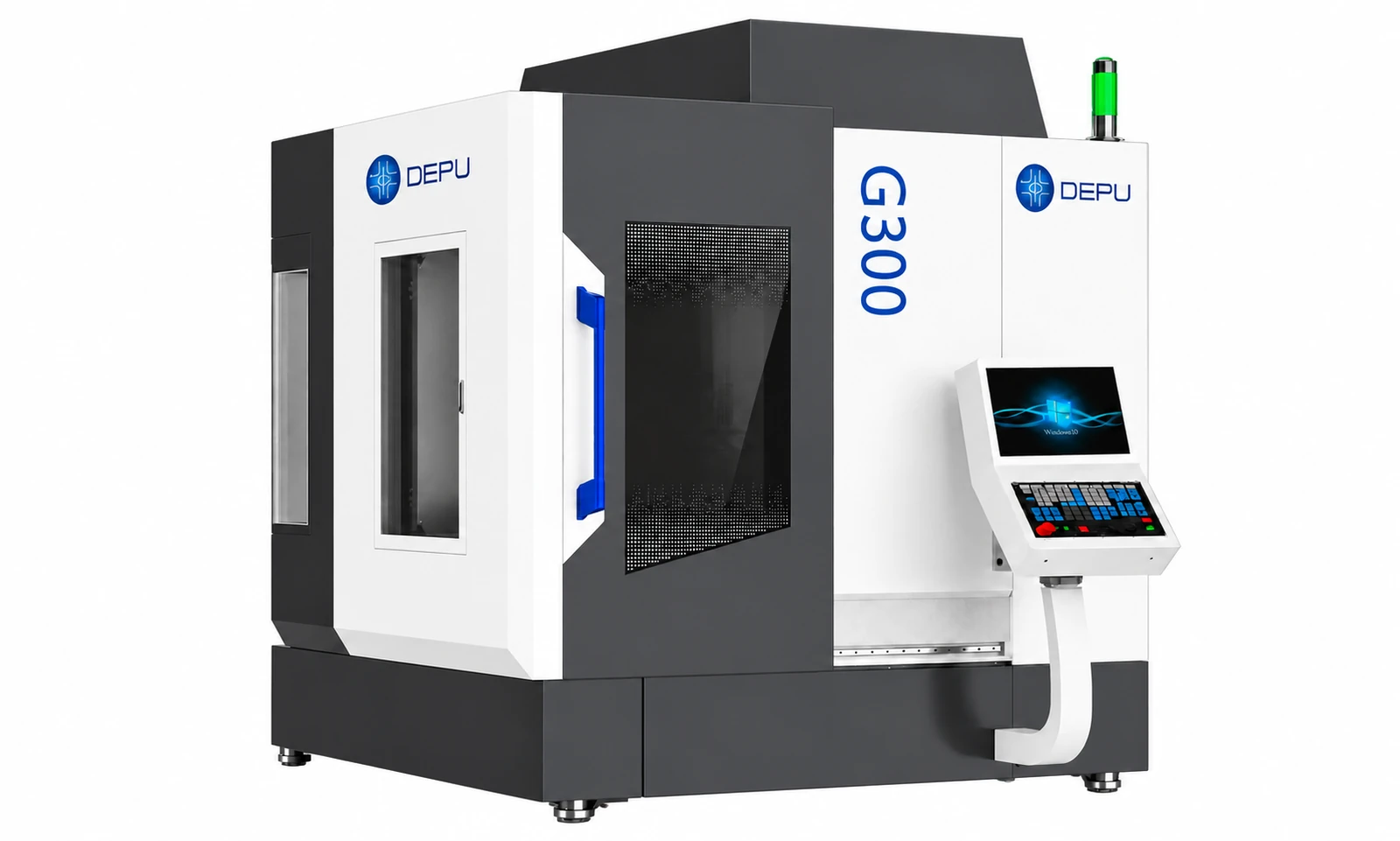
Achieving mirror-like surface finishes and aggressive metal removal rates (MRR) without scrapping expensive aerospace billets requires balancing cutting parameters with machine tool dynamics. Here is the engineering guide to dialing in speeds, feeds, toolpaths, and dynamic stability on a high-rigidity 5-axis platform like the
DEPU G300.
1. Dialing in Speeds & Feeds: The Science of Chip Load
A common shop-floor mistake in aluminum cutting is simply running the spindle at maximum RPM with an arbitrary feedrate.
Machining 7075-T6 effectively is governed by chip thickness control. If the feed per tooth is too light, the cutting edge rubs, friction rises, and built-up edge (BUE) forms on the flute. If the feed is too heavy, the cutting force spikes, causing tool deflection and harmonic chatter.
| Operation | Tool Spec | Cutting Speed (Vc) | Feed / Tooth (fz) | Axial (ap) | Radial (ae) |
|---|---|---|---|---|---|
| High-Efficiency Roughing | 12 mm 3-Flute | 650–950 m/min | 0.08–0.14 mm | Up to 1.5×D | 10%–15% D |
| Deep Pocket Clearing | 10 mm 3-Flute | 600–850 m/min | 0.06–0.10 mm | Up to 1.0×D | 25%–35% D |
| Floor & Wall Finishing | 10 mm Finisher | 750–1,100 m/min | 0.04–0.08 mm | Full wall height | 0.2–0.4 mm |
| Thin-Wall Contouring | 8 mm Ball Nose | 500–800 m/min | 0.03–0.06 mm | 0.2–0.5 mm step | 0.1–0.15 mm |
Swipe to compare →
Pro Tip: On a platform equipped with a 24,000 RPM high-speed electric spindle (such as the G300), running an 8 mm or 10 mm 3-flute endmill maintains optimal surface footage (Vc > 700 m/min) while feeding comfortably at 6,000 to 9,000 mm/min. Never starve the tool—proper chip thickness acts as a heat sink, carrying thermal energy away from the cut.
2. The 5-Axis Dynamics Trap: Why Rigidity Dictates Chatter
In 3-axis milling, cutting resistance pushes straight down into a fixed cast-iron machine bed.
In simultaneous 5-axis milling, the dynamics change completely. As the cradle tilts (A-axis) and rotates (C-axis) to follow complex contours, the cutting force vector exerts severe bending moments on the rotary trunnion bearings and spindle nose.
Eliminating chatter in high-speed aluminum cuts comes down to three structural factors:
- Dual-Supported Trunnions vs. Cantilevered Tables: Single-sided trunnion arms flex under side-milling loads. The
DEPU G300 cradle-type 5-axis vertical machining center
uses a symmetrical, double-supported cradle assembly anchored in a heavy gantry structure, absorbing harmonic frequencies directly beneath the workpiece. - Spindle Tooling Interface (HSK-E50): At spindle speeds above 18,000 RPM, centrifugal force causes traditional steep tapers (like BT30 or ISO) to expand slightly, causing the holder to sink and lose radial contact. The G300 deploys a precision HSK-E50 spindle interface that locks simultaneous face-and-taper contact for maximum radial stiffness.
- Massive Cast-Iron Damping: Cast iron has up to ten times the vibration-damping capacity of fabricated steel or aluminum plates. A heavy, rigid machine base dissipates resonance before harmonic frequencies can transfer into the cutter.
3. Toolpath Strategies for Thin Walls and Deep Bores
Aerospace brackets rarely feature uniform cross-sections. Thin vertical ribs, intersecting bores, and deep cavities require strategic CAM toolpaths:
- Dynamic / Trochoidal Milling (Constant Engagement Angle): Traditional pocketing drives the endmill into 90-degree internal corners at 100% radial engagement, causing tool shock and chatter. Dynamic toolpaths maintain a constant tool engagement angle (≤ 40°), keeping cutting forces steady and allowing full flute depth cutting at elevated feedrates.
- The “Waterfall” (Stepped) Wall Support Strategy: When machining tall, thin aluminum walls (e.g., 1.5 mm thickness over 60 mm height), never finish one side completely before cutting the opposite side. Rough both sides in staggered Z-levels, using a waterfall approach so the uncut stock supports the opposite wall during each pass.
- Chip Evacuation with High-Flow Flood Coolant: 7075 aluminum produces light, curled chips at high feedrates. If chips fall back into the cutting zone, the cutter recuts them, causing micro-welding (built-up edge) and tool wear. High-pressure flood coolant directed straight at the tool tip flushes chips out of deep cavities instantly.
4. Real-World Case Study: Aerospace Structural Bracket on the G300
The practical application of these techniques is demonstrated on the Aerospace Structural Bracket machined on the DEPU G300:
- Component: Asymmetric Actuator Bracket / Bearing Housing (198 × 185 × 88.5 mm)
- Material: Aerospace 7075-T6 Billet
- Process Strategy: 2 Setups (OP01 Base Datum + OP02 Full 5-Face Continuous Done-in-One)
- Spindle Package: HSK-E50 (24,000 RPM)
- Profile Tolerance Achieved: ±0.01 mm
- Surface Roughness: Ra ≤ 0.8 µm
- Cycle Time: 32 Minutes
By leveraging the G300’s cradle table, the part was completed without transferring between multiple machines. The deep central bearing bore, angled side mounting flanges, and multi-directional cross-holes were finished in one setup—eliminating cumulative fixturing errors and reducing cycle time by over 60%.
The Verdict: Speed Means Nothing Without Stability
7075-T6 aluminum is designed for high-velocity cutting. But high speeds without machine rigidity and thermal control simply result in premature tool failure, noisy chatter, and scrapped parts.
By pairing constant chip-load toolpathing with a dual-supported cradle center like the DEPU G300, precision machine shops can push feedrates, hold sub-0.01 mm tolerances, and achieve flawless surface finishes on every production run.
Optimize Your 5-Axis Aluminum Machining
Ready to eliminate chatter and reduce cycle times on complex aerospace, medical, or robotics components?
Originally published by DEPU on 9 Nov 2026.