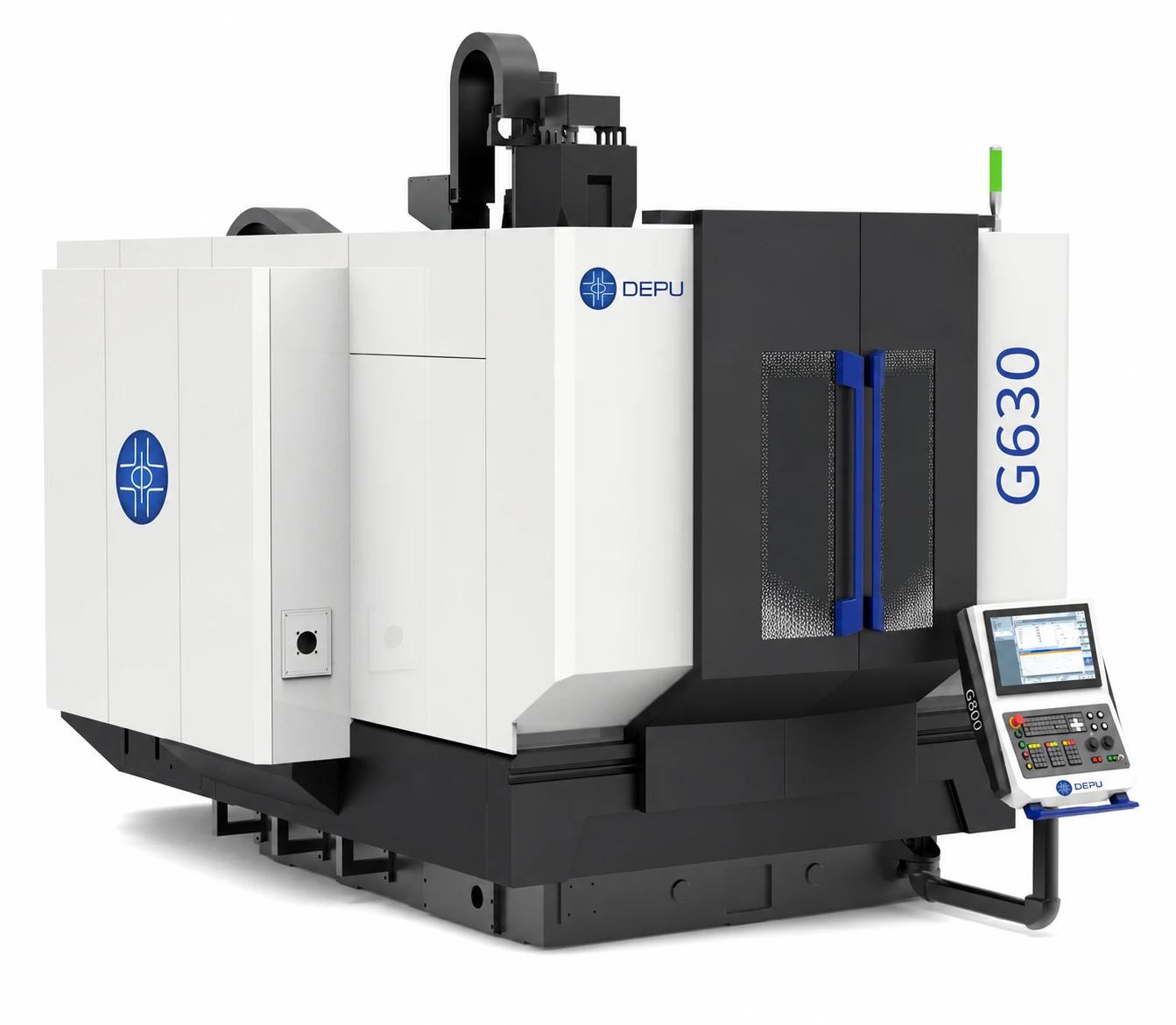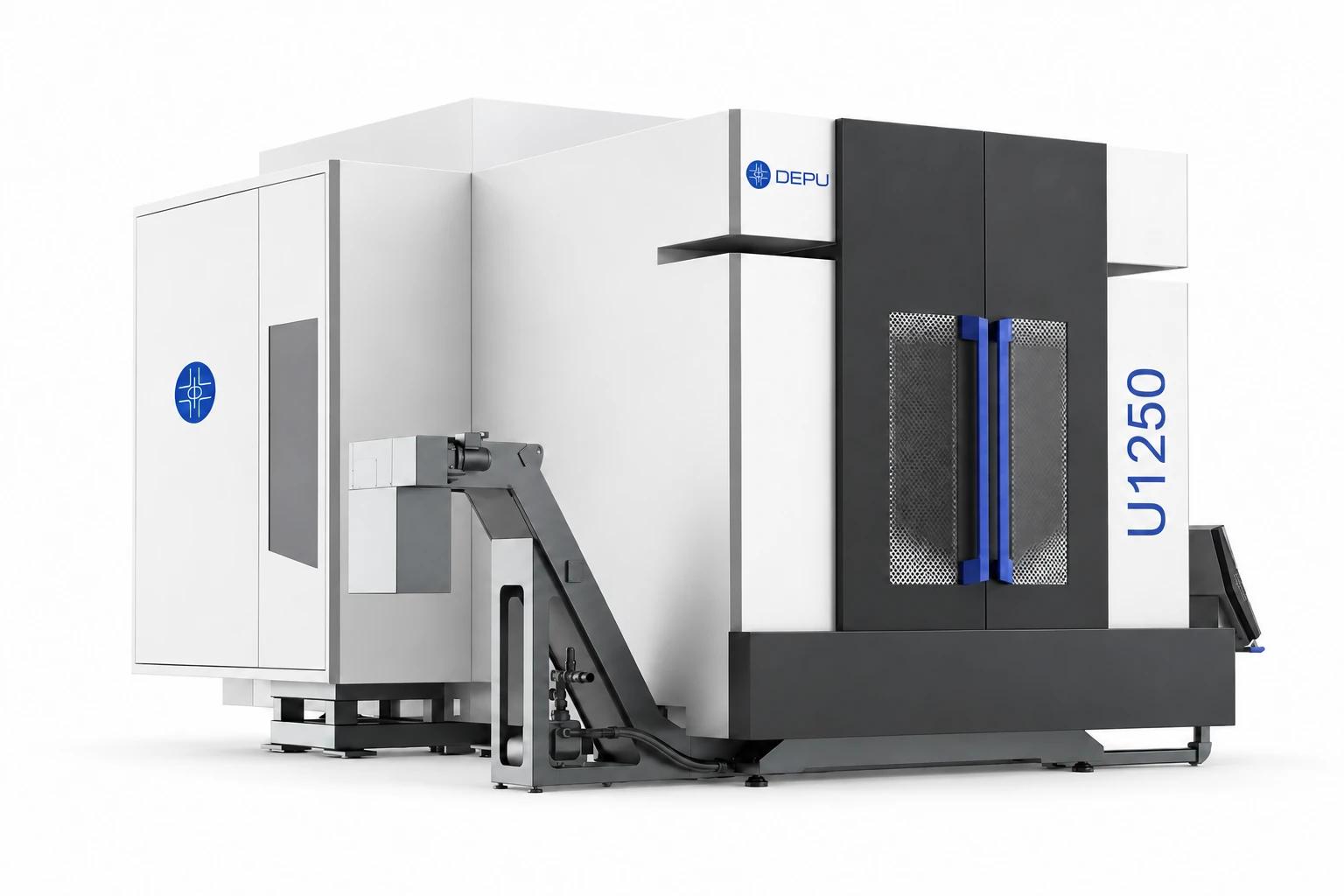

More importantly, the number of controlled axes is not the same as the number of axes that can move simultaneously or cut a part at the same time. If you’re comparing CNC machines, you need to understand how their axes are configured and what the machine can actually do—not just the number in its name.
This guide explains how CNC axis counts work, what 5-, 6-, 7-, 9-, and 12-axis configurations typically mean, and how to choose the right machine for your parts and production requirements.
What Does the Number of Axes Mean in a CNC Machine?
A CNC axis describes a direction or type of movement that the machine can control. The most familiar axes are the three linear directions:
-
X-axis: Moves left and right.
-
Y-axis: Moves forward and backward.
-
Z-axis: Moves up and down.
Rotary axes add the ability to rotate a workpiece or cutting tool. They are commonly identified as:
-
A-axis: Rotation around the X-axis.
-
B-axis: Rotation around the Y-axis.
-
C-axis: Rotation around the Z-axis.
A machine’s total axis count may include several linear and rotary movements, as well as additional axes assigned to separate turrets, spindles, slides, or tool groups.
For example, a mill-turn machine might have multiple tool turrets and two spindles. Each tool group can have its own linear axes, while the spindles provide additional rotary movement. The machine can therefore have many more controlled axes than a conventional milling machine.
Three Different Ways to Count CNC Axes
Before comparing machines, distinguish between these three terms:
| Term | What it means |
|---|---|
| Total controlled axes | All axes the CNC control system can manage |
| Simultaneously interpolated axes | Axes that can coordinate their movement along a programmed toolpath at the same time |
| Physical machine axes | The actual linear and rotary movements built into the machine |
Swipe to compare →
These numbers are not necessarily the same.
For instance, Beckhoff’s TwinCAT CNC documentation specifies support for up to 128 axes or controlled spindles, with up to 32 simultaneously interpolating axes. This describes the capabilities of the control system, not a standard machine configuration with 128 physical machining axes.
What Are the Different Types of CNC Machines by Axis Count?
The following configurations are common reference points. Keep in mind that 6-axis, 7-axis, and 9-axis machines do not all follow one universal mechanical design. Their actual capabilities depend on how the manufacturer combines linear axes, rotary axes, spindles, and tool groups.
3-Axis CNC Machine
A 3-axis CNC machine moves along the X, Y, and Z directions. The cutting tool approaches the workpiece from a fixed general orientation while the machine controls its position along these three linear axes.
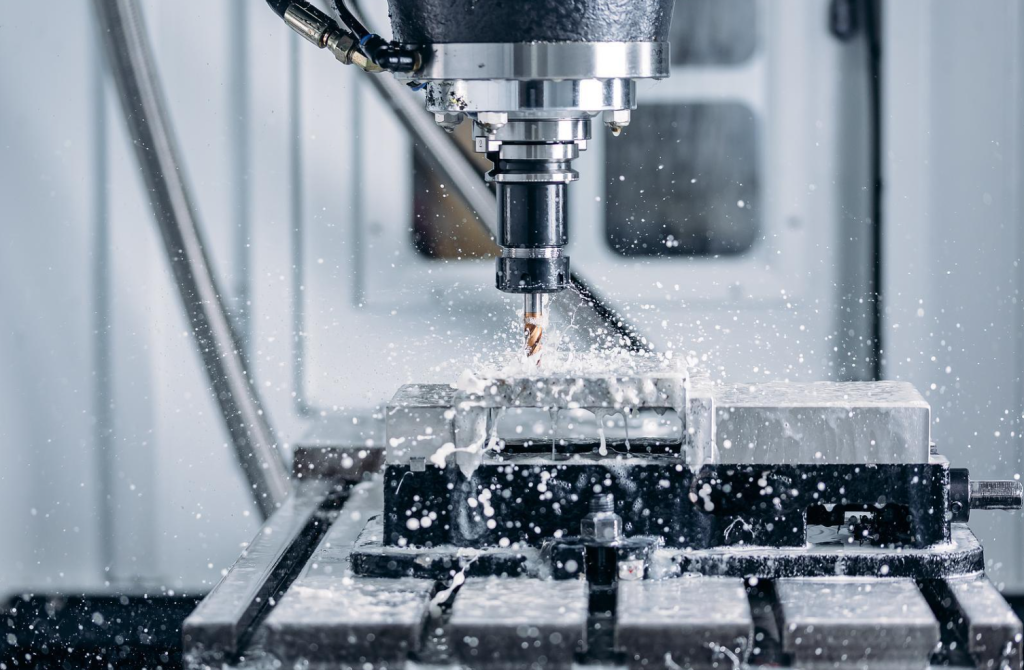
Typical applications include:
-
Flat surfaces and pockets
-
Drilling and tapping
-
Slots and grooves
-
Basic molds and mechanical components
-
Parts with relatively simple geometries
A 3-axis machine is often a cost-effective choice when most features can be machined from one direction or through a manageable number of setups.
Its main limitation is tool access. If your part has angled surfaces, complex contours, or features on multiple sides, you may need to reposition the workpiece and run additional setups.
4-Axis CNC Machine
A 4-axis CNC machine adds one rotary axis to the standard X, Y, and Z movements. The rotary axis is commonly an A-axis or C-axis, depending on the machine’s design.
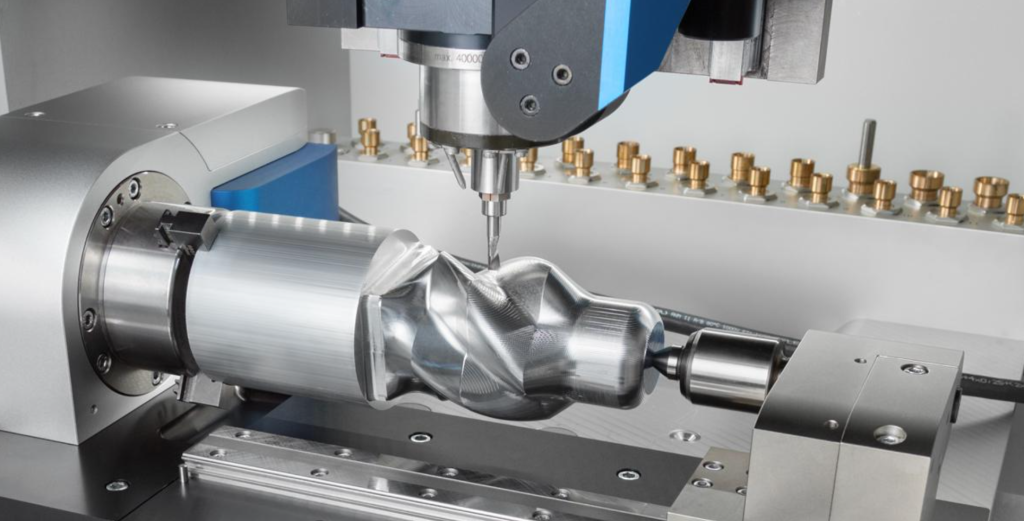
This allows you to rotate the workpiece or coordinate rotary movement with the cutting tool.
Typical applications include:
-
Cylindrical components
-
Parts with features around multiple sides
-
Indexing and angled drilling
-
Components that require machining around a central axis
A 4-axis machine can reduce the number of repositioning operations compared with a 3-axis machine. However, a rotary axis does not automatically mean the machine can perform continuous, simultaneous multi-axis cutting. You need to check the control system and machine configuration.
5-Axis CNC Machine
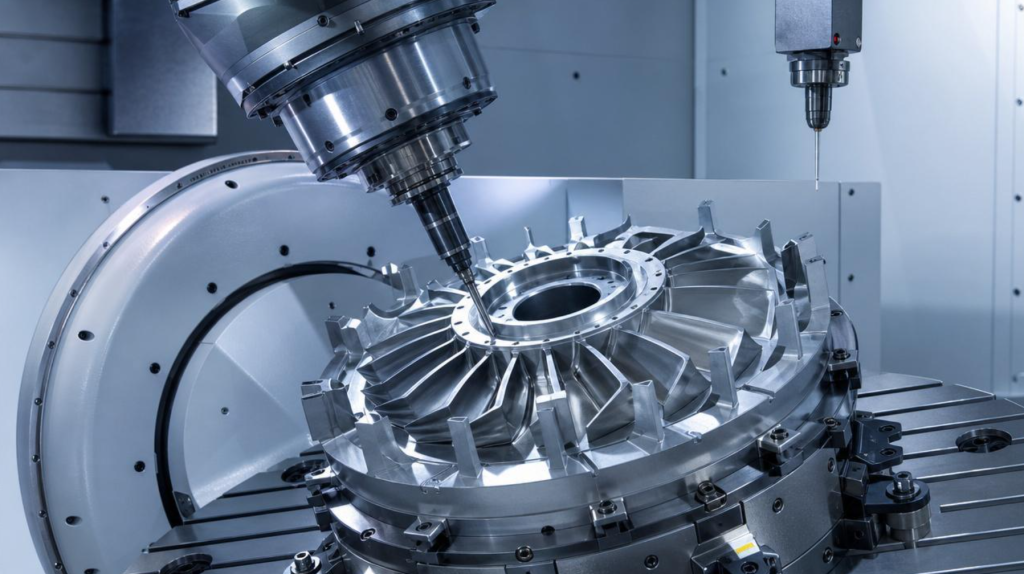
A 5-axis CNC machine typically combines three linear axes (X, Y, and Z) with two rotary axes. Depending on the design, the rotary movements may be built into the machine table, the spindle head, or a combination of both.
This configuration gives you more freedom to position the cutting tool relative to the workpiece. You can machine complex surfaces and reach multiple sides of a component with fewer setups.
Typical applications include:
-
Aerospace components
-
Medical implants and instruments
-
Automotive components
-
Complex molds and dies
-
Impellers and turbine-related parts
-
Precision parts with angled surfaces
One important distinction is the difference between 3+2 machining and simultaneous 5-axis machining.
| Machining method | How it works |
|---|---|
| 3+2 machining | The two rotary axes position and hold the workpiece or tool at an angle while the three linear axes perform the cutting operation |
| Simultaneous 5-axis machining | All five axes can move in a coordinated manner during cutting |
Swipe to compare →
Both methods are useful, but they are not interchangeable. If your parts require continuous tool orientation changes along complex surfaces, you need a machine and CNC system capable of simultaneous 5-axis interpolation.
For many manufacturers producing complex milled components, 5-axis machining offers a practical balance between machining flexibility, setup reduction, and production capability.
6-Axis CNC Machine
A 6-axis CNC machine has six controlled axes, but the exact configuration varies by machine type.
Some systems add another rotary or linear axis to a conventional multi-axis milling configuration. Others use additional movements in mill-turn or specialized machining equipment.
You should not assume that every machine described as a 6-axis CNC machine has the same kinematics or can perform the same operations.
When evaluating one, ask the manufacturer:
-
What are the six axes?
-
Which axes move simultaneously during machining?
-
Are the additional axes used for positioning, tool movement, or workpiece rotation?
-
Can the machine perform the operations your parts require?
The answers matter more than the axis count alone.
7-Axis CNC Machine
A 7-axis CNC configuration may combine conventional machining movements with an additional rotary, linear, or robotic axis.
For example, some systems use a multi-axis machining platform with an additional axis for positioning or handling. In other applications, a robotic system provides extra movement beyond the conventional machine axes.
Potential applications include:
-
Complex part positioning
-
Robotic machining and material handling
-
Specialized multi-axis production
-
Components requiring additional access or movement
However, the term “7-axis CNC machine” does not describe one standardized machine architecture. Two machines with seven controlled axes may have very different capabilities.
Check the actual axis arrangement and determine whether the additional axis contributes to cutting, positioning, or automation.
9-Axis CNC Machine
A 9-axis CNC machine is more likely to be found in specialized multi-tasking equipment than in a conventional vertical milling center.
A typical configuration may combine multiple linear axes, rotary spindle movements, and additional tool-group movements. The exact arrangement depends on the machine’s design.
Typical applications may include:
-
Complex shaft components
-
Parts requiring turning and milling
-
Components with features on multiple ends
-
Production processes that benefit from multiple tool groups
-
High-throughput manufacturing
These machines can reduce manual repositioning and combine several operations in one production cycle. However, they also require more sophisticated programming, setup, and process coordination.
12-Axis and Higher CNC Machines
If you’re looking for CNC machines with 12 or more axes, specialized multi-spindle and multi-tool-group systems are important examples.
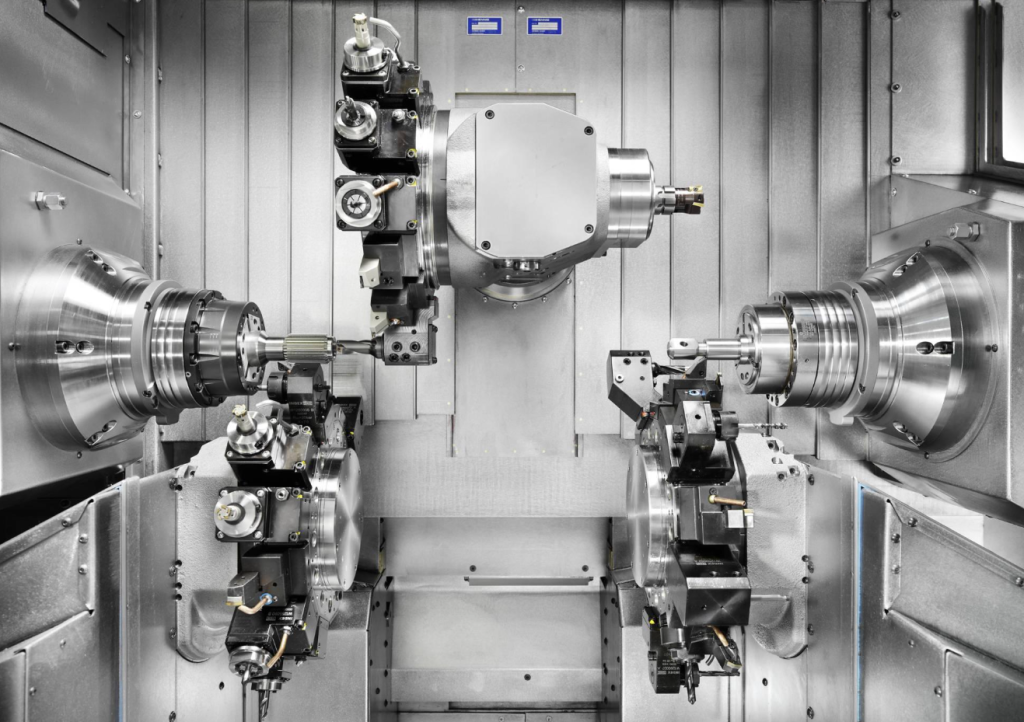
A multi-tasking mill-turn machine may have several turrets, multiple spindles, and independent slides. Each group can contribute additional controlled movements, increasing the total axis count.
GibbsCAM’s multi-tasking machine reference material describes configurations with 12 or more axes, including multi-tool-group and multi-spindle arrangements. These systems are designed for specialized production requirements rather than simply adding more axes to a conventional milling machine.
Typical applications include:
-
High-volume precision component production
-
Complex medical and electronic components
-
Multi-sided turning and milling
-
Parts requiring multiple synchronized operations
-
Automated production with reduced manual intervention
A 12-axis machine does not necessarily perform 12-axis simultaneous cutting. Some axes may operate independently, support different tool groups, or handle workpiece transfer and positioning.
The machine’s actual machining capability depends on its configuration, CNC control, and programming.
CNC Axis Comparison: 3-Axis vs. 4-Axis vs. 5-Axis vs. 12-Axis
The table below summarizes the general differences. The 6-, 7-, 9-, and 12-axis labels are broad descriptions, not standardized machine categories.
| Axis count | General configuration | Main advantage | Common applications |
|---|---|---|---|
| 3-axis | X, Y, Z linear movements | Simple operation and lower equipment complexity | Flat surfaces, pockets, basic components |
| 4-axis | Three linear axes plus one rotary axis | Access to additional sides of a part | Cylindrical parts, indexed machining |
| 5-axis | Three linear axes plus two rotary axes | Complex surfaces and flexible tool orientation | Aerospace, medical, molds, impellers |
| 6-axis | Varies by machine architecture | Additional movement or positioning capability | Specialized milling and mill-turn |
| 7-axis | Varies by machine architecture | More flexible positioning or automation | Robotic and specialized machining |
| 9-axis | Often multiple tool groups or spindles | Combines multiple machining operations | Complex mill-turn production |
| 12+ axis | Often multi-spindle, multi-tool-group systems | High production integration and throughput | Specialized high-volume manufacturing |
Swipe to compare →
The most important takeaway is that more axes do not automatically mean better machining performance. A well-configured 5-axis machining center may be a better choice for a complex aerospace component than a 12-axis production machine designed for a different type of work.
Does a CNC Machine With More Axes Always Perform Better?
No. A higher axis count gives you more possible movements, but it does not automatically improve accuracy, surface finish, or productivity.
The right machine depends on your workpiece geometry, material, production volume, and machining requirements.
More Axes Can Reduce Setups
When a machine can reach more surfaces without manually repositioning the workpiece, you may be able to reduce the number of setups.
This can help:
-
Reduce workpiece handling
-
Improve positional consistency between operations
-
Shorten production cycles
-
Machine complex geometries more efficiently
However, these benefits depend on the machine’s actual kinematics and how well the machining process is programmed.
More Axes Increase Programming Complexity
Multi-axis machining requires more than a machine with additional motors and rotary components.
You also need compatible CAM software, an accurate postprocessor, and a CNC control system that supports the required movements.
If the machine has several tool groups or spindles, programming and process synchronization can become even more demanding.
More Axes Do Not Guarantee Higher Accuracy
Accuracy depends on multiple factors, including:
-
Machine structure and rigidity
-
Rotary-axis positioning accuracy
-
Thermal stability
-
Backlash and compensation
-
Spindle performance
-
Workholding and fixture stability
-
Tool condition and cutting parameters
A machine with fewer axes but better mechanical performance may produce more consistent results than a more complicated machine that is poorly matched to the application.
How to Choose the Right CNC Machine Axis Configuration
If you’re buying a CNC machine for your factory, start with the parts you need to produce. Do not choose a machine simply because it has the highest axis count.
1. Evaluate Your Part Geometry
Look at the number of sides that require machining, the angles of the features, and whether the part contains complex curved surfaces.
If most features are accessible from one direction, a 3-axis machine may be sufficient.
If you need to machine multiple sides or cylindrical surfaces, a 4-axis configuration may be more practical.
If your parts have complex surfaces, deep cavities, or angled features that require continuous tool orientation changes, consider simultaneous 5-axis machining.
2. Check the Required Simultaneous Axis Movement
Ask the manufacturer how many axes can be interpolated simultaneously.
This is particularly important if you need continuous multi-axis machining. A machine with five controlled axes may support only 3+2 positioning for a particular operation, while another configuration may support simultaneous movement across all five axes.
Do not rely on the total axis count in the product description. Request the actual control specifications and machining capabilities.
3. Match the Machine to Your Workpiece Size and Weight
Before comparing models, confirm that the machine can accommodate your largest and heaviest workpieces.
Check:
-
X, Y, and Z travel
-
Maximum workpiece dimensions
-
Table size
-
Maximum table load
-
Rotary-axis capacity
-
Tool and fixture clearance
A machine with more axes is not useful if your parts exceed its working envelope or load capacity.
4. Evaluate the Spindle and Machine Structure
Axis count is only one part of machining performance.
If you work with aluminum, steel, titanium, or other demanding materials, evaluate the spindle power, torque, speed range, machine rigidity, and thermal stability.
For heavy cutting, structural stiffness and torque may be more important than a higher spindle speed. For small, intricate parts, spindle speed, toolholding, and precision may deserve more attention.
5. Confirm CAM Software and CNC Controller Compatibility
Your CAM software and postprocessor must support the machine’s actual axis configuration.
For complex 5-axis or multi-tasking machining, check whether the system supports the required kinematic transformations, tool center point control, collision checking, and simultaneous interpolation.
A machine’s advertised axis count is not enough to establish that your existing programming workflow will work with it.
6. Consider Maintenance, Training, and Production Costs
More complex machines can require additional operator training, programming expertise, maintenance, and service support.
Compare the total cost of ownership rather than focusing only on the purchase price.
Consider:
-
Initial machine investment
-
Tooling and fixture costs
-
CAM software and postprocessor costs
-
Operator and programmer training
-
Preventive maintenance
-
Spare parts availability
-
Local technical support
A machine that reduces setups and labor may justify a higher investment, but only if those savings apply to your actual production workload.
Is a 5-Axis CNC Machine Better Than a 9-Axis or 12-Axis Machine?
Not necessarily. These machines are designed for different production requirements.
A 5-axis machining center is often a strong choice when you need to mill complex components, machine multiple surfaces, and maintain accurate relationships between features.
A 9-axis or 12-axis machine may be more suitable when your production process requires multiple spindles, several tool groups, or coordinated turning and milling operations.
| Your production requirement | Configuration to consider |
|---|---|
| Basic milling and drilling | 3-axis |
| Machining around a cylindrical workpiece | 4-axis |
| Complex surfaces and multi-sided milling | 5-axis |
| Specialized positioning or robotic machining | 6- or 7-axis, depending on the design |
| Integrated turning and milling with multiple tool groups | 9-axis or higher, depending on the machine |
| High-volume production with multiple spindles and synchronized operations | 12-axis or higher, depending on the process |
Swipe to compare →
You should compare machines based on the finished part, required tolerances, cycle time, and production volume—not simply the number of axes.
FAQ
What is the highest number of axes in a CNC machine?
There is no universal maximum for all CNC machine types. Specialized multi-tasking machines can have 12 or more controlled axes. CNC control systems may support even higher axis counts. For example, Beckhoff documents up to 128 controlled axes or spindles in its TwinCAT CNC system, with up to 32 simultaneously interpolating axes. This is a controller capability, not a claim that a standard machine has 128 physical machining axes.
Final Thoughts
The CNC machine with the most axes is not necessarily the best machine for your production needs. Specialized multi-tasking systems can have 12 or more controlled axes, while advanced CNC controllers can manage even larger numbers. But total axis count, simultaneous interpolation, and actual machining capability are three different things.
If you manufacture complex components that require multiple machining angles and precise tool orientation, a 5-axis CNC machining center may provide the flexibility you need without the additional complexity of a multi-spindle production system.
Before making a purchase, evaluate your part geometry, material, workpiece size, accuracy requirements, and production volume. Then compare the machine’s actual kinematics, controller capabilities, spindle performance, and CAM compatibility. That approach will help you select a CNC machine that fits your manufacturing process—not just one with a bigger number in its specifications.
Is a 5-axis CNC machine better than a 3-axis machine?
A 5-axis CNC machine offers more flexibility for complex parts, angled features, and multi-sided machining. It can reduce the need to reposition a workpiece between operations. However, if your parts have simple geometries and can be machined efficiently from one direction, a 3-axis machine may be more economical and easier to operate.
Can all five axes move at the same time?
Yes, if the machine and CNC control support simultaneous 5-axis interpolation. However, not every machine marketed as a 5-axis CNC machine uses all five axes simultaneously for every operation. Some processes use 3+2 positioning, where the rotary axes position the workpiece or tool before the three linear axes perform the cut.
What is the difference between a 5-axis and a 6-axis CNC machine?
A typical 5-axis machining center uses three linear axes and two rotary axes. A 6-axis machine has an additional controlled axis, but its configuration varies by manufacturer and machine type. You need to check the actual axis arrangement to understand what the sixth axis does.
Do more CNC axes mean higher accuracy?
No. Accuracy depends on machine rigidity, axis positioning performance, thermal stability, calibration, compensation, spindle condition, and workholding. Additional axes can improve access and reduce setups, but they do not automatically make a machine more accurate.
What CNC machine should you choose for complex metal parts?
For many complex metal components, a 5-axis CNC machining center is a practical option because it can machine multiple surfaces and complex geometries with fewer setups. However, your choice should also account for material, workpiece dimensions, required tolerances, spindle performance, and production volume. Specialized mill-turn machines may be more suitable when the part requires extensive turning and milling operations.
Originally published by DEPU on 12 Nov 2026.