
If you have ever programmed or operated a 5-axis CNC machine, you have likely heard the term RTCP—short for Rotated Tool Center Point (also known as TCPM, or Tool Center Point Management).
For shops transitioning from 3-axis milling to simultaneous 5-axis machining, RTCP is often the difference between effortless micron-level precision and hours of frustrating fixture-offset recalculations.
In this guide, we break down what RTCP actually does, how it works across different CNC controllers, and why your machine’s mechanical accuracy is just as important as the software behind it.
What Is RTCP (Tool Center Point Control)?
In a standard 3-axis CNC machine, the tool only moves linearly along X, Y, and Z. The tool tip stays in a fixed orientation relative to the spindle.
In a 5-axis CNC machine, however, two rotary axes (such as A/B, A/C, or B/C) tilt either the workpiece (trunnion style) or the spindle head (tilting-head style). When a rotary axis tilts by even a few degrees, the physical center point of the tool tip swings away from its original X, Y, Z position in space.
Without RTCP:
- The CAM programmer must know the exact distance from the rotary axis center of rotation to the workpiece origin before generating G-code.
- If the operator shifts the part by 2 mm on the table—or changes the tool length—the program has to be reposted from CAM.
With RTCP Enabled:
- The CNC controller automatically calculates and compensates for the rotary pivot offsets in real time.
- As the A, B, or C axes rotate, the linear X, Y, and Z axes simultaneously adjust so the tool tip stays locked on the programmed surface coordinate—regardless of where the workpiece is clamped on the table.
3 Major Benefits of RTCP for 5-Axis Machine Shops
1. Freedom from Fixture-Center Dependency
With RTCP active, operators don’t need to waste hours dialing a part into the exact mechanical center of the rotary table. You can clamp the fixture anywhere within the work envelope, probe the work offset (G54), and run the same verified G-code.
2. True Tool-Length Independence
Because the controller tracks the actual tool length from the spindle gauge line in real time, you can swap a worn end mill for a slightly shorter or longer tool, update the tool offset table on the machine, and keep running without returning to the CAM workstation.
3. Smoother Surface Finishes on Complex Contours
During simultaneous 5-axis surfacing (such as turbine blades, impellers, or mold cavities), RTCP synchronizes rotary and linear feed rates so the tool tip maintains a constant cutting speed across curved geometry—preventing dwell marks and sudden acceleration spikes.
Common RTCP Commands Across CNC Controllers
Depending on the CNC control system on your shop floor, RTCP goes by slightly different names and G-codes:
| CNC Controller | Feature Name | Typical Activation Code |
|---|---|---|
| FANUC | Tool Center Point Control | G43.4 (Type 1) / G43.5 (Type 2) |
| SIEMENS | Orientation Transformation | TRAORI |
| HEIDENHAIN | Tool Center Point Management | M128 / FUNCTION TCPM |
| Mitsubishi / Others | 3D Tool Compensation / RTCP | G43.4 |
Swipe to compare →
Why RTCP Accuracy Still Depends on Machine Structure
While RTCP is a controller function, software cannot fix an unstable machine frame.
For RTCP compensation to hold tight tolerances—especially during heavy multi-axis cuts or long cycles—the CNC machine itself must maintain exact geometric alignment between its linear ways and rotary pivot centers:
- Rigid Structural Design: Machine frames (such as gantry or heavy-duty trunnion architectures) must resist deflection under cutting forces; otherwise, the true pivot point shifts dynamically away from the controller’s mathematical model.
- Thermal Stability: Thermal growth in the spindle or rotary housings alters pivot-length offsets over multi-hour runs.
- High-Resolution Feedback: Direct-drive rotary encoders and linear scales ensure the controller knows the exact real-time position of all five axes.
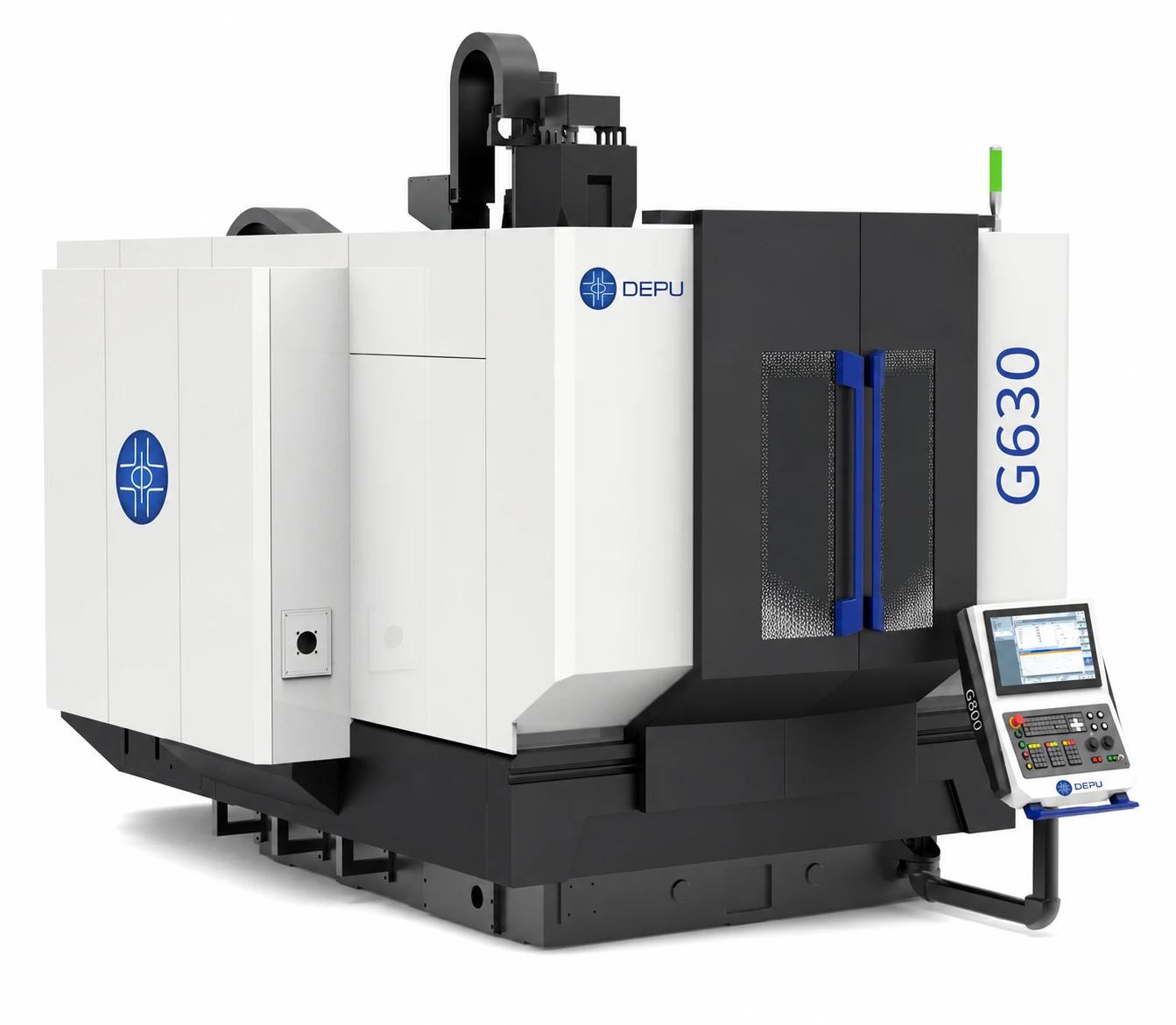
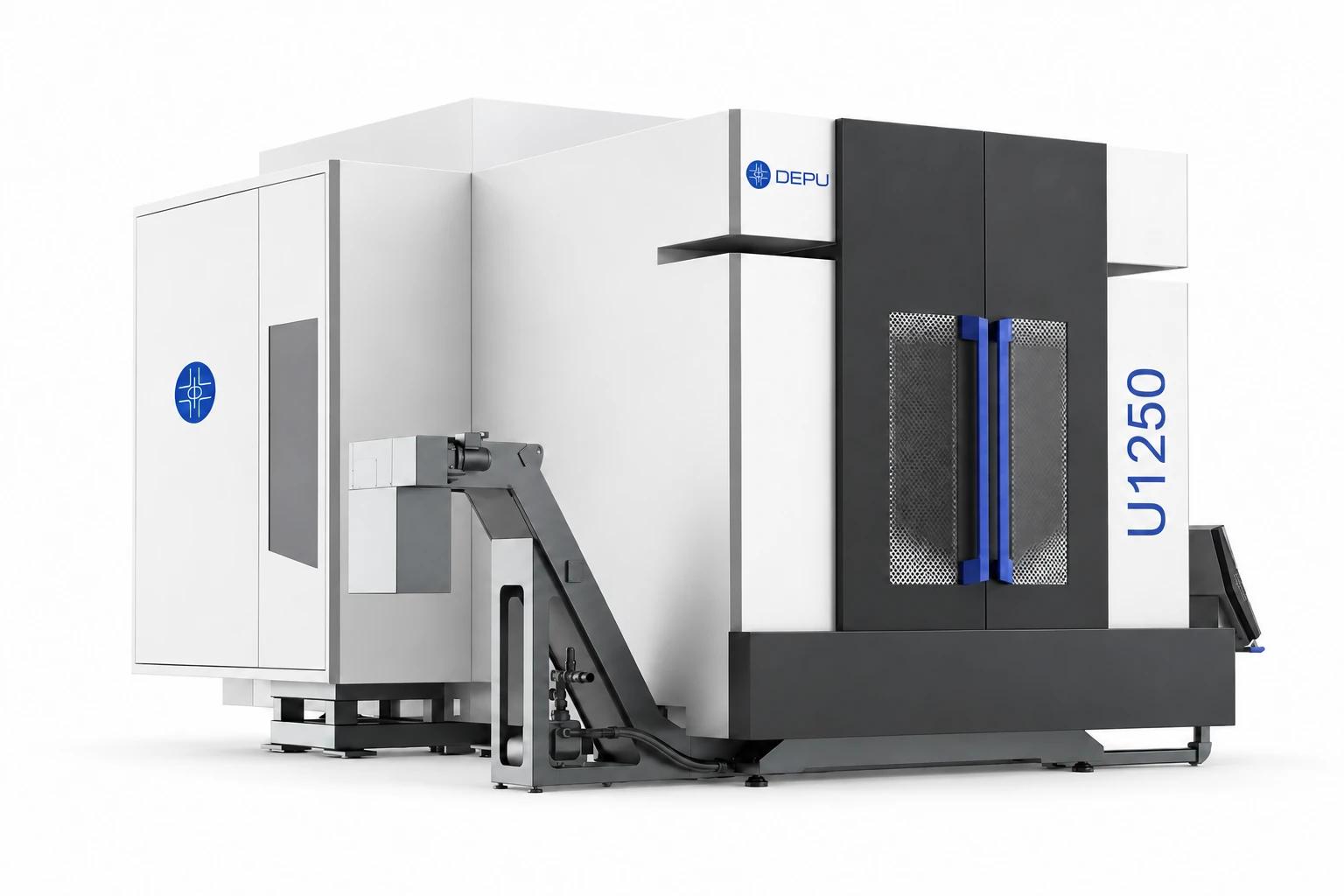
At DEPU, both our U-Series tilting-head centers and G-Series gantry 5-axis machines are engineered and laser-calibrated so that RTCP kinematics stay true under real-world industrial cutting loads.
Frequently Asked Questions (FAQ)
Is RTCP used in 3+2 indexed machining or only simultaneous 5-axis?
While RTCP is essential for simultaneous 5-axis machining, many shops also use tilted workplane cycles (such as G68.2 or CYCLE800) for 3+2 indexed positioning to achieve the same fixture-independent flexibility.
Does turning on RTCP slow down my cycle time?
No. In fact, RTCP often shortens overall production time by eliminating repetitive CAM reposting, reducing setup time on the shop floor, and maintaining smoother feed rates around tight corners.
How often should 5-axis RTCP kinematics be calibrated?
Most precision shops verify rotary pivot offsets after machine installation, following any spindle collision, or every 6–12 months using ballbar or probing calibration routines (such as KinematicsOpt).
Originally published by DEPU on 18 Nov 2026.