
Understanding the Difference Between 3+2 and Simultaneous 5-Axis Machining
In modern precision manufacturing, 5-axis machining has become an essential technology for producing complex components used in aerospace, medical, automotive, semiconductor, and mold industries.
However, many manufacturers are still confused about the difference between 3+2 machining and simultaneous 5-axis machining.
Although both methods use five axes, their machining principles, capabilities, and applications are fundamentally different.
What Is 3+2 Machining?
3+2 machining, also known as positional 5-axis machining, uses a traditional three-axis machining process combined with two additional rotary axes.
The workflow is:
- The rotary axes rotate the workpiece or tool to a specific angle.
- The rotary axes lock into position.
- The machine performs normal 3-axis cutting.
During cutting:
- X-axis moves left and right
- Y-axis moves forward and backward
- Z-axis moves up and down
The A/B/C rotary axes remain fixed.
In simple terms:
3+2 machining positions the tool from different angles, but does not continuously move all five axes during cutting.
What Is Simultaneous 5-Axis Machining?
Simultaneous 5-axis machining allows all five axes to move at the same time during cutting.
The machine continuously controls:
- X-axis
- Y-axis
- Z-axis
- Rotary axis A
- Rotary axis B/C
The cutting tool can smoothly follow complex surfaces while maintaining the optimal tool angle.
This enables:
- Complex curved surface machining
- Continuous contouring
- Better surface finish
- Reduced machining time
Key Differences Between 3+2 and Simultaneous 5-Axis Machining
| Feature | 3+2 Machining | Simultaneous 5-Axis Machining |
|---|---|---|
| Rotary movement | Fixed during cutting | Continuous movement |
| Axis movement | 3 axes cutting | All 5 axes moving |
| Programming difficulty | Easier | More advanced |
| Surface quality | Good | Excellent |
| Complex geometry | Limited | Excellent |
| Setup time | More setups required | Fewer setups |
| Accuracy | Good | Higher consistency |
| Tool access | Multiple angles | Any angle continuously |
| Suitable parts | Simple angled features | Complex freeform surfaces |
1. Machining Complexity
3+2 Machining
3+2 is suitable for parts requiring:
- Multiple side machining
- Angled holes
- Simple inclined surfaces
Examples:
- Brackets
- Fixtures
- Basic aerospace components
However, it has limitations when machining:
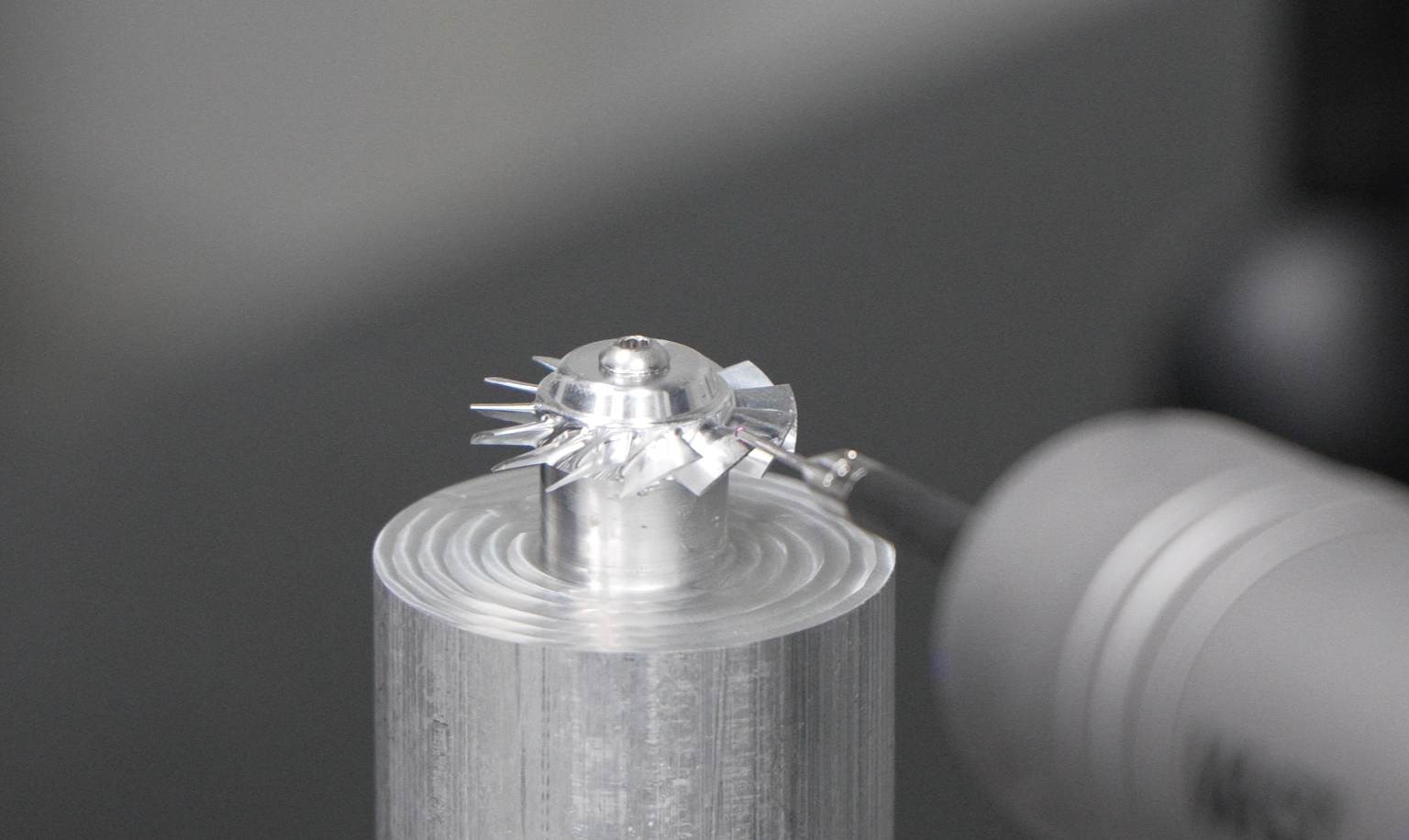
- Impellers
- Blades
- Medical implants
- Complex molds
Simultaneous 5-Axis Machining
True 5-axis machining is designed for complex geometries.
Typical applications:
Aerospace
- Turbine blades
- Structural components
- Engine parts
Medical
- Dental implants
- Surgical tools
- Orthopedic components
Semiconductor
- Precision test fixtures
- Wafer inspection components
2. Surface Finish and Accuracy
One major advantage of simultaneous 5-axis machining is improved tool orientation control.
During machining, the cutting tool can maintain the optimal angle relative to the surface.
Benefits:
- Reduced vibration
- Stable cutting conditions
- Better surface finish
- Longer tool life
For high-value parts requiring precision machining, this difference is significant.
3. Workpiece Setup and Accuracy
With traditional machining:
A complex part may require:
- First setup
- Second setup
- Third setup
- Manual repositioning
Each setup introduces potential errors.
A true 5-axis CNC machine can complete more operations in one setup.
Advantages:
- Reduced fixture errors
- Improved positional accuracy
- Shorter production time
4. Programming Difference
3+2 Machining
Advantages:
- Easier programming
- Lower CAM requirements
- Suitable for standard machining operations
Simultaneous 5-Axis Machining
Requires:
- Advanced CAM software
- Experienced programmers
- Better machine control
Common CAM systems:
- Siemens NX
- Mastercam
- hyperMILL
- PowerMill
Why Choose Simultaneous 5-Axis Machining?
For manufacturers producing:
- Complex geometries
- High-value components
- Small batch production
- Customized precision parts
simultaneous 5-axis machining provides greater flexibility.
Main advantages:
1. One-time clamping
Complete multiple surfaces without repositioning.
2. Better precision
Reduce accumulated positioning errors.
3. Higher efficiency
Reduce setup time and improve production workflow.
4. Better surface quality
Maintain ideal cutting angles.
Is 3+2 Machining Enough?
The answer depends on the application.
Choose 3+2 machining when:
✔ Parts have simple angled features
✔ Cost efficiency is the priority
✔ Complex surface machining is not required
Choose simultaneous 5-axis machining when:
✔ Parts have complex curves
✔ Tight tolerances are required
✔ Multiple setups affect accuracy
✔ High-value materials are used
DEPU True 5-Axis CNC Solution
DEPU five-axis machining centers are designed for manufacturers requiring:
- High precision
- Complex part machining
- Stable long-term performance
With true simultaneous 5-axis capability, DEPU machines support industries including:
- Aerospace
- Medical
- Semiconductor
- Automotive
- Precision mold manufacturing
Products such as DEPU G300, G630, and G800 five-axis machining centers provide the flexibility required for modern precision manufacturing.
FAQ
1. Is 3+2 machining considered true 5-axis machining?
No. Although it uses five axes, only three axes move during cutting. True 5-axis machining requires simultaneous movement of all five axes.
2. Is simultaneous 5-axis machining more expensive?
Yes, because it requires advanced machine structures, CNC systems, and CAM programming. However, it can reduce setup time and improve productivity.
3. Which industries need simultaneous 5-axis machining?
Industries such as aerospace, medical, semiconductor, and high-precision manufacturing commonly use simultaneous 5-axis CNC machines.
4. Can a 5-axis machine replace a 3-axis machine?
For many complex applications, yes. However, simple machining operations may still be more economical on a 3-axis machine.
Conclusion
The difference between 3+2 machining and simultaneous 5-axis machining is not simply the number of axes available, but how those axes work together.
3+2 machining provides multi-angle positioning, while simultaneous 5-axis machining enables continuous motion and advanced complex part manufacturing.
For manufacturers pursuing higher accuracy, shorter production cycles, and greater flexibility, a true 5-axis CNC machine is the future of precision machining