
What Does the Fourth Axis Actually Do?
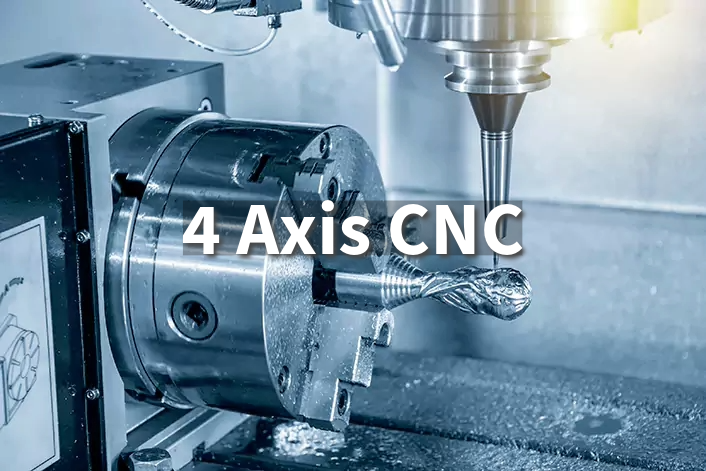
A fourth axis adds a controlled rotary movement to the machine. It is commonly identified as an A-axis, B-axis, or C-axis:
-
A-axis: Rotation around the X-axis.
-
B-axis: Rotation around the Y-axis.
-
C-axis: Rotation around the Z-axis.
The letter depends on the machine’s rotary-axis orientation. A vertical milling machine with a horizontal rotary attachment, for example, may use an A-axis. Other machine layouts may use a B-axis or C-axis.
The rotary movement can be provided by a CNC rotary table, an integrated rotary unit, or another machine-specific arrangement. Depending on the design, the workpiece, cutting tool, or both may move to create the required relative motion.
The practical benefit is access. Instead of machining one side, removing the part, and setting it up again to reach another side, you can rotate the workpiece while it remains clamped.
However, the fourth axis only adds rotation around one direction. It does not give you unrestricted access to every surface or feature.
Indexed vs. Simultaneous 4-Axis Machining
One of the most important things to check when evaluating a 4-axis CNC machine is how its rotary axis operates. A machine may support indexed positioning, simultaneous four-axis interpolation, or both.
Indexed 4-Axis Machining
Indexed machining is also called positional or 3+1-axis machining.
The rotary axis moves the workpiece to a programmed angle and holds it there. The machine then performs the cutting operation using its three linear axes.
Consider a square bar with holes or milled flats on several longitudinal faces. A rotary attachment can turn the bar to the required positions so the spindle can machine each face without the operator removing and reclamping the part.
This approach is useful for:
-
Drilling holes at different angular positions.
-
Milling flats on multiple sides of a component.
-
Machining features around a shaft or housing.
-
Producing repeated features at defined rotary positions.
The main advantage is more controlled access to multiple sides in one setup. You still need to check whether the tool can reach each feature and whether the fixture leaves enough clearance.
Simultaneous 4-Axis Machining
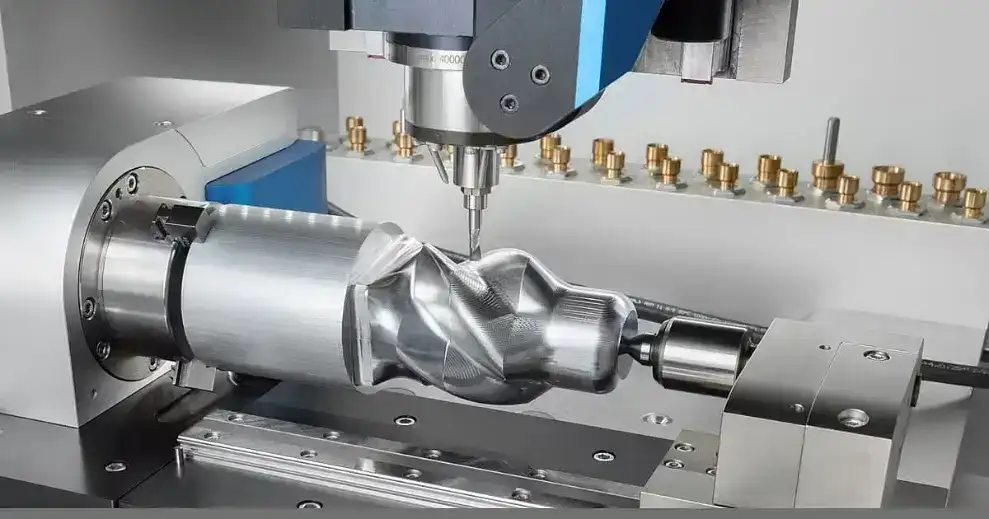
In simultaneous four-axis machining, the rotary axis moves while cutting is taking place. The CNC controller coordinates the rotary movement with the X, Y, and Z axes to follow the programmed toolpath.
A typical example is a helical groove on a cylindrical workpiece. The part rotates while the cutting tool moves along its length, creating a continuous path around the surface.
Other possible applications include:
-
Spiral and helical features.
-
Certain cam profiles.
-
Continuous contours around cylindrical components.
-
Parts that require coordinated rotary and linear movement.
This capability depends on the complete machining system. A rotary table alone does not guarantee simultaneous four-axis machining. The CNC controller, servo drives, machine configuration, CAM software, and postprocessor must all support the intended operation.
How the Two Modes Compare
| Factor | Indexed 4-Axis | Simultaneous 4-Axis |
|---|---|---|
| Rotary movement | Moves to a programmed position, then holds | Moves during cutting |
| Cutting axes | Linear axes perform the cut at each position | Linear and rotary axes move in coordination |
| Typical applications | Multiple faces, angular holes, repeated positions | Helical grooves and continuous rotary contours |
| Programming | Generally simpler | Requires coordinated multi-axis toolpaths |
| Main consideration | Positioning, work offsets, and setup | Synchronization, toolpath control, and collision avoidance |
Swipe to compare →
If your parts only need features machined at several fixed angles, indexed four-axis machining may be enough. You do not need simultaneous movement just because a part has features on multiple sides.
What Parts Can You Machine With a 4-Axis CNC Machine?
A four-axis milling machine is particularly useful when features are distributed around one primary rotary direction. The following examples illustrate where it can help.
Shafts and Bar-Type Components
A rotary axis can present different longitudinal faces of a shaft or bar to the cutting tool.
For example, you may need to mill flats, drill cross-holes, or machine angular features along the length of a component. Indexing the workpiece can reduce manual repositioning and help maintain the relationship between features.
The actual result depends on the part’s length, fixture arrangement, rotary-axis capacity, and available tool clearance.
Housings and Components With Circumferential Features
Some housings and mechanical components have holes, slots, or other features arranged around a central axis.
A rotary table can position these features for machining. If the toolpath follows a continuous path around the component, simultaneous four-axis movement may be useful.
For parts with features on several different faces, check whether one rotary direction provides the required tool access. Some features may still need another setup.
Helical Grooves and Spiral Features
Helical grooves are a clear example of where simultaneous four-axis machining can be useful.
The workpiece rotates while the cutting tool moves along its length. The coordinated movement produces a path that wraps around the part.
Whether a four-axis milling setup is the best approach depends on the groove geometry, workpiece material, tooling, and required surface quality. Some rotational parts may be more appropriately produced on a CNC lathe or mill-turn machine.
Certain Cam Profiles and Specialized Components
Some cam profiles and other specialized parts require coordinated rotation and cutting movement. A four-axis machine may be suitable when the geometry can be generated around one rotary direction.
If the profile requires the tool to approach the workpiece from multiple compound angles, one rotary axis may not provide enough flexibility.
The key is to evaluate the actual geometry and tool approach—not just the part’s general shape.
Where Does 4-Axis Machining Reach Its Limits?
A fourth axis can reduce repositioning, but it cannot solve every tool-access problem. Before choosing a machine, consider the following limitations.
One Rotary Axis Cannot Provide Every Tool Orientation
A four-axis machine rotates the workpiece or tool around one direction. Features that require a different approach direction may remain inaccessible.
For example, imagine a long square bar mounted along a horizontal rotary axis. You can rotate its four longitudinal faces toward a vertical spindle. But rotating the bar does not necessarily make a hole entering its end accessible to that same vertical tool approach.
You may need another setup, a different fixture, specialized tooling, or a machine with an additional rotary axis.
Compound-Angle Features May Require More Movement
A part may have holes or surfaces oriented in several different directions. If those directions cannot be reached by rotating around one axis, a four-axis machine may require additional setups.
A five-axis machine, with two rotary axes, can provide more freedom to change the relative orientation between the tool and workpiece. Whether it can reach a specific feature still depends on its rotary range, machine layout, tooling, and clearance.
Workholding Can Restrict Access
The rotary table, chuck, fixture, and workpiece all occupy space inside the machine. As the part rotates, its full swept volume must clear the spindle, cutting tool, enclosure, and other machine components.
Before machining a large or irregular workpiece, check:
-
Maximum workpiece dimensions.
-
Rotary-table load capacity.
-
Fixture and chuck dimensions.
-
Clearance throughout the required rotation.
-
Potential collisions between the tool, holder, fixture, and workpiece.
A component that fits on the rotary table in its starting position may not have enough clearance to rotate through the entire machining range.
Programming and Setup Require Additional Planning
Indexed four-axis machining requires correct rotary positioning and work-coordinate setup. Simultaneous machining adds the need to coordinate rotary and linear movement throughout the toolpath.
Your team also needs to account for tool orientation, collision risks, postprocessor configuration, and the machine’s actual kinematics.
The more demanding the part geometry, the more important it becomes to verify the machining strategy before production.
3-Axis vs. 4-Axis vs. 5-Axis CNC Machining
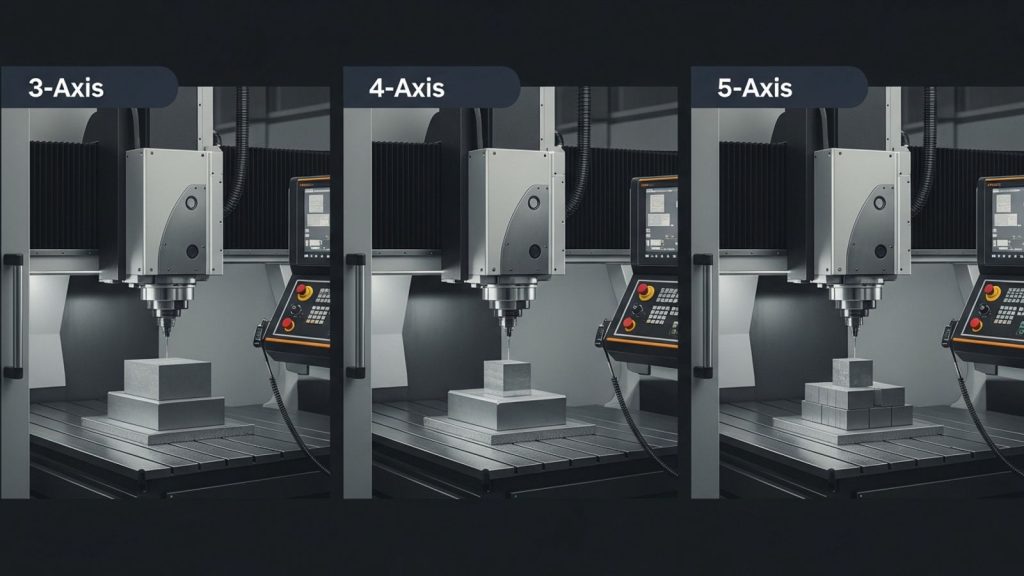
The difference between these machine types is not simply how many directions they can move. It is how much freedom they give you to position the cutting tool relative to the workpiece while it remains clamped.
| Factor | 3-Axis CNC | 4-Axis CNC | 5-Axis CNC |
|---|---|---|---|
| Controlled movements | X, Y, Z | X, Y, Z plus one rotary axis | X, Y, Z plus two rotary axes |
| Rotary positioning | None in the standard milling configuration | One rotary direction | Two rotary directions |
| Multiple-side access | Often requires additional setups | Can reach multiple positions around one rotary direction | Can reach a wider range of orientations |
| Indexed machining | Not applicable to the standard three-axis setup | Yes, if configured | Yes, if configured |
| Simultaneous machining | Three-axis interpolation | Can support four-axis interpolation | Can support five-axis interpolation |
| Typical applications | Prismatic parts, pockets, holes, and accessible contours | Shafts, bar-type components, radial features, and helical paths | Complex angled features, freeform surfaces, and difficult-to-reach geometry |
| Programming and setup | Generally simpler | More involved, depending on the operation | Generally more demanding |
Swipe to compare →
When Is a 5-Axis Machine Worth Considering?
A five-axis machine adds a second rotary direction. Depending on its architecture, that movement may come from a tilting rotary table, a swivel head, or a combination of table and head movements.
This additional freedom can help you:
-
Reach features on differently inclined surfaces.
-
Machine complex compound-angle geometry.
-
Access certain deep cavities and undercuts.
-
Maintain a suitable tool orientation along complex surfaces.
-
Reduce repositioning when a part requires several machining orientations.
However, a five-axis machine is not automatically faster, more accurate, or more economical for every part. A simpler four-axis setup may be more practical when all required features can be reached around one rotary direction.
Also distinguish between indexed 3+2 machining and simultaneous five-axis machining. In 3+2 machining, the rotary axes position the tool or workpiece and hold that orientation while the linear axes cut. In simultaneous five-axis machining, rotary and linear movements can be coordinated during cutting. The appropriate method depends on the part geometry and machining strategy.
How to Choose Between a 4-Axis and 5-Axis CNC Machine
If you’re purchasing equipment for a production facility, start with the parts you actually manufacture. The following process can help you make a more practical decision.
Step 1: Map the Feature Directions on Your Part
Review your engineering drawings or 3D models. Identify the approach direction required for every important feature.
Ask:
-
Are the features arranged around one central axis?
-
Do you need to machine several longitudinal faces?
-
Are there holes on multiple angled surfaces?
-
Do you have compound angles or undercuts?
-
Does the tool need to change orientation continuously along a surface?
If one rotary direction can expose all the required features, a four-axis machine may be sufficient.
If the part requires several different tool orientations, consider whether a five-axis machine can reach them more effectively.
Step 2: Check Whether You Need Indexing or Continuous Movement
Not every four-axis job requires simultaneous movement.
If you only need to drill holes at fixed angular positions, indexed machining may be enough. If you need to machine a continuous helical or rotary contour, check whether simultaneous four-axis interpolation is required.
This distinction affects the machine configuration, CNC control, CAM software, and programming work you need.
Step 3: Review Workholding and Machine Clearance
A machine may have enough nominal travel but still be unsuitable for your part because of fixture interference or rotary-table limitations.
Check the complete setup, including:
-
Workpiece dimensions and weight.
-
Fixture and chuck size.
-
Rotary-axis range.
-
Tool and holder length.
-
Clearance during the full rotary movement.
-
Access to the surfaces that must remain clamped.
For large or heavy parts, rotary-table load capacity and machine rigidity deserve particular attention.
Step 4: Compare Your Production Requirements
Consider your production mix, batch sizes, changeover frequency, and expected machine utilization.
A four-axis machine may be a sensible choice for repeated production of parts with features around one rotary direction.
A five-axis machine may be more useful if you regularly manufacture complex components with multiple angled surfaces or changing tool orientations.
If your production includes both simple and complex parts, estimate how often you will actually use the additional five-axis capability. Do not base the investment decision only on the most complicated part you occasionally produce.
Step 5: Calculate Total Manufacturing Cost
Compare more than the purchase price. Include:
-
Machine purchase and installation.
-
Rotary fixtures, tooling, and workholding.
-
CAM software and postprocessor development.
-
Operator and programmer training.
-
Setup and changeover time.
-
Maintenance and calibration.
-
Scrap and rework.
-
Labor and machining cycle time.
A five-axis machine may justify its higher investment if it removes several setups or makes difficult parts practical to produce. For simpler work, a four-axis machine may deliver the required capability with a less complex process.
The best choice is the machine that meets your part requirements and production targets at an acceptable total cost.
What Should You Check Before Buying a 4-Axis CNC Machine?
Once you’ve confirmed that four-axis machining suits your parts, evaluate the complete machine system rather than focusing only on the rotary axis.
Rotary-Axis Performance
Ask the manufacturer for the rotary axis’s movement range, positioning specifications, and repeatability. Make sure the information applies to the exact machine configuration you plan to purchase.
If your process requires simultaneous four-axis machining, request confirmation that the CNC control and servo system support it.
Workpiece Capacity and Load
Check the rotary table’s load capacity and the maximum workpiece dimensions. Include the weight and dimensions of the fixture, chuck, and other workholding components in your assessment.
Also ask how the manufacturer defines its load rating and whether it applies to your intended workpiece arrangement.
CNC Controller and CAM Compatibility
Confirm that the controller supports your required machining mode. For simultaneous four-axis work, check that your CAM software and postprocessor can generate the correct toolpaths for the machine’s kinematics.
A rotary attachment, a CNC-controlled fourth axis, and a system capable of continuous four-axis interpolation are not necessarily the same thing.
Machine Rigidity and Accuracy
Evaluate the machine structure, spindle performance, axis drive systems, thermal behavior, and installation requirements.
For precision components, ask how positioning accuracy and repeatability are measured and verified. You should also understand the machine’s calibration and maintenance requirements.
Technical Support and Training
Your team may need help with rotary-axis setup, work-coordinate configuration, CAM programming, and collision checking.
Before purchasing, clarify what commissioning, operator training, programming support, maintenance guidance, and after-sales service the manufacturer provides.
How DEPU Approaches High-End 5-Axis CNC Manufacturing
If your parts require more than one rotary direction, a five-axis machining center may be worth evaluating.
Founded in 2014, DEPU Group focuses on the research, development, manufacturing, and sales of high-end five-axis CNC machine tools and core components. According to the company’s published information, its core team has more than 20 years of machine-tool R&D and manufacturing experience, with backgrounds at leading machine-tool companies in China and abroad.
DEPU operates a global R&D center in Shenzhen and maintains its global headquarters and manufacturing base in Haining, Jiaxing, Zhejiang. The company reports that these facilities cover more than 30,000 m² in total.
For heavy-duty, high-precision machine tools, the installation environment also matters. DEPU reports that its Haining facility uses a high-load-bearing foundation solution, supported by controlled construction and inspection procedures. According to the company, differential settlement among equipment support points is controlled at the micrometer level during assembly, commissioning, and machining tests.
When you evaluate a high-end CNC machine, consider more than its axis count. Machine structure, manufacturing quality, installation conditions, calibration, and long-term stability all contribute to whether the equipment can meet your production requirements.
If you’re comparing four-axis and five-axis equipment, DEPU recommends starting with the part drawing or 3D model, material and tolerance requirements, batch size, and cycle-time target. These details help establish the working envelope, rotary movement, and machine configuration your application actually needs.
Conclusion
A 4-axis CNC machine is a practical choice when your parts require machining around one primary rotary direction. It can help you access multiple sides, machine angular features, and produce certain continuous rotary contours without repeatedly removing and repositioning the workpiece.
Its main limitation is that one rotary axis cannot provide every tool orientation. If your parts require compound angles, complex freeform surfaces, or access from several different directions, a five-axis machine may be a better fit.
Before purchasing, review your part geometry, required machining mode, workholding, machine clearance, and total manufacturing cost. Choosing the right CNC machine means matching its actual capabilities to the work you need to produce—not simply choosing the machine with more axes.
FAQ
Is a 4-axis CNC machine better than a 3-axis machine?
Not necessarily. A four-axis machine adds a rotary movement that can help you machine multiple sides or features around a workpiece without manually repositioning it.
For simpler parts that can be completed efficiently with three linear axes, a three-axis machine may be more economical and easier to program. The right choice depends on your part geometry and production requirements.
Can all four axes move at the same time?
Some four-axis CNC machines support simultaneous movement of the three linear axes and the rotary axis. Others use the rotary axis mainly for indexed positioning.
You need to confirm the machine’s CNC control, servo configuration, and CAM compatibility before assuming it supports continuous four-axis interpolation.
What is the difference between a fourth axis and a fifth axis?
A typical four-axis milling machine has three linear axes and one rotary axis. A typical five-axis machine has three linear axes and two rotary axes.
The fifth axis provides another direction of rotation, allowing the machine to change the relative orientation between the tool and workpiece more freely. This is useful for many compound-angle features and complex surfaces.
Can a 4-axis CNC machine machine complex surfaces?
It can machine certain curved, helical, and rotary features, especially when the geometry is organized around its rotary axis.
However, complex surfaces that require the cutting tool to approach from several different directions may need five-axis machining. The actual requirement depends on the surface geometry, tool access, and machine configuration.
Is a 4-axis CNC machine suitable for aerospace parts?
It can be suitable for certain aerospace components, including shafts and other parts with features distributed around one primary axis.
Other aerospace components may have complex compound angles, deep cavities, or freeform surfaces that require greater tool-orientation flexibility. Evaluate the actual part drawings and machining strategy before selecting the equipment.
Does adding a fourth axis automatically improve accuracy?
No. An additional axis does not automatically make a machined part more accurate.
A fourth axis can help preserve the relationship between features by reducing the need to remove and manually reposition a workpiece. However, the final result still depends on machine accuracy, rotary-axis performance, workholding, calibration, thermal conditions, and the machining process.
Is a 5-axis CNC machine worth the extra investment?
It can be worthwhile when your parts require complex tool orientations, multiple angled surfaces, or machining strategies that benefit from fewer setups.
However, five-axis equipment is not automatically more cost-effective for every job. Compare the total cost of producing your parts, including programming, tooling, setup, cycle time, labor, and maintenance.
Originally published by DEPU on 23 Nov 2026.