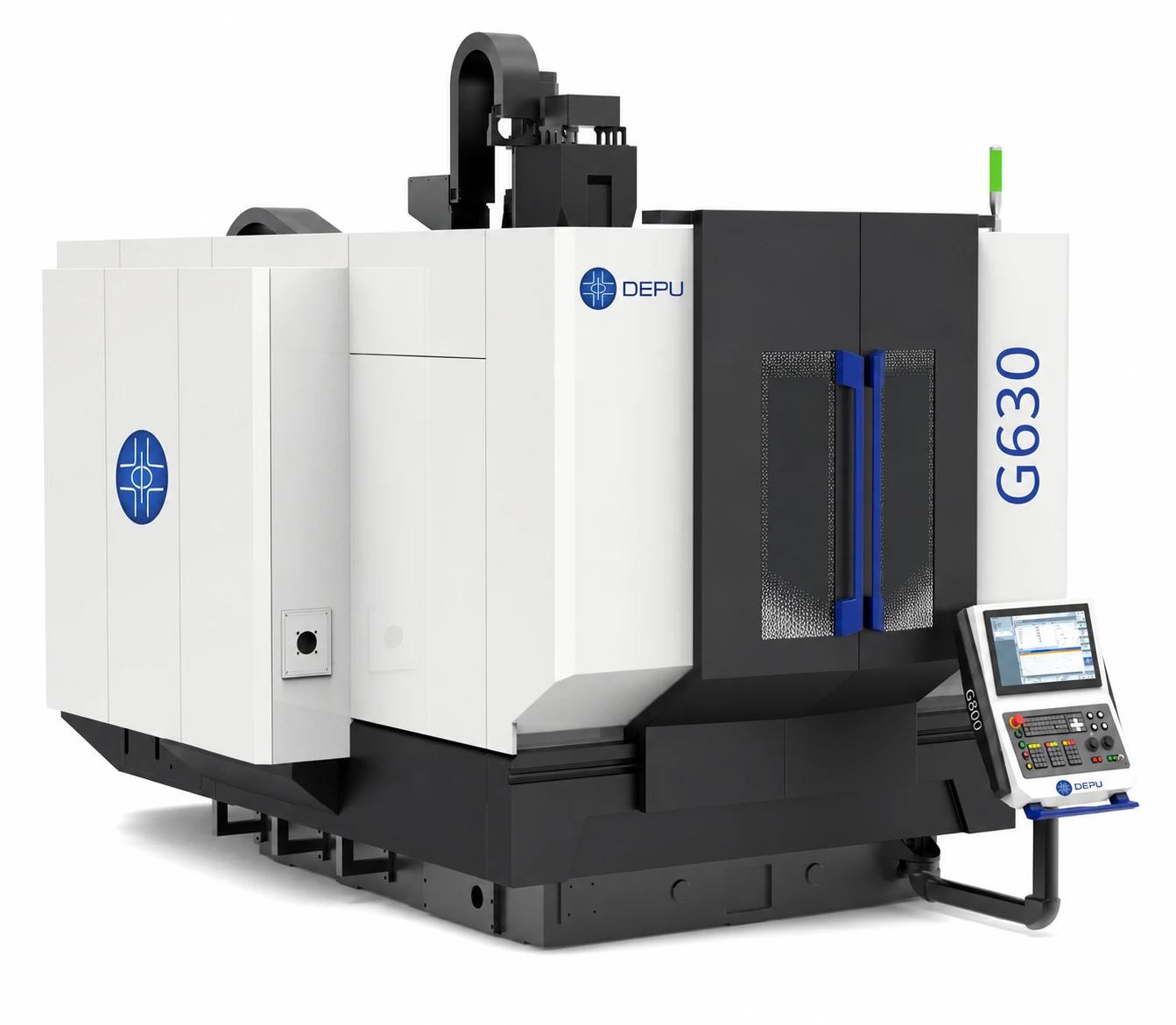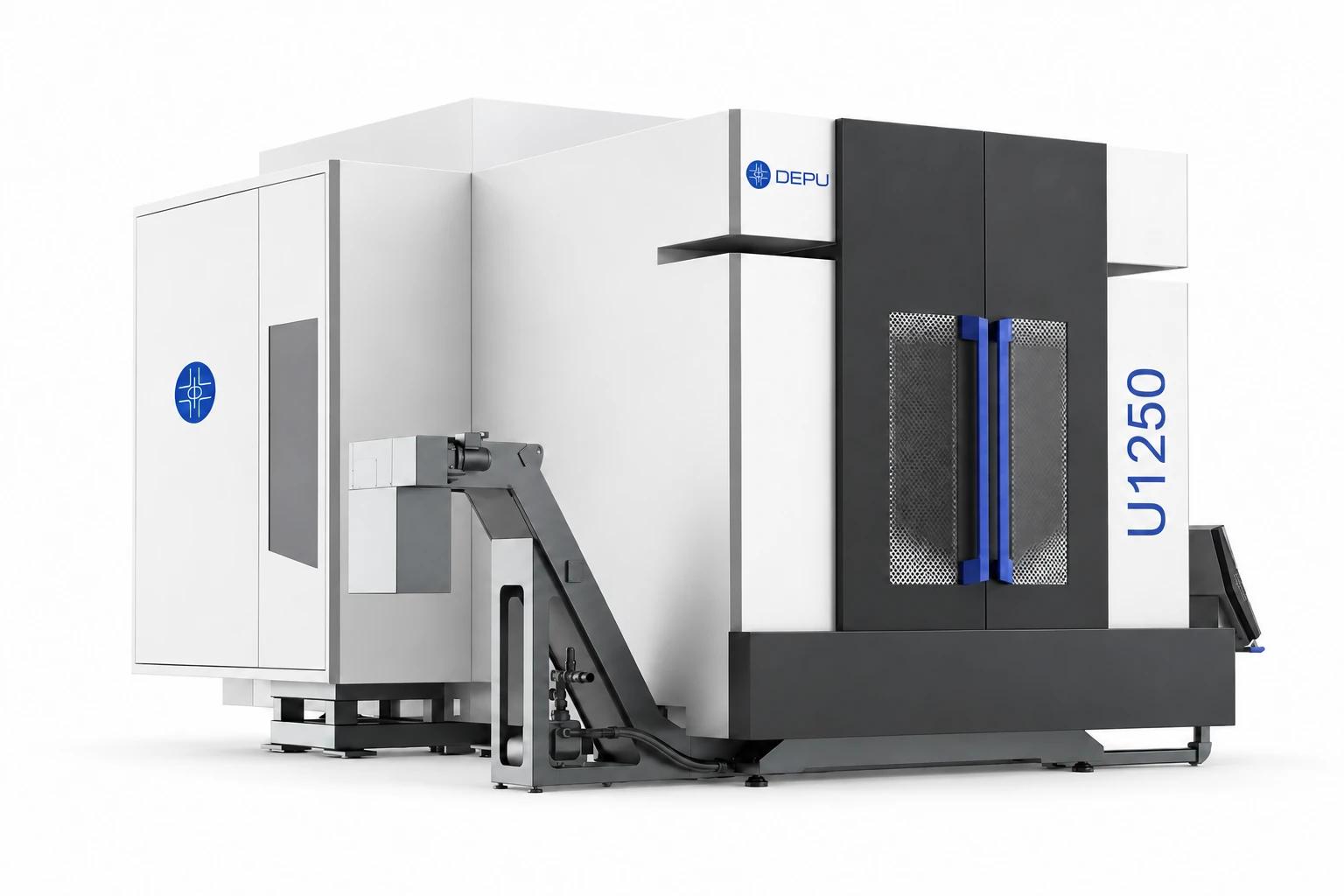
These limitations do not make five-axis machining a poor investment. They mean you need to evaluate whether its capabilities solve real production problems in your shop. For simple parts, a three-axis machine may be more economical. For complex molds, aerospace components, medical parts, and contoured surfaces, the benefits of five-axis machining may justify the additional investment.
Here are the main disadvantages you should consider before purchasing a five-axis CNC machine or introducing five-axis machining into your production process.
1. Higher Initial Investment
One of the biggest disadvantages of five-axis machining is its higher purchase cost compared with a comparable three-axis machine.
A five-axis machining center requires additional rotary-axis capabilities, sophisticated CNC controls, and a machine structure designed to coordinate multiple axes. Depending on the configuration, you may also need specialized workholding equipment and advanced software.
However, the machine itself is only part of the investment. You should also account for:
-
CAM software: Five-axis programming may require specialized CAM software or additional modules.
-
Tooling and workholding: You may need suitable toolholders, fixtures, vises, and clamping systems.
-
Installation and commissioning: Machine positioning, alignment, calibration, and setup can add to the initial project cost.
-
Training: Your programmers, operators, and maintenance technicians may need additional training.
-
Postprocessor development: Your CAM system needs a postprocessor configured and validated for the specific machine and CNC control.
The total cost of ownership can therefore be considerably higher than the machine’s quoted purchase price.
When does the higher investment make sense?
Five-axis machining is more likely to justify its cost when your production involves:
-
Complex parts with features on multiple sides
-
Deep cavities, angled surfaces, and undercuts
-
Freeform surfaces that require continuous tool orientation
-
Components that need several setups on a three-axis machine
-
Tight positional relationships between features on different faces
If you mainly produce flat plates, simple brackets, or parts with easily accessible features, a three-axis machine may provide better value.
The key is to compare the complete manufacturing cost of representative parts, not just the purchase prices of two machines.
2. More Complex CAM Programming
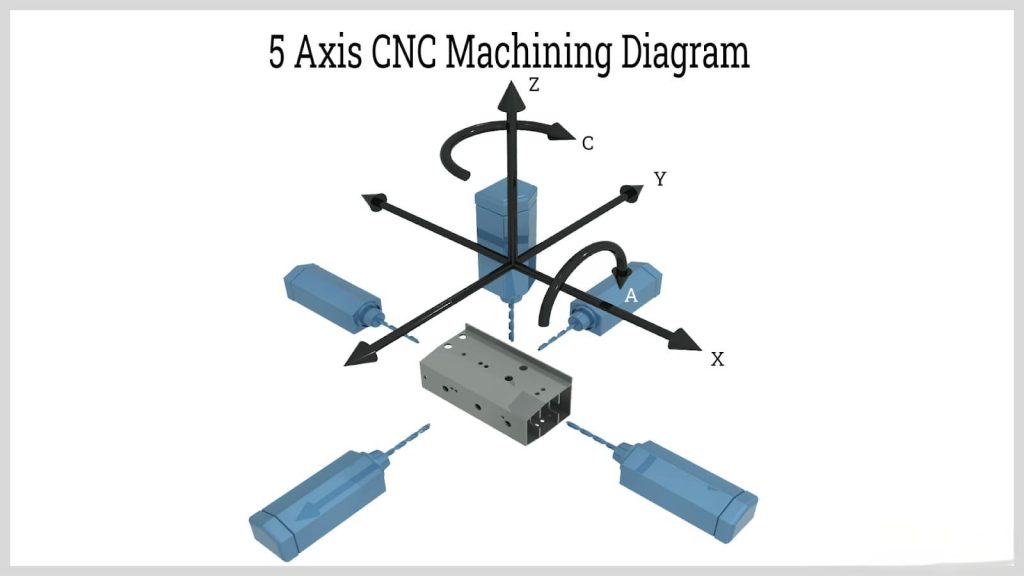
Five-axis machining requires more advanced programming than conventional three-axis milling, particularly when all five axes move simultaneously.
In three-axis machining, the tool generally moves along the X, Y, and Z axes while maintaining a fixed tool orientation. In simultaneous five-axis machining, the machine coordinates its linear and rotary axes to continuously adjust the tool’s position and orientation.
This creates more programming variables.
Your programmer must consider:
-
Tool orientation and tilt angles
-
Rotary-axis limits and machine kinematics
-
Toolholder and fixture clearance
-
Cutting conditions and tool engagement
-
Collision avoidance
-
Postprocessor accuracy
-
Machine-specific motion behavior
A toolpath that appears correct in CAM simulation may not behave as expected on the actual machine if the postprocessor, machine configuration, or kinematic settings are incorrect.
The distinction between 3+2 machining and simultaneous five-axis machining is especially important.
3+2 vs. simultaneous five-axis programming
| Factor | 3+2 machining | Simultaneous 5-axis machining |
|---|---|---|
| Rotary-axis movement | Axes index to a position and remain fixed during cutting | Rotary and linear axes move together |
| Programming complexity | Generally lower | Generally higher |
| Collision considerations | Requires clearance checks | More complex because tool orientation changes during cutting |
| Typical applications | Angled holes, multiple faces, and indexed features | Blades, impellers, and complex freeform surfaces |
| Programming requirements | Often simpler toolpath strategies | More advanced toolpath and machine-kinematic control |
Swipe to compare →
You do not necessarily need simultaneous five-axis programming for every five-axis job. If your parts mainly require machining from several fixed angles, 3+2 positioning may be sufficient.
Siemens’ milling technology documentation recommends using simpler three-axis and 3+2 strategies where the workpiece geometry and machine kinematics allow, while reserving simultaneous five-axis machining for operations that benefit from continuous tool-orientation changes. The documentation also identifies greater programming effort and collision risk as potential challenges of simultaneous machining.
This distinction can help you control programming time and avoid paying for capabilities your parts do not need.
3. Higher Skill Requirements for Operators and Programmers
Buying a five-axis machine does not automatically give your shop five-axis manufacturing expertise.
Your team needs to understand more than basic CNC operation. Programmers must be familiar with tool orientation, rotary-axis behavior, machine kinematics, and collision avoidance. Operators need to understand workpiece positioning, fixture clearance, tool setup, and the machine’s operating limits.
Maintenance personnel may also need additional knowledge of rotary-axis systems, feedback devices, and machine calibration.
This can create several practical challenges:
-
Experienced five-axis programmers may be harder to recruit.
-
Training existing employees takes time and resources.
-
New programs may require more careful verification before production.
-
Troubleshooting can be more demanding when problems involve coordinated axis movement.
-
Production may depend heavily on a small number of experienced employees.
For a small or medium-sized machine shop, this skill gap can become a serious operational issue.
How to evaluate your team’s readiness
Before investing in five-axis equipment, consider whether you have:
-
A programmer with relevant five-axis CAM experience.
-
Operators who understand rotary-axis positioning and workholding.
-
A reliable process for program verification and machine prove-out.
-
Access to technical support and training from the machine supplier.
-
A plan for maintaining programming knowledge across the team.
If you do not have these capabilities yet, include training and implementation time in your investment plan.
4. Higher Risk of Tool and Machine Collisions
Collision risk is another important disadvantage of five-axis machining.
With additional rotary movement, the tool, spindle, workpiece, fixture, and machine structure can move through a more complex range of positions. A tool that clears the workpiece in one orientation may collide with a fixture, rotary table, spindle housing, or another machine component after the tool angle changes.
The risk is particularly relevant when machining:
-
Deep cavities and narrow openings
-
Complex curved surfaces
-
Large workpieces mounted on rotary tables
-
Parts requiring long tools or extended toolholders
-
Jobs with complicated fixtures or limited clearance
A collision can damage the cutting tool, workpiece, spindle, fixture, or machine components. It can also interrupt production and require inspection before machining resumes.
Why CAM simulation matters
A proper five-axis CAM simulation should account for the actual machine configuration, not just the cutting tool and workpiece.
Before running a new program, you should verify:
-
The machine model matches the actual machine.
-
The postprocessor is configured for the correct kinematics.
-
The tool and toolholder geometry are accurate.
-
Fixtures and clamping components are included in the simulation.
-
Rotary-axis travel and machine limits are respected.
-
Potential collisions are checked throughout the toolpath.
For new or high-risk programs, a controlled prove-out process and careful dry run can provide another layer of protection.
Simulation reduces risk, but it does not guarantee that every real-world collision will be detected. Its reliability depends on the accuracy of the machine model, tooling data, fixture data, and postprocessor.
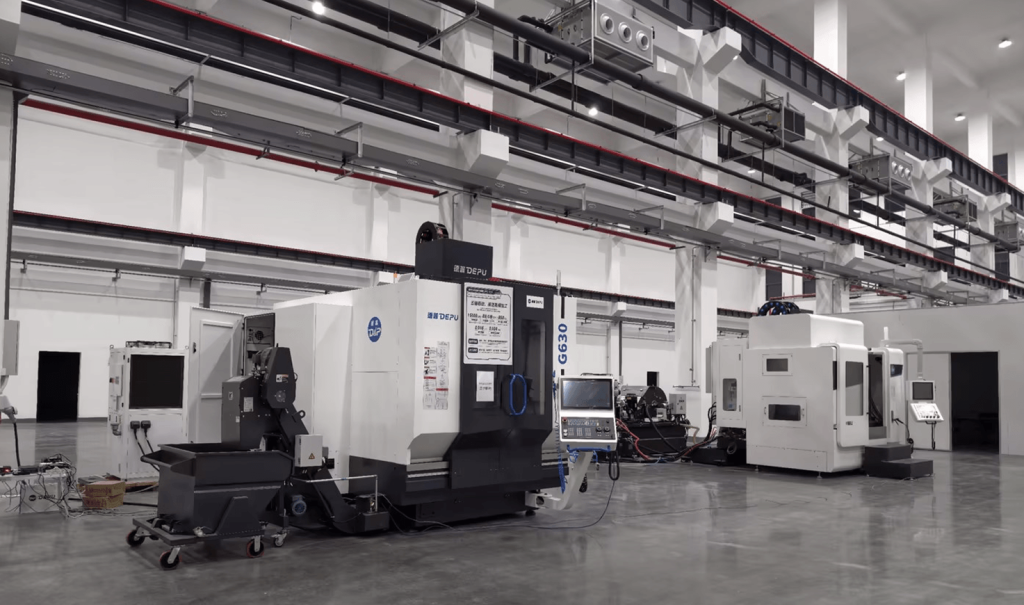
5. More Complex Maintenance and Calibration
A five-axis machine has additional rotary-axis systems and control functions compared with a conventional three-axis configuration.
Depending on the machine design, these systems may involve rotary bearings, drive systems, encoders, brakes, and additional feedback and compensation functions.
These components introduce more areas that may require inspection, adjustment, and technical support.
For example, your maintenance team may need to pay attention to:
-
Rotary-axis positioning and repeatability
-
Rotary-axis backlash and mechanical condition
-
Encoder and feedback-system performance
-
Machine geometry and kinematic calibration
-
Lubrication and cooling systems
-
Thermal behavior during extended machining cycles
Calibration is particularly important because rotary-axis errors can affect the position of the cutting tool relative to the workpiece.
A machine may still appear to move normally while producing dimensional deviations that are difficult to identify without appropriate measurement procedures.
However, this does not mean every five-axis machine requires frequent recalibration or will have higher maintenance costs by a fixed amount. Actual maintenance requirements depend on the machine design, usage, operating environment, service history, and maintenance program.
What should you check before buying?
Ask the manufacturer:
-
What routine maintenance is required for the rotary axes?
-
What calibration procedures are recommended?
-
Are diagnostic tools or calibration equipment included?
-
What technical support is available if rotary-axis accuracy changes?
-
Are replacement parts and service technicians readily available?
A clear maintenance plan is just as important as the machine’s advertised machining capabilities.
6. Workholding and Workpiece Size Limitations
Five-axis machining can reduce the number of setups, but it does not eliminate workholding challenges.
In fact, fixturing can become more demanding because the workpiece may rotate or tilt during machining. The fixture must hold the part securely while leaving enough clearance for the tool, spindle, and moving machine components.
This creates several considerations.
Fixture interference
A fixture that works well on a three-axis machine may obstruct the tool or spindle when the workpiece is tilted.
You may need lower-profile fixtures, custom clamping solutions, or a different workpiece orientation.
Workpiece size and weight
The maximum workpiece size is not determined by the machine’s linear travel alone.
You also need to consider:
-
Rotary-table diameter
-
Maximum allowable table load
-
Workpiece center of gravity
-
Available clearance during rotation
-
Fixture dimensions and weight
-
The machine’s usable working envelope
A part may fit within the nominal X, Y, and Z travels but still be unsuitable for machining at certain rotary-axis positions.
This is particularly important when evaluating trunnion-style machines. The table and workpiece rotate together, so the available space can change significantly with the machine’s orientation.
Clamping access
Some parts have features that are difficult to reach even with five-axis movement. Internal passages, enclosed cavities, and surfaces blocked by the workpiece itself may still require different tooling, another setup, or a separate manufacturing process.
Before purchasing a machine, check the complete machining envelope with your actual workpiece and fixture model.
7. More Demanding Accuracy and Thermal Control
One common misconception is that a five-axis machine automatically produces more accurate parts than a three-axis machine.
That is not necessarily true.
Five-axis machining can improve accuracy between features on different faces because you may be able to machine them in one setup rather than repeatedly repositioning the workpiece. Fewer setups can reduce errors introduced by manual handling and re-datuming.
However, the additional rotary axes also introduce potential sources of positioning error.
The final machining accuracy depends on several factors, including:
-
Linear- and rotary-axis positioning accuracy
-
Machine geometry and kinematic compensation
-
Rotary-axis calibration
-
Thermal deformation
-
Spindle and toolholder condition
-
Tool deflection and cutting forces
-
Workpiece clamping and stability
-
Cutting strategy and inspection methods
Thermal behavior also matters. Long machining cycles, changing ambient temperatures, spindle heat, and machine component temperatures can influence dimensional stability.
For complex parts with demanding tolerances, you should evaluate the machine’s actual accuracy and repeatability under relevant operating conditions rather than relying on the number of axes.
What should you ask the manufacturer?
Ask for machine-specific technical information and verification methods, such as:
-
Linear-axis and rotary-axis accuracy specifications
-
Recommended calibration procedures
-
Relevant machine inspection reports
-
Thermal compensation capabilities
-
Accuracy verification under representative working conditions
You should also define which dimensions and geometric tolerances are critical on your parts. A general statement that a machine is “high precision” is not enough to establish whether it can meet your production requirements.
8. Higher Operating Costs for Some Parts
A five-axis machine may reduce production costs for complex components, but it can increase costs when the part does not benefit from its additional capabilities.
Consider a simple aluminum plate with several drilled holes and shallow pockets. If all features are accessible from the top, a three-axis machine may complete the job with straightforward programming and relatively simple workholding.
Using a five-axis machine for the same part may add unnecessary costs:
-
A higher allocated machine cost
-
More programming or setup work than the part requires
-
Additional verification work
-
More complex tooling or fixtures, depending on the setup
-
Machine capacity that could be used for more suitable jobs
The same issue can occur in high-volume production. If a part has simple geometry and a stable manufacturing process, dedicated fixtures and optimized three-axis operations may provide a lower cost per part.
On the other hand, a complex component that requires several setups on a three-axis machine may be more economical on a five-axis machine.
The correct comparison is the total cost per finished part, including programming, setup, machining, inspection, labor, tooling, and rework. Machine-hour rates and actual operating costs vary by shop, machine, and production conditions.
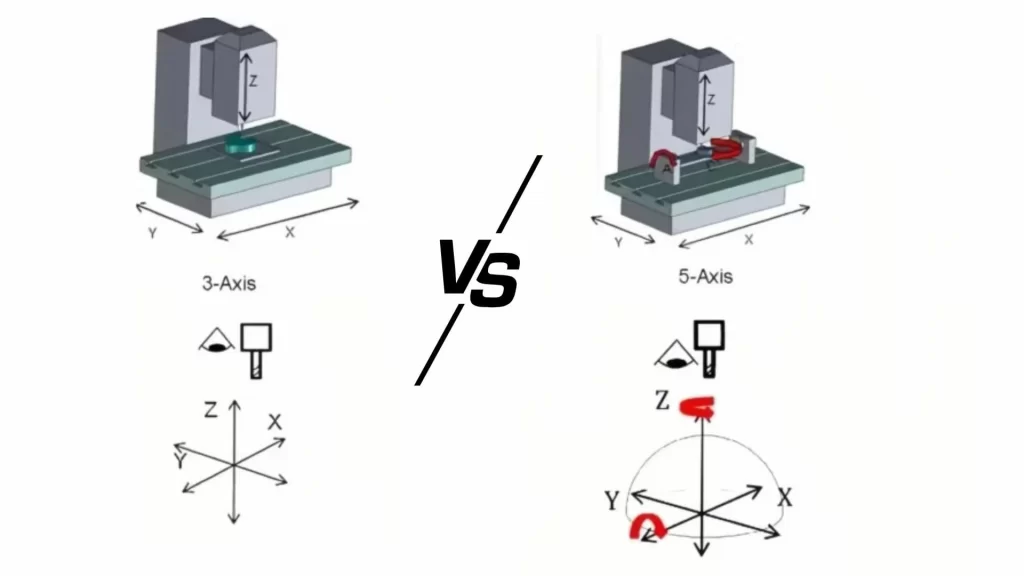
5-Axis vs. 3-Axis Machining: Which Is More Practical?
Neither machine type is automatically better. The right choice depends on your part geometry, production volume, tolerance requirements, and manufacturing resources.
| Comparison | 3-Axis CNC Machining | 5-Axis CNC Machining |
|---|---|---|
| Initial equipment cost | Generally lower | Generally higher |
| Programming | Usually simpler | More demanding, especially for simultaneous machining |
| Workpiece access | Primarily three linear directions | More flexible tool orientation |
| Setup requirements | May require multiple setups for multi-face parts | Can reduce setups for many complex parts |
| Collision considerations | Generally simpler motion envelope | More complex tool and machine clearance |
| Operator skills | Standard CNC machining skills | Additional five-axis knowledge may be needed |
| Best suited for | Simple parts, flat surfaces, and accessible features | Complex geometry, angled features, and contoured surfaces |
Swipe to compare →
Choose 3-axis machining when:
-
Your parts have relatively simple geometry.
-
Most features are accessible from one direction.
-
Your production process is already efficient.
-
You manufacture large quantities of relatively simple components.
-
The additional rotary-axis capability would rarely be used.
Choose 5-axis machining when:
-
Your parts require machining on multiple faces.
-
You need to machine complex contours or freeform surfaces.
-
Multiple setups create significant labor or alignment problems.
-
Tool access is difficult with conventional three-axis machining.
-
You manufacture high-value components where setup reduction matters.
If you are unsure, start by reviewing several representative parts from your current production schedule. Compare the number of setups, machining operations, programming requirements, and total production costs for each machine type.
How to Reduce the Disadvantages of 5-Axis Machining
You cannot eliminate every limitation of five-axis machining, but you can reduce many of its practical effects with the right equipment, processes, and planning.
1. Match the machine configuration to your parts
Five-axis machines come in different configurations, including trunnion-table and swivel-head designs.
A trunnion-style machine rotates the workpiece on a rotary table, while a swivel-head machine changes the tool orientation through the spindle head.
Each design has different advantages and limitations related to workpiece size, weight, access, and machining flexibility.
Do not select a machine based on axis count alone. Check the actual working envelope, rotary travel, table load, spindle configuration, and workpiece clearance.
2. Use 3+2 machining when simultaneous movement is unnecessary
Not every five-axis job requires all five axes to move continuously.
If your part mainly requires machining from several fixed orientations, 3+2 positioning may reduce programming complexity and make the process easier to verify.
Reserve simultaneous five-axis toolpaths for geometries that genuinely require continuous changes in tool orientation.
3. Invest in suitable CAM software and postprocessor validation
Your CAM system should support the machining strategies your parts require.
More importantly, the postprocessor must be correctly configured for the specific machine and control system. A generic postprocessor should not be assumed to produce safe and accurate machine code.
Validate the setup with simulation and controlled prove-out before releasing programs for production.
4. Build a consistent training and verification process
Do not rely on one experienced programmer or operator to manage every five-axis job.
Develop repeatable procedures for:
-
Program verification
-
Tool and fixture setup
-
Collision checks
-
Machine prove-out
-
Workpiece inspection
-
Routine maintenance and calibration
This makes production less dependent on individual employees and helps your team handle new jobs more consistently.
5. Evaluate total manufacturing cost, not just machine price
Before making a purchase, compare the full production process for representative parts.
Include programming, setup, machining, tooling, inspection, labor, maintenance, and expected production volume.
A five-axis machine may have a higher hourly operating cost but still reduce the total cost of a complex part by eliminating multiple setups. For simple parts, the opposite may be true.
Is 5-Axis Machining Worth It for Your Business?
Five-axis machining is worth considering when your production requires complex tool orientations, multi-face machining, or difficult-to-reach surfaces. It can reduce setup operations, improve access to complex geometry, and make certain high-value components more practical to manufacture.
However, the investment may not make sense if your production mainly involves simple parts that a three-axis machine can handle efficiently.
Before purchasing, evaluate five questions:
-
Part complexity: Do your parts require angled machining, undercuts, or complex curved surfaces?
-
Setup reduction: Could five-axis machining eliminate multiple workpiece repositioning operations?
-
Production volume: Will the machine have enough suitable work to justify its investment?
-
Technical capability: Do you have access to qualified programmers, operators, and maintenance support?
-
Total cost: Will the expected savings in setup time, labor, and rework offset the higher equipment and operating costs?
You should also consider future production requirements. If your customers are increasingly requesting complex components, investing in five-axis capability may support new manufacturing opportunities. But buying a machine without a clear application plan can leave expensive capacity underused.
The best investment is not necessarily the machine with the most advanced specifications. It is the machine that fits your actual parts, production targets, and available technical resources.
Conclusion
The disadvantages of five-axis machining mainly involve higher investment, more complex programming, increased skill requirements, collision risks, and more demanding maintenance and accuracy control.
These limitations matter, but they do not outweigh the benefits in every application. If you manufacture complex molds, aerospace components, medical parts, or other workpieces that require multiple machining orientations, five-axis technology can make production more efficient and reduce setup-related problems.
If your parts are relatively simple and easy to machine from one direction, a three-axis solution may be more cost-effective.
Before making a decision, evaluate your actual workpieces, compare complete production costs, and confirm that your team and machine supplier can support the required five-axis processes. That will give you a much clearer basis for deciding whether the additional capability is worth the investment.
FAQ
What is the biggest disadvantage of 5-axis machining?
The biggest disadvantage for many manufacturers is the higher overall investment. Beyond the machine purchase price, you may need advanced CAM software, specialized tooling, operator training, postprocessor validation, and additional maintenance support.
For shops without suitable five-axis work or experienced personnel, these costs can make the investment difficult to justify.
Is 5-axis machining harder to program than 3-axis machining?
Yes, particularly when you use simultaneous five-axis machining. Programmers must account for rotary-axis movement, tool orientation, machine kinematics, collision avoidance, and postprocessor configuration.
However, 3+2 machining is generally less demanding because the rotary axes position the workpiece or tool before cutting rather than moving continuously during the operation.
Does 5-axis machining have a higher risk of collisions?
It can. The additional rotary movement creates more possible interactions between the tool, holder, workpiece, fixture, spindle, and machine structure.
Accurate machine simulation, correct postprocessor configuration, complete tool and fixture models, and controlled prove-out procedures can help reduce this risk.
Is 5-axis machining always more accurate than 3-axis machining?
No. Five-axis machining can improve the relationship between features on different faces by reducing the need to reposition the workpiece. However, rotary-axis errors, calibration, machine geometry, thermal behavior, and cutting conditions also affect accuracy.
You should evaluate the machine’s verified performance against your actual part tolerances rather than assuming that more axes automatically mean higher precision.
Is 5-axis machining suitable for mass production?
It can be, especially when complex parts require multiple setups or precise machining from different directions. However, it is not automatically the most economical option for high-volume production.
For simple, repeatable parts, dedicated fixtures and three-axis machining may provide a lower cost per unit. The best choice depends on the part geometry, cycle time, setup requirements, and production volume.
Can a 5-axis CNC machine replace a 3-axis machine?
A five-axis machine can perform many operations that a three-axis machine handles, but replacing every three-axis machine is not always practical.
For simple jobs, a three-axis machine may offer lower equipment costs, simpler programming, and efficient production. Many manufacturers benefit from using both machine types for different applications.
Originally published by DEPU on 19 Nov 2026.