
How Rotary Axis Positioning Affects Complex Part Machining
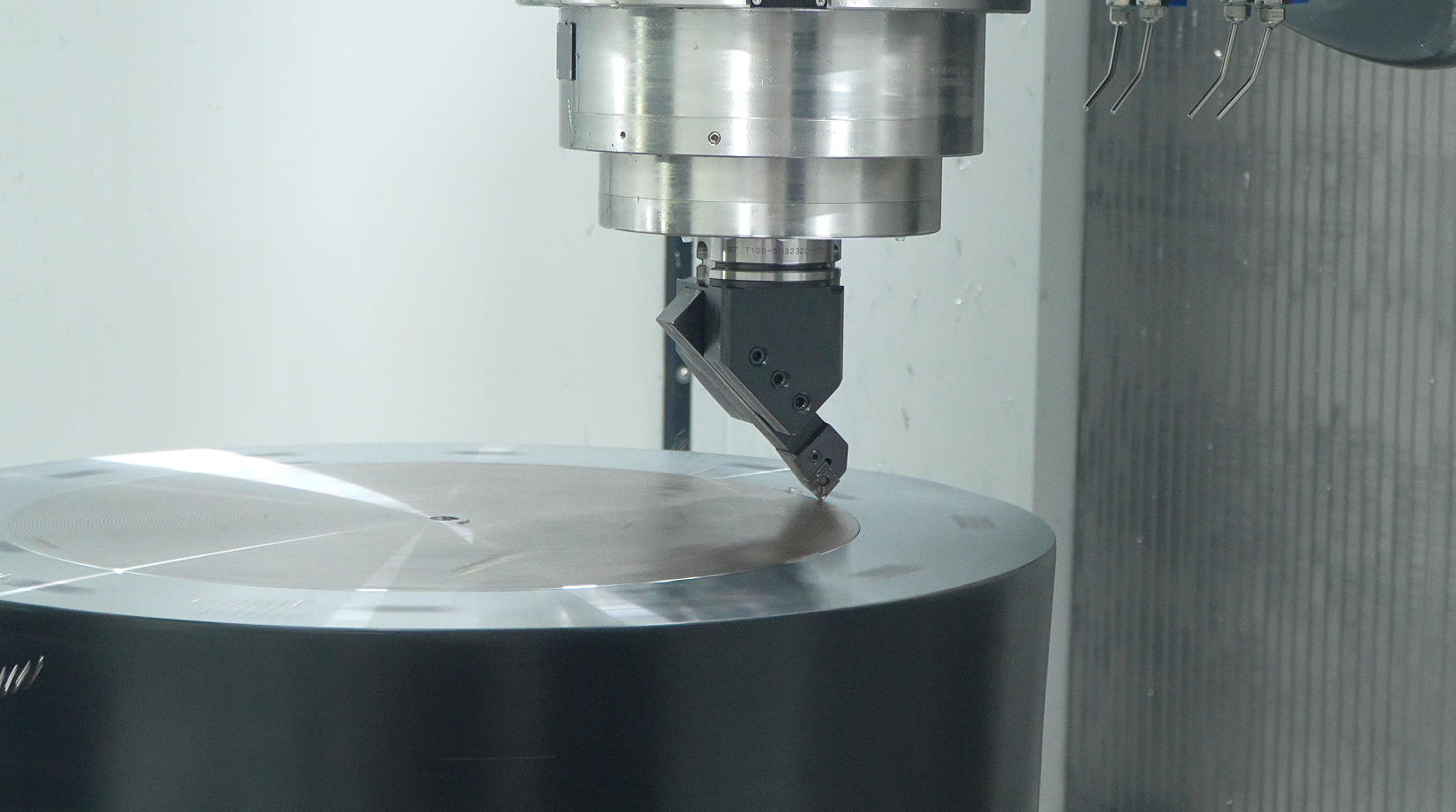
Complex part manufacturing places demands on a CNC machine that conventional three-axis machining cannot always meet efficiently. Deep cavities, angled surfaces, undercuts, compound curves, and multiple machining faces often require the workpiece or cutting tool to change orientation during the machining process. This is where rotary axis positioning becomes a critical part of modern 5-axis CNC machining.
Unlike a conventional three-axis CNC machine, a 5-axis CNC machine combines X, Y, and Z linear movement with two additional rotary axes. These rotary axes allow the cutting tool and workpiece to approach a feature from different directions without requiring the part to be manually repositioned.
However, simply having five axes does not automatically guarantee better results. How those rotary axes are positioned, controlled, and synchronized directly influences machining accuracy, tool accessibility, surface quality, cycle time, and collision risk.
For engineers, machinists, and production managers working with complex components, understanding rotary axis positioning is therefore essential to achieving reliable precision machining results.
Understanding Rotary Axis Positioning in 5-Axis CNC Machining
What Are Rotary Axes?
In a 5-axis CNC machine, the rotary axes provide angular movement around the machine's linear axes. Depending on the machine architecture, these axes may be configured as A, B, or C axes.
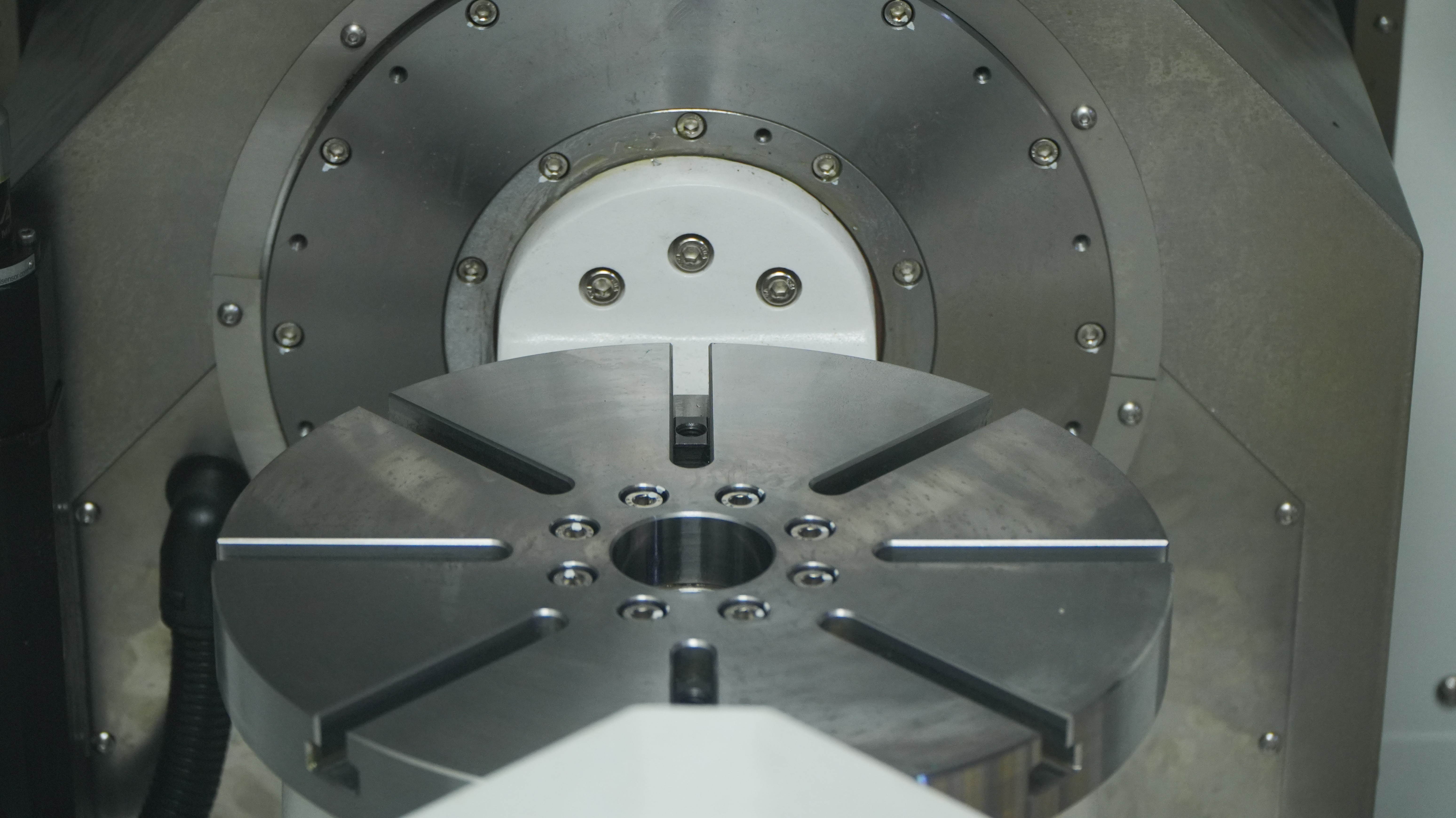
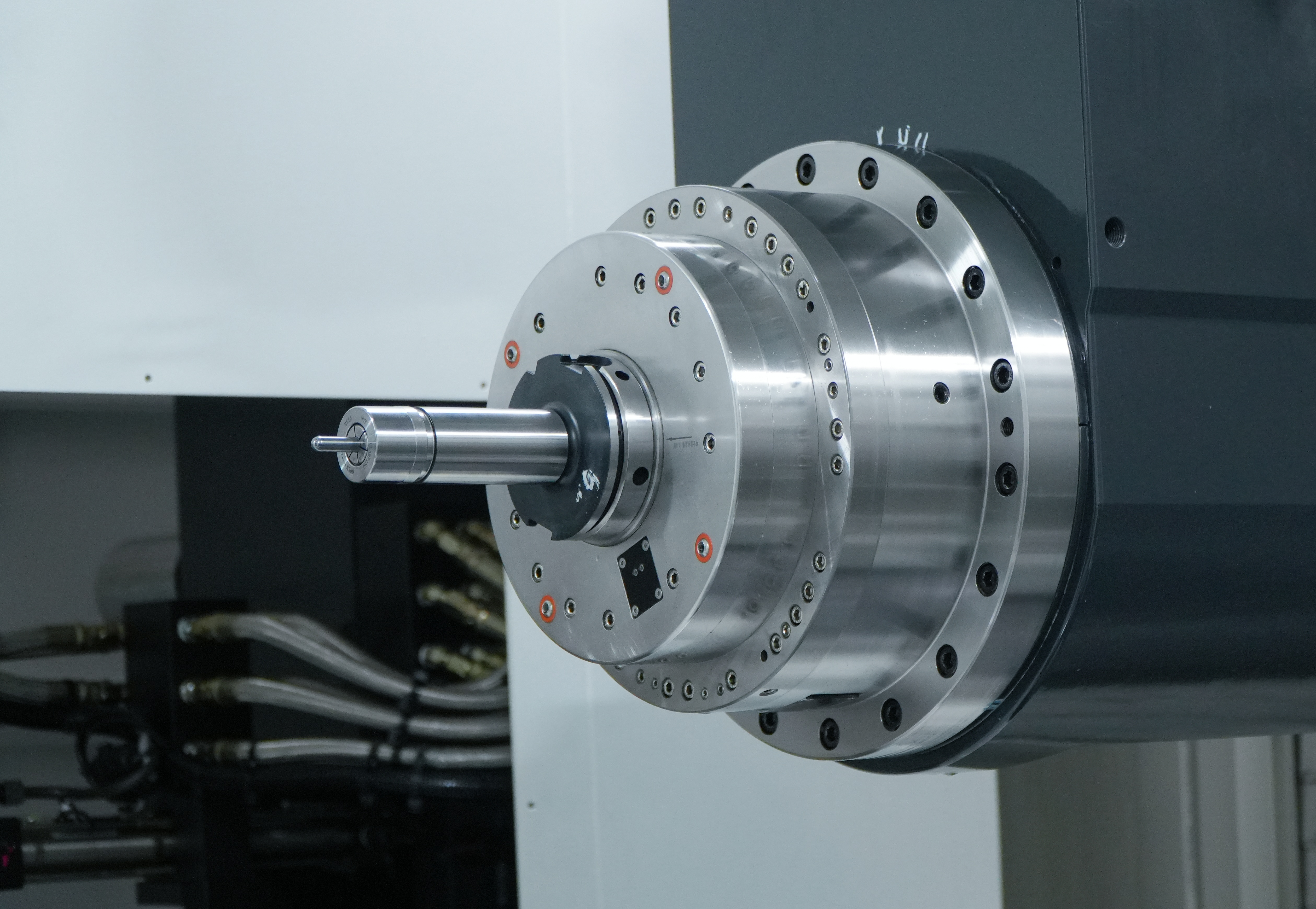
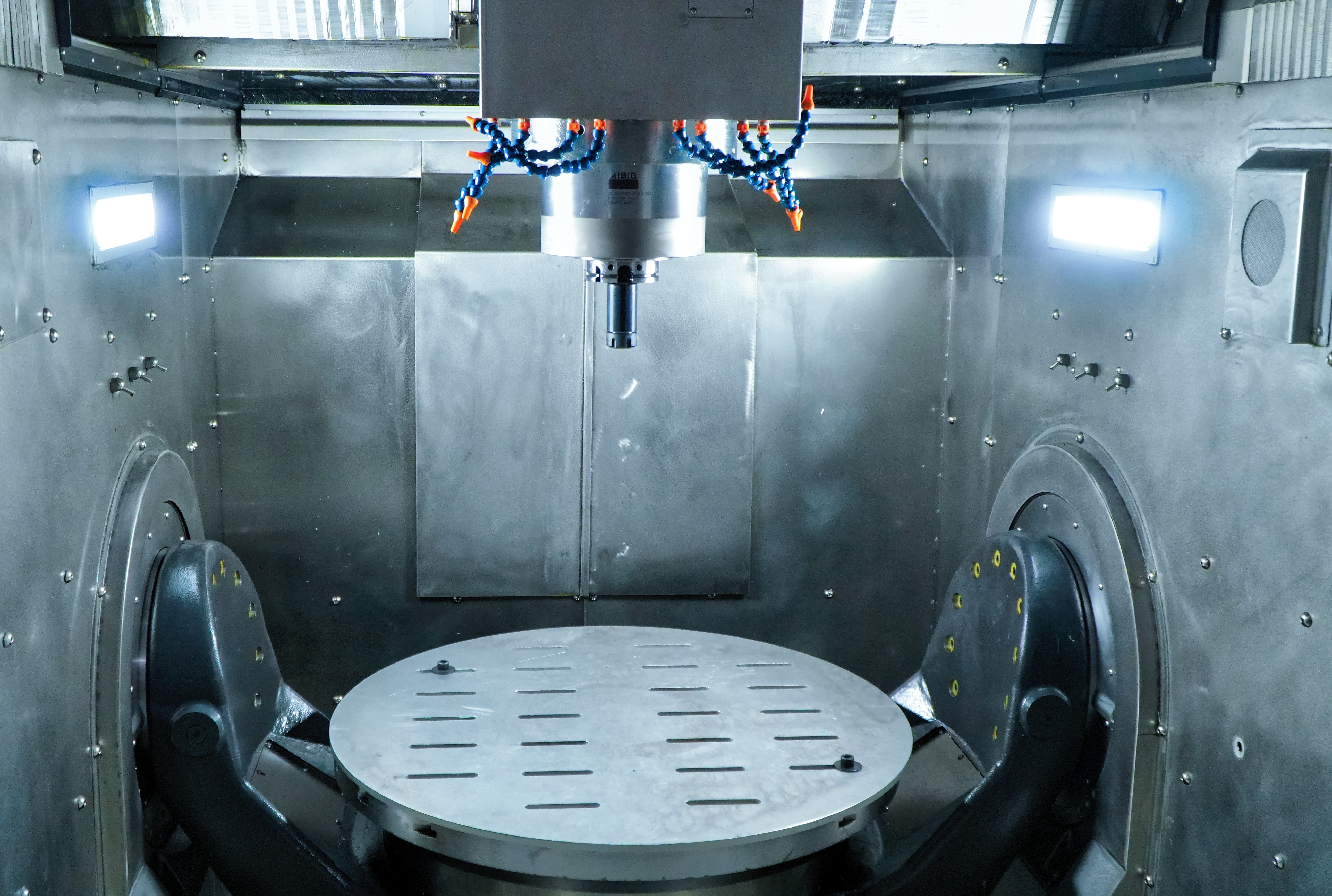
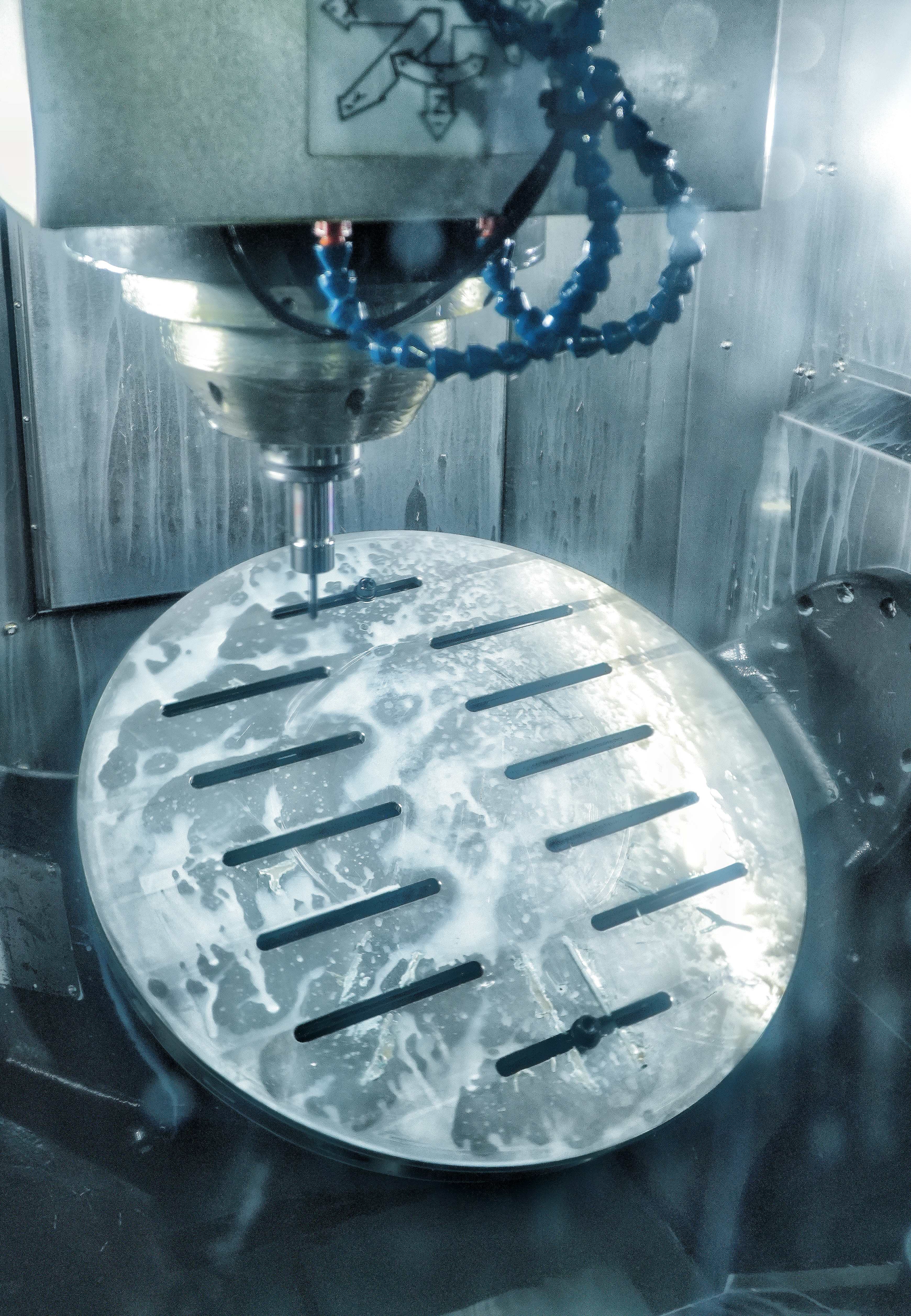
The exact configuration varies according to machine design. Some machines rotate the workpiece using a rotary table or trunnion, while others rotate the spindle head. Hybrid configurations combine table rotation with spindle-head tilting.
This difference is important because the location of the rotary axes changes how the machine handles the workpiece.
A trunnion-style 5-axis CNC machine, for example, rotates the workpiece around a defined center of rotation. A swivel-head configuration instead changes the orientation of the cutting tool relative to a stationary or less-mobile workpiece.
The rotary axis configuration affects:
- Workpiece accessibility
- Machine travel requirements
- Tool orientation
- Collision avoidance
- Workholding strategy
- Rotary axis accuracy
- Overall machining envelope
For complex part machining, these factors must be considered before programming begins.
Why Rotary Position Matters
Rotary positioning determines the angle at which the cutting tool approaches the workpiece. Changing this angle can dramatically alter the effective cutting conditions.
A tool that cannot reach a deep cavity vertically may be able to access the same feature by tilting the tool through a rotary axis. Similarly, a side wall that would require a separate setup on a three-axis machine may be machined from a new orientation without removing the workpiece.
This is one of the primary advantages of 5-axis machining.
Instead of repeatedly moving the part between fixtures, the machine can reposition the tool or workpiece and continue machining from another direction.
The result can be fewer setups, better positional consistency, and shorter overall production time.
Rotary Axis Positioning and Tool Accessibility
Reaching Difficult Features
One of the biggest benefits of rotary axis positioning is improved tool accessibility.
Complex components often contain features that cannot be reached efficiently with a fixed vertical tool orientation. Examples include:
- Deep cavities
- Angled holes
- Undercuts
- Blades
- Impellers
- Curved surfaces
- Inclined pockets
- Multi-face components
With a 5-axis CNC machine, the rotary axes can orient the tool toward these features.
Instead of forcing a long tool to reach a deep feature, the machine can tilt the tool into a more favorable cutting position. This allows the use of shorter and more rigid tools.
That change can significantly improve precision machining performance.
Shorter Tools and Greater Rigidity
Tool length has a direct relationship with tool deflection.
As tool length increases, the cutting tool becomes more susceptible to bending under cutting forces. Excessive deflection can lead to dimensional errors, poor surface finish, vibration, and premature tool wear.
Rotary axis positioning allows the programmer to change the tool orientation so that the cutting edge can reach the feature with a shorter tool whenever possible.
A shorter tool provides greater rigidity and helps maintain stable cutting conditions.
For complex parts with demanding tolerances, this can make a significant difference.
How Rotary Positioning Improves Multi-Surface Machining
Reducing Multiple Setups
Traditional machining often requires a part to be removed from the machine and repositioned whenever a different surface needs to be machined.
Every additional setup introduces another opportunity for error.
The operator must establish the workpiece position again, align the datum, secure the fixture, and verify the new coordinate system. Small positioning errors can accumulate across multiple operations.
A 5-axis CNC machine reduces this problem by allowing multiple surfaces to be machined from different orientations within a single setup.
The rotary axes reposition the workpiece or cutting tool while maintaining the relationship between the machine coordinate system and the part.
This is particularly valuable in precision machining applications where the relationship between multiple features is more important than the absolute accuracy of any individual feature.
Improving Feature-to-Feature Accuracy
Consider a complex housing with holes and pockets located on several angled faces.
With multiple setups, each face must be aligned independently. Even if every setup is performed carefully, small errors may occur during repositioning.
With 5-axis machining, the machine can access multiple faces without releasing the workpiece.
The original datum remains active throughout the operation, reducing setup-related variation.
This makes rotary axis positioning especially valuable for aerospace, medical, automotive, mold, and other industries where feature relationships are tightly controlled.
Rotary Axis Positioning and Surface Quality
Maintaining a Better Tool Orientation
Rotary axis positioning does more than simply provide access. It also allows programmers to maintain a more effective tool orientation relative to the workpiece surface.
For complex curved surfaces, a fixed tool orientation can create unfavorable cutting conditions. The effective contact area between the tool and material may change continuously as the tool moves across the surface.
A 5-axis CNC machine can continuously adjust the tool orientation to maintain a more consistent relationship between the cutting tool and the workpiece.
This can improve:
- Surface finish
- Cutting stability
- Tool life
- Material removal consistency
- Dimensional control
The result is more predictable precision machining performance across complex geometries.
Reducing Sudden Changes in Tool Engagement
Poor rotary axis positioning can cause sudden changes in tool engagement.
When the cutting tool enters a region with significantly different contact conditions, cutting forces can increase rapidly. This can create vibration, tool deflection, or surface defects.
A properly programmed rotary axis motion can gradually transition the tool orientation instead of making abrupt changes.
Smooth rotary movement therefore becomes an important part of maintaining stable cutting conditions.
Rotary Axis Positioning and Collision Avoidance
The Importance of Machine Envelope
Rotary movement creates additional collision possibilities that do not exist in conventional three-axis machining.
As the workpiece or spindle rotates, components that were previously far apart may move into the same space.
Potential collision points include:
- Cutting tool and workpiece
- Tool holder and workpiece
- Spindle head and fixture
- Spindle housing and rotary table
- Fixture and machine enclosure
- Tool and clamps
For this reason, rotary axis positioning must be evaluated against the complete machine configuration.
A toolpath that appears safe when viewed only from the cutting-tool perspective may still produce a collision when the spindle head or fixture rotates.
Simulation Before Machining
CAM simulation is an essential part of modern 5-axis CNC programming.
Before running a complex program, the programmer should verify the complete machine model, including the workpiece, fixture, tool holder, spindle head, rotary table, and other relevant machine components.
Simulation can identify problematic rotary movements before the program reaches the actual machine.
This is particularly important for simultaneous 5-axis machining, where multiple axes may move continuously during a cutting operation.
Rotary Axis Positioning and Cutting Efficiency
Maintaining Favorable Cutting Conditions
Rotary positioning can also influence cutting efficiency.
When the cutting tool approaches a surface at an appropriate angle, the programmer may be able to increase effective tool engagement while reducing unnecessary cutting forces.
For some applications, changing the tool orientation can allow the use of a more productive section of the cutting tool.
This is particularly useful when machining complex curved surfaces.
Rather than forcing a fixed tool orientation across the entire part, the 5-axis CNC machine can continuously adjust the tool axis to follow the geometry.
Reducing Non-Cutting Motion
Multiple setups often require additional handling, probing, alignment, and repositioning.
A well-planned 5-axis machining strategy can eliminate many of these non-cutting activities.
The machine can reposition the rotary axes automatically between features, allowing more machining operations to occur without operator intervention.
This can reduce:
- Setup time
- Workpiece handling
- Alignment time
- Inspection interruptions
- Non-cutting machine time
The cumulative effect can be substantial in production environments.
Rotary Axis Accuracy and Calibration
Rotary Axis Accuracy Matters
The benefits of rotary positioning depend heavily on rotary axis accuracy.
If a rotary axis does not position accurately, the resulting angular error can translate into significant dimensional errors at the cutting location.
This effect becomes more pronounced as the distance between the rotary axis center and the cutting point increases.
For example, a small angular positioning error may produce a much larger linear deviation at the end of a long tool or on a large workpiece.
Therefore, rotary axis accuracy should be evaluated alongside linear positioning accuracy when selecting a 5-axis CNC machine.
Calibration and Compensation
Modern 5-axis CNC machines use calibration and compensation systems to maintain rotary axis accuracy.
Machine builders may use precision measurement equipment to identify geometric errors and compensate for them through the CNC control system.
Regular verification is still important, particularly for machines performing demanding precision machining operations.
Rotary axis calibration should be included within the machine's maintenance and accuracy verification program.
Choosing Rotary Positions in CAM Programming
3+2 Positioning vs. Simultaneous 5-Axis Motion
Not every complex component requires continuous five-axis movement.
In many cases, 3+2 machining is sufficient.
The rotary axes move to a predefined orientation and then remain fixed while the X, Y, and Z axes perform the cutting operation.
This approach can simplify programming and verification.
Full simultaneous 5-axis machining is more appropriate when the geometry requires continuous tool orientation changes, such as complex freeform surfaces, blades, impellers, and certain deep or undercut features.
The best strategy depends on the geometry rather than simply using all five axes because the machine has them.
Choosing the Optimal Tool Angle
The ideal rotary position depends on several variables:
- Part geometry
- Tool diameter
- Tool length
- Cutting direction
- Surface curvature
- Workholding configuration
- Machine travel limits
- Collision clearance
- Required surface finish
A small change in tool angle can sometimes improve accessibility significantly.
However, excessive rotary movement can increase programming complexity and create unnecessary axis motion.
The goal is to find a tool orientation that provides sufficient access while maintaining stable cutting conditions and adequate clearance.
How Rotary Axis Positioning Supports Precision Manufacturing
Rotary axis positioning is ultimately about controlling the relationship between the tool, workpiece, and cutting surface.
When that relationship is properly managed, a 5-axis CNC machine can perform complex machining operations with fewer setups and more consistent positioning.
This capability supports precision machining in industries where components contain complex geometries and demanding tolerances.
Aerospace components may require multiple angled surfaces and blended transitions. Medical components may contain highly complex freeform geometries. Automotive and mold applications often involve deep cavities, curved surfaces, and multiple machining directions.
In each case, rotary axis positioning provides a way to approach the geometry more effectively.
The machine's value therefore comes not simply from having two additional axes, but from using those axes intelligently.
Best Practices for Rotary Axis Positioning
To achieve reliable results, manufacturers should establish a systematic approach to rotary axis positioning.
1. Understand the Machine Kinematics
Know whether the machine uses a table-table, head-head, or head-table configuration.
Understand the rotary axis centers, travel limits, home positions, and machine-specific restrictions before programming.
2. Minimize Tool Stick-Out
Use rotary positioning to reach features with the shortest practical tool.
Reducing tool length improves rigidity and reduces deflection.
3. Include Fixtures in Simulation
Always model the complete workholding system when verifying a 5-axis CNC toolpath.
A safe toolpath is not enough if the spindle or fixture can collide during rotary movement.
4. Use 3+2 When Appropriate
Do not use simultaneous five-axis motion simply because the machine is capable of it.
If a feature can be machined efficiently with indexed positioning, 3+2 may provide a simpler and more stable solution.
5. Verify Rotary Axis Accuracy
Include rotary axis positioning accuracy in regular machine verification and calibration procedures.
6. Optimize Tool Orientation
Evaluate tool angle, cutting force, accessibility, surface finish, and collision clearance together rather than optimizing only one variable.
7. Verify the First Part
Run the first component conservatively and inspect critical dimensions before moving into full production.
This provides an opportunity to identify rotary positioning errors before they affect an entire batch.
Conclusion
Rotary axis positioning is one of the defining capabilities of 5-axis CNC machining. By allowing the tool or workpiece to change orientation, rotary axes provide access to complex surfaces, reduce the number of setups, improve tool rigidity, and support more consistent cutting conditions.
However, effective 5-axis machining requires more than simply adding rotary movement to a toolpath. Machine kinematics, rotary axis accuracy, tool orientation, workholding, collision avoidance, and CAM programming must all work together.
When these factors are properly coordinated, rotary axis positioning can significantly improve complex part machining efficiency while supporting the accuracy and surface quality required for modern precision machining.
For manufacturers working with increasingly complex components, understanding how to use rotary axes effectively is therefore not just a programming skill. It is an important part of building a reliable and competitive 5-axis manufacturing process.
FAQ
What is rotary axis positioning in 5-axis CNC machining?
Rotary axis positioning refers to the controlled angular movement of the rotary axes on a 5-axis CNC machine. These axes allow the cutting tool or workpiece to change orientation, providing access to complex surfaces and enabling multiple machining operations to be completed from different directions.
How does rotary axis positioning improve machining accuracy?
Rotary axis positioning can reduce the number of setups required to manufacture a complex component. By machining multiple surfaces without removing the workpiece from the fixture, the machine can maintain the original datum and reduce setup-related positioning errors.
Does rotary axis positioning reduce machining time?
It can significantly reduce total production time by minimizing manual repositioning, setup changes, and non-cutting operations. A well-planned 5-axis machining strategy can allow multiple surfaces to be completed within one setup.
Is simultaneous 5-axis machining always necessary?
No. Many components can be machined efficiently using 3+2 positioning, where the rotary axes index to a fixed orientation before the linear axes perform the cutting operation. Simultaneous 5-axis machining is most useful when the geometry requires continuous tool orientation changes.
How does rotary axis positioning affect tool life?
Proper rotary positioning can improve tool life by maintaining more favorable cutting conditions and allowing shorter, more rigid tools to reach difficult features. Better tool orientation can also reduce vibration and excessive tool engagement.
Why is rotary axis calibration important?
Small angular errors in a rotary axis can create larger dimensional deviations at the cutting point, particularly when the tool or workpiece is positioned far from the rotary axis center. Regular calibration and verification help maintain reliable 5-axis CNC machining accuracy.
What industries benefit most from rotary axis positioning?
Aerospace, medical, automotive, mold, energy, and precision component manufacturing can all benefit from rotary axis positioning. These industries frequently produce parts with complex surfaces, angled features, deep cavities, and tight dimensional requirements.