
How the DEPU G Series Gantry Machine Structure Sustains Long-Term 5-Axis Machining Precision
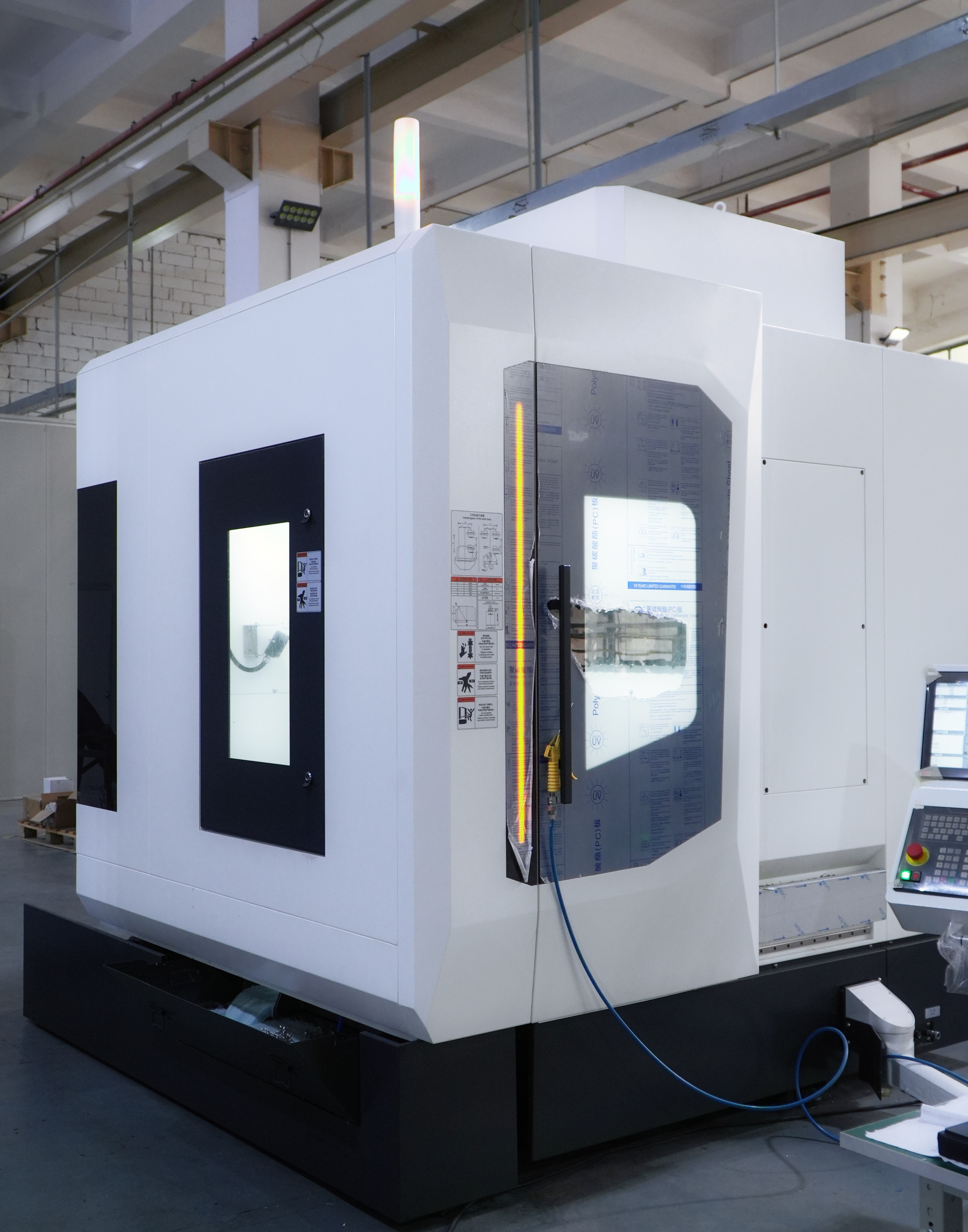
Introduction: The Problem With Precision That Doesn't Last
In precision manufacturing, a machine that hits tolerance on day one but drifts within six months is not a precision machine — it is a liability. For manufacturers in aerospace, automotive, medical device, and mold-making industries, long-term dimensional consistency is as critical as initial accuracy.
The structural choices made during machine design determine whether precision is a launch-day specification or a sustained production reality. Symmetry, material quality, heat management, and drivetrain stiffness all compound over time — either in favor of accuracy or against it.
The DEPU G Series cradle 5-axis machining center was engineered specifically to address this challenge. Its gantry-type symmetrical structure, high-quality cast iron construction, and full closed-loop control architecture are not marketing features — they are engineering decisions made to ensure that the machine performing on month one is the same machine performing on year three.
1. Gantry Machine Structure: Symmetry as a Precision Strategy
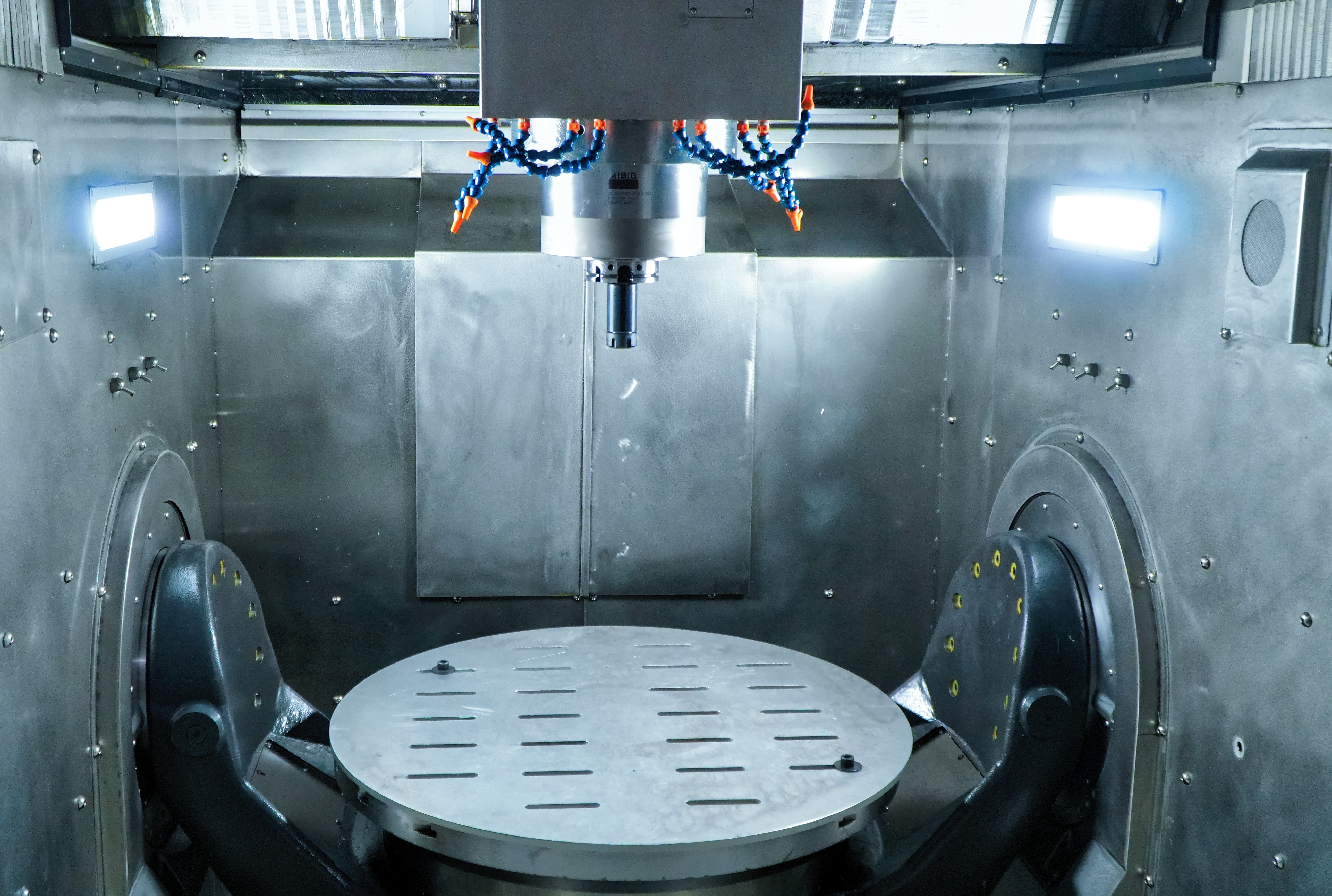
The most fundamental structural decision in the DEPU G Series is its gantry-type symmetrical layout. Unlike C-frame designs where the column offsets the load path asymmetrically, a gantry structure distributes cutting forces evenly across both sides of the machine body.
This symmetry delivers three measurable precision benefits:
- Balanced deformation under load — Symmetric force paths mean that deflection under cutting loads is predictable and consistent, rather than directionally biased
- Reduced thermal asymmetry — Symmetrical structures expand more evenly when temperature changes, minimizing the positional drift that asymmetric designs generate under thermal cycling
- Higher natural frequency — The closed-frame gantry geometry raises the machine's resonant frequency, reducing susceptibility to vibration-induced surface errors during aggressive cutting
For the DEPU G Series, this structural symmetry is combined with main castings made from high-quality cast iron that has been double heat-treated to eliminate residual stress — a process that prevents the slow dimensional changes that untreated castings undergo in service.
2. CNC Machine Rigidity: Cast Iron, Finite Element Optimization, and Stiff Drivetrains
Structural rigidity in the DEPU G Series cradle 5-axis machining center is not achieved through mass alone — it is the result of systematic engineering across the machine's entire load path.
Key rigidity design decisions include:
- High-quality cast iron throughout all major structural components — Cast iron's superior vibration damping coefficient compared to fabricated steel structures reduces chatter and improves surface finish under dynamic cutting conditions
- Finite element optimization of all moving components — Every structural member has been analyzed and refined to maximize stiffness-to-weight ratio, lightening moving masses while preserving the rigidity needed for accurate positioning
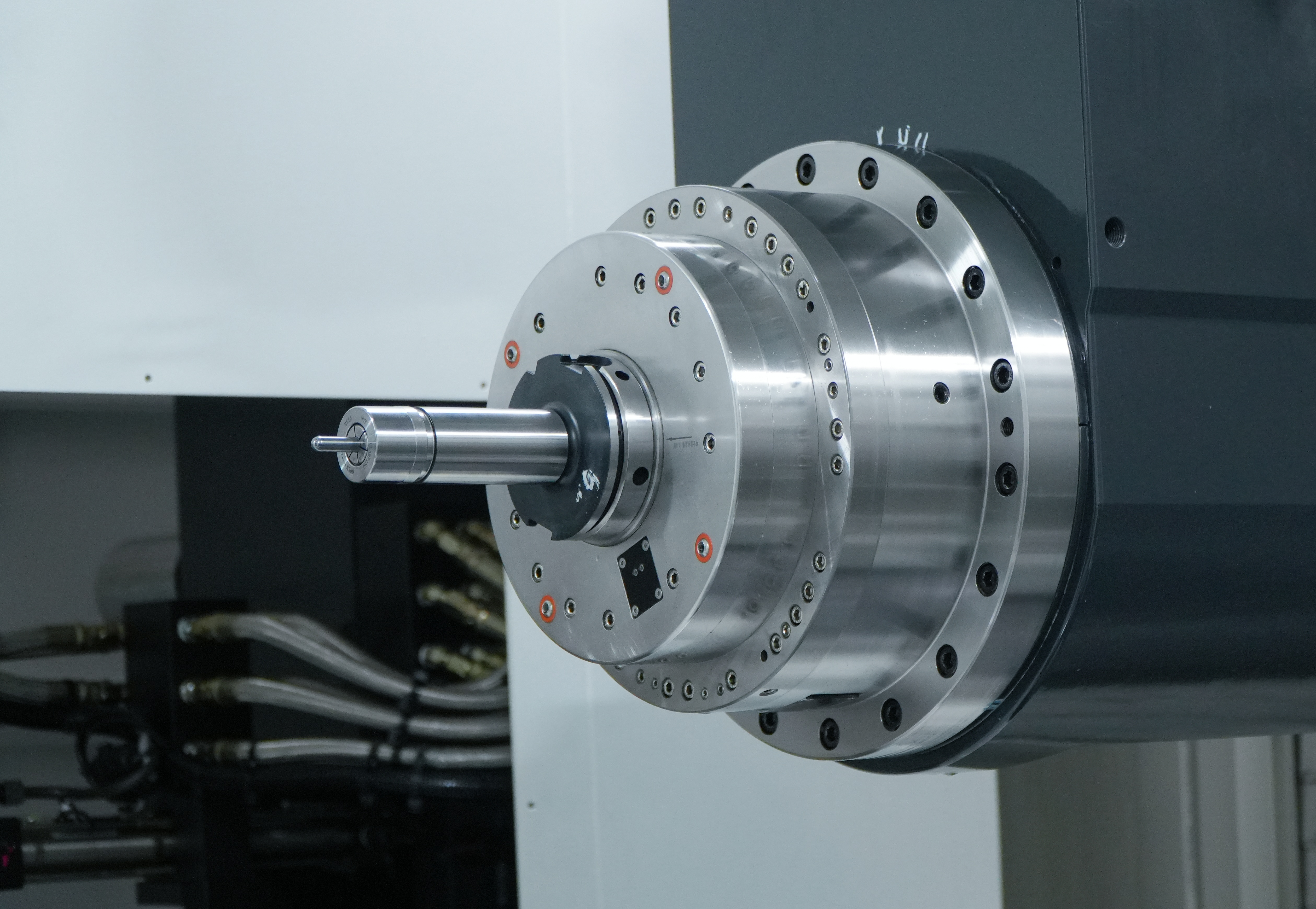
- NSK/THK precision ball screws and Schneeberger/THK linear guide rails — Full-series standard drivetrain components from top-tier suppliers ensure that the mechanical transmission system contributes no measurable backlash or compliance to the positioning loop
Together, these choices give the G Series the CNC machine rigidity needed to maintain 5-axis machining accuracy of 0.003–0.006 mm across the full working envelope — from the compact G300 to the large-format G800.
3. Thermal Stability: Double Heat Treatment and Active Cooling
Thermal stability is one of the most demanding requirements in high precision machining. Steel expands approximately 10–12 microns per meter per degree Celsius — meaning that even a modest temperature rise in a machine's column or spindle housing can shift a part's dimensions beyond tolerance without any mechanical fault.
The DEPU G Series manages thermal stability through a two-layer approach:
- Structural thermal preparation — All major cast components undergo double heat treatment before machining. This process relieves the residual stresses introduced during casting, which would otherwise cause slow dimensional changes as the machine is used and temperature cycles
- Active thermal management in operation — A standard water chiller continuously cools the spindle assembly, preventing heat buildup from transferring into the machine's structural members during production. Cabinet air conditioning stabilizes the electrical and control environment, eliminating thermally induced servo drift
For manufacturers running multi-hour production cycles — particularly on aerospace components with tight geometric tolerances — this combination of passive structural preparation and active thermal management ensures that part dimensions at the end of a shift match those at the beginning.
4. DD Rotary Table: Direct Drive Precision Without Mechanical Transmission Loss
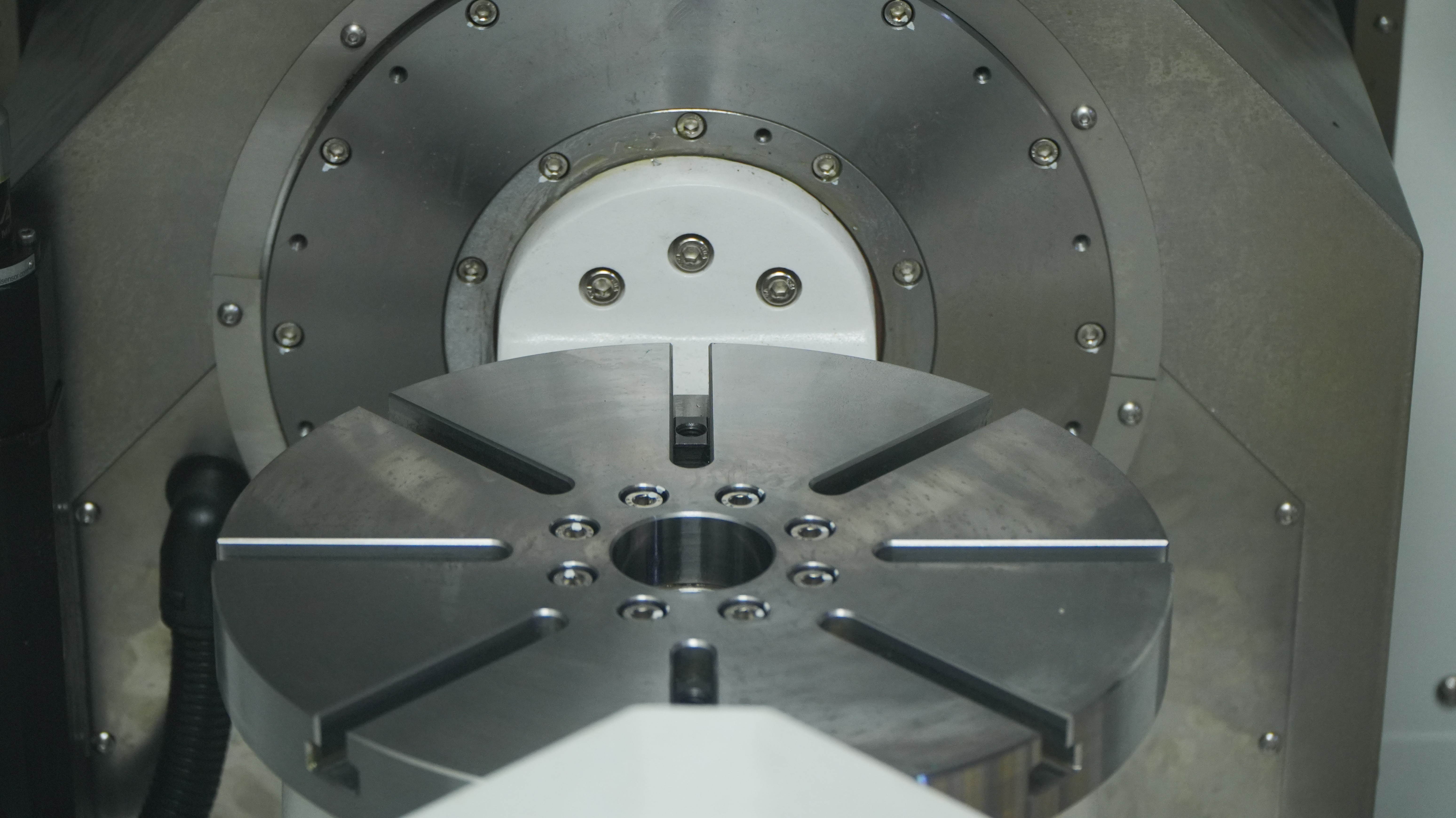
The cradle rotary table is the defining structural element of the DEPU G Series architecture, and its design has a direct impact on 5-axis machining accuracy.
The G Series standard DD (direct drive) rotary table delivers rotary axis precision through:
- YRT rotary table bearings — Designed specifically for rotary table applications, YRT bearings provide high axial and radial load capacity with minimal runout, maintaining angular accuracy under heavy workpiece loads
- Elimination of mechanical transmission — Unlike worm-gear driven tables, a DD table has no gear mesh error, no backlash, and no transmission compliance — the motor directly drives the table without intermediate mechanical elements that can wear or flex
- Heidenhain angular position feedback — Real-time angular measurement by Heidenhain's position feedback system closes the rotary axis loop, continuously correcting for any deviation between commanded and actual angular position
For the DEPU G Series cradle 5-axis machining center, this rotary axis architecture delivers A/C-axis positioning accuracy of 8 arcseconds and repeat positioning accuracy of 4 arcseconds — specifications that are maintained in production rather than only at acceptance testing.
5. Full Closed-Loop Control: Heidenhain Feedback Across All Axes
Structural and mechanical precision set the foundation, but full closed-loop control is what ensures that the machine's positioning accuracy is verified and corrected in real time during every cutting cycle.
The DEPU G Series implements closed-loop control through:
- Linear encoders on all X/Y/Z axes (standard from G630 and G800) — Direct position measurement at the point of interest — rather than at the motor — eliminates the accumulated errors of ball screw thermal expansion, wear, and elastic deformation from the positioning loop
- Heidenhain position feedback on the DD rotary table — Angular errors on the A and C axes are measured and corrected in real time, preventing the rotary axis drift that degrades complex surface accuracy over extended runs
- Servo tool magazine — Consistent tool change positioning ensures that tool-length offsets remain repeatable between operations, eliminating a common source of dimensional variation in multi-tool programs
This full closed-loop architecture means that the G Series does not just achieve precision — it actively maintains precision, compensating for the thermal, mechanical, and dynamic disturbances that accumulate during real production conditions.
6. Application Range: Where G Series Structural Precision Delivers ROI
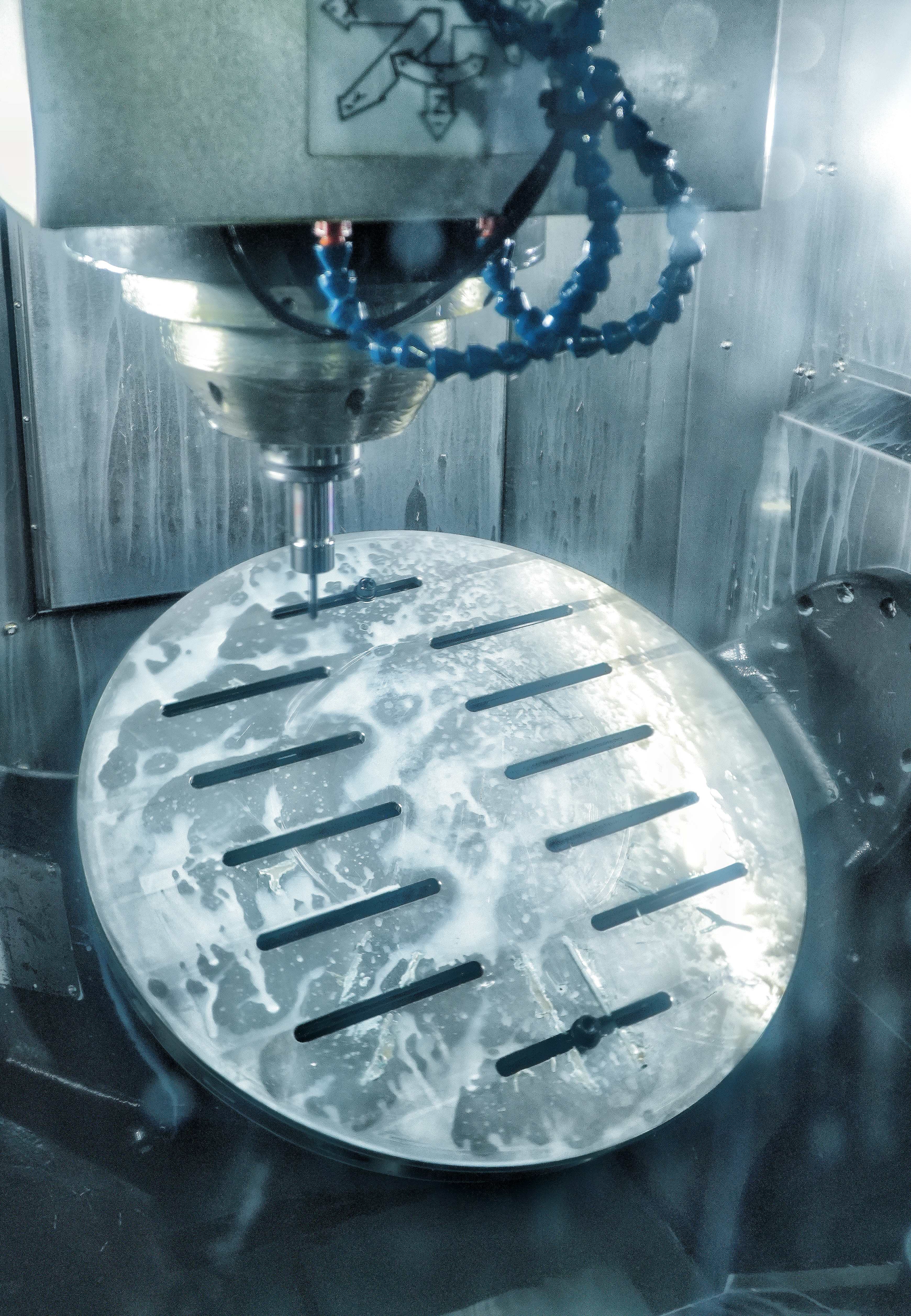
The structural design choices of the DEPU G Series cradle 5-axis machining center translate into measurable production advantages across a range of demanding industries:
- Aerospace — Turbine blades, structural brackets, and engine housings require sustained geometric accuracy across long production runs. The G Series's rigidity and closed-loop rotary control deliver the consistent airfoil tolerances and datum repeatability these parts demand
- Automotive — Precision molds and dies require high surface finish quality combined with tight form accuracy. The G Series's gantry rigidity and vibration damping characteristics support aggressive material removal without compromising final surface quality
- Medical devices — Implant components and surgical instruments require micron-level dimensional consistency. The G Series's thermal stability and DD table precision maintain the tolerances needed for regulatory compliance across full production batches
- Precision mold-making — Complex cavity geometries require sustained accuracy over long machining cycles. The G Series's structural thermal preparation and active cooling prevent the mid-cycle drift that causes mismatch between mold halves
With three platform sizes — G300 (workpiece up to Φ390×250mm), G630 (up to Φ700×400mm), and G800 (up to Φ900×500mm) — the G Series covers the full range of precision cradle 5-axis applications from compact medical components to large aerospace assemblies.
Conclusion: Precision That Holds
The DEPU G Series cradle 5-axis machining center demonstrates that sustained machining precision is an engineering outcome, not a specification claim. Through gantry symmetry, double heat-treated cast iron construction, direct-drive rotary technology, and Heidenhain closed-loop feedback across all axes, the G Series is designed to deliver the same accuracy on year three that it delivers on day one.
For manufacturers where long-term dimensional consistency directly determines product quality, yield rates, and customer confidence, the structural investment in the DEPU G Series is an investment in reliable, repeatable, production-grade precision.
FAQ
1. What makes the gantry structure of the DEPU G Series effective for long-term precision? The gantry's symmetrical design distributes cutting forces and thermal expansion evenly across both sides of the machine body, preventing the asymmetric deformation and positional drift that C-frame machines experience under load and temperature cycling. Combined with double heat-treated cast iron castings, the structure maintains its geometric accuracy over years of production use.
2. Why does the DEPU G Series use a DD rotary table instead of a conventional worm-gear table? A direct-drive DD table eliminates the gear mesh error, backlash, and transmission compliance inherent in worm-gear designs. With YRT rotary bearings and Heidenhain angular feedback, the DD table delivers rotary axis positioning accuracy of 8 arcseconds with no mechanical wear mechanism that could degrade accuracy over time.
3. How does double heat treatment of castings contribute to machining accuracy? Casting processes introduce residual stresses into the material. Without treatment, these stresses slowly relax in service, causing gradual dimensional changes in the machine structure. Double heat treatment fully relieves these stresses before machining, ensuring that the structural geometry established during manufacturing remains stable throughout the machine's operational life.
4. What is the difference between the G300, G630, and G800 in terms of precision capability? All three models share the same gantry structure design principles, DD rotary table, and closed-loop control architecture. The primary differences are workpiece capacity (Φ390mm to Φ900mm), table load (50 kg to 1,200 kg), and available tool magazine sizes (24T to 60T). Positioning accuracy is 0.003 mm on the G300 and 0.006 mm on the G630 and G800.
5. Which industries benefit most from the DEPU G Series cradle 5-axis machining center? Aerospace (turbine blades, structural parts), automotive (precision molds and dies), medical devices (implants, surgical instruments), and precision mold-making all benefit significantly. These industries share a common requirement: dimensional accuracy that holds across full production batches, not just at machine acceptance.