
From First Setup to Final Surface: Where 5-Axis Machining Creates the Biggest Gains
For manufacturers producing complex components, the biggest advantages of 5 axis machining are often associated with reducing the number of setups. While fewer setups are certainly valuable, they represent only one part of the productivity improvement that a modern 5-axis CNC machine can deliver.
The real gains begin before cutting starts and continue through every stage of the machining process. Workpiece positioning, tool accessibility, cutting-tool orientation, surface finishing, dimensional consistency, and inspection requirements can all be affected by the machine configuration and machining strategy.
A properly implemented 5 axis CNC machine can approach a complex component from multiple directions while maintaining a common datum throughout the process. This allows manufacturers to rethink how parts are fixtured, how tools engage surfaces, and how machining operations are organized from the first setup to the final surface.
For aerospace components, medical parts, molds, impellers, precision mechanical components, and other geometrically complex workpieces, understanding where these gains occur is essential for evaluating whether 5 axis machining can deliver meaningful production advantages.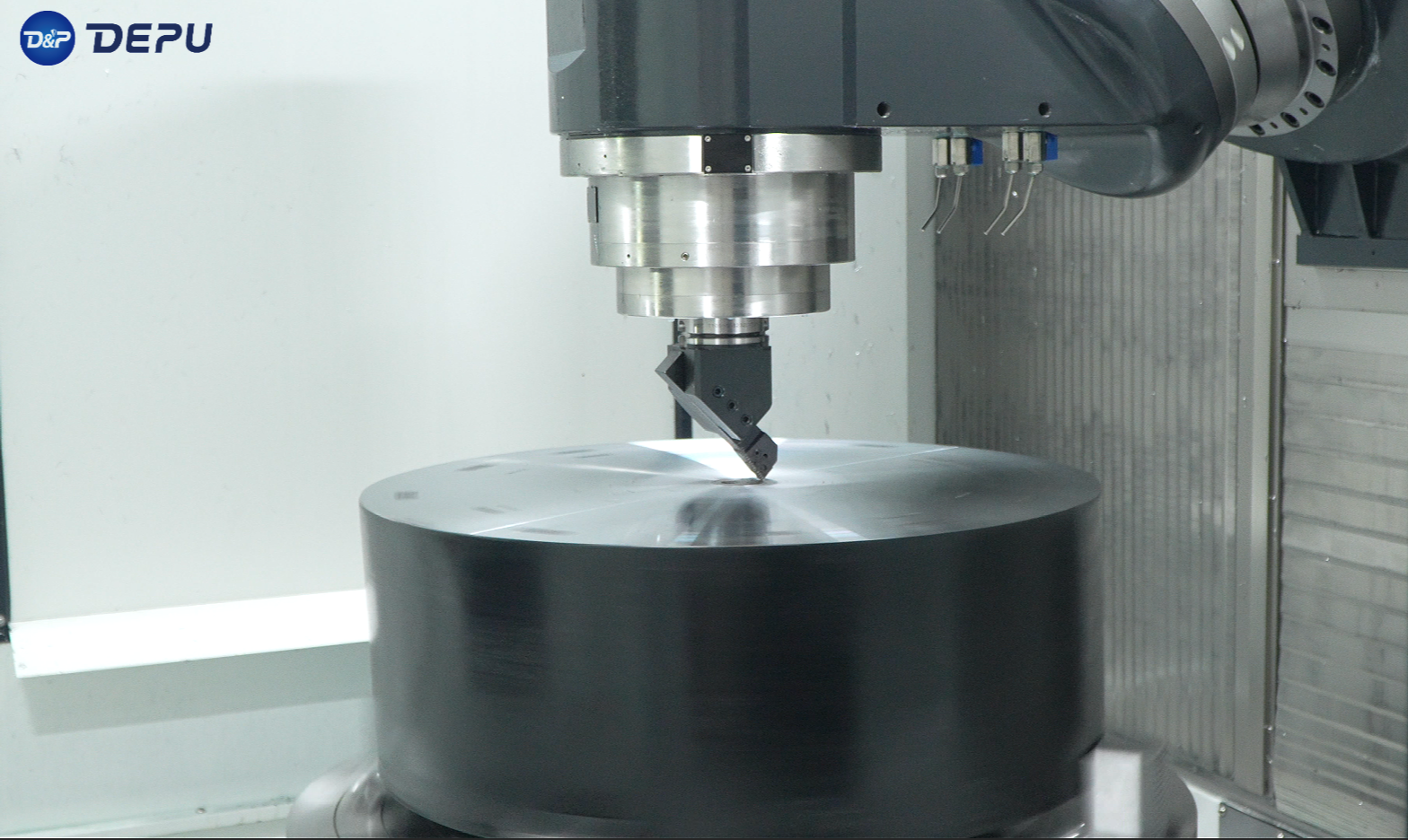
The First Gain: Simplifying the Initial Setup
Why Setup Strategy Matters
Every machining process begins with a setup. The workpiece must be positioned, secured, aligned, and referenced before the first cutting operation can begin.
On a conventional three-axis machine, a complex component may require multiple setups because certain surfaces cannot be reached from the initial tool direction. Each additional setup requires the operator to reposition the workpiece and establish the correct relationship between the part and the machine coordinate system.
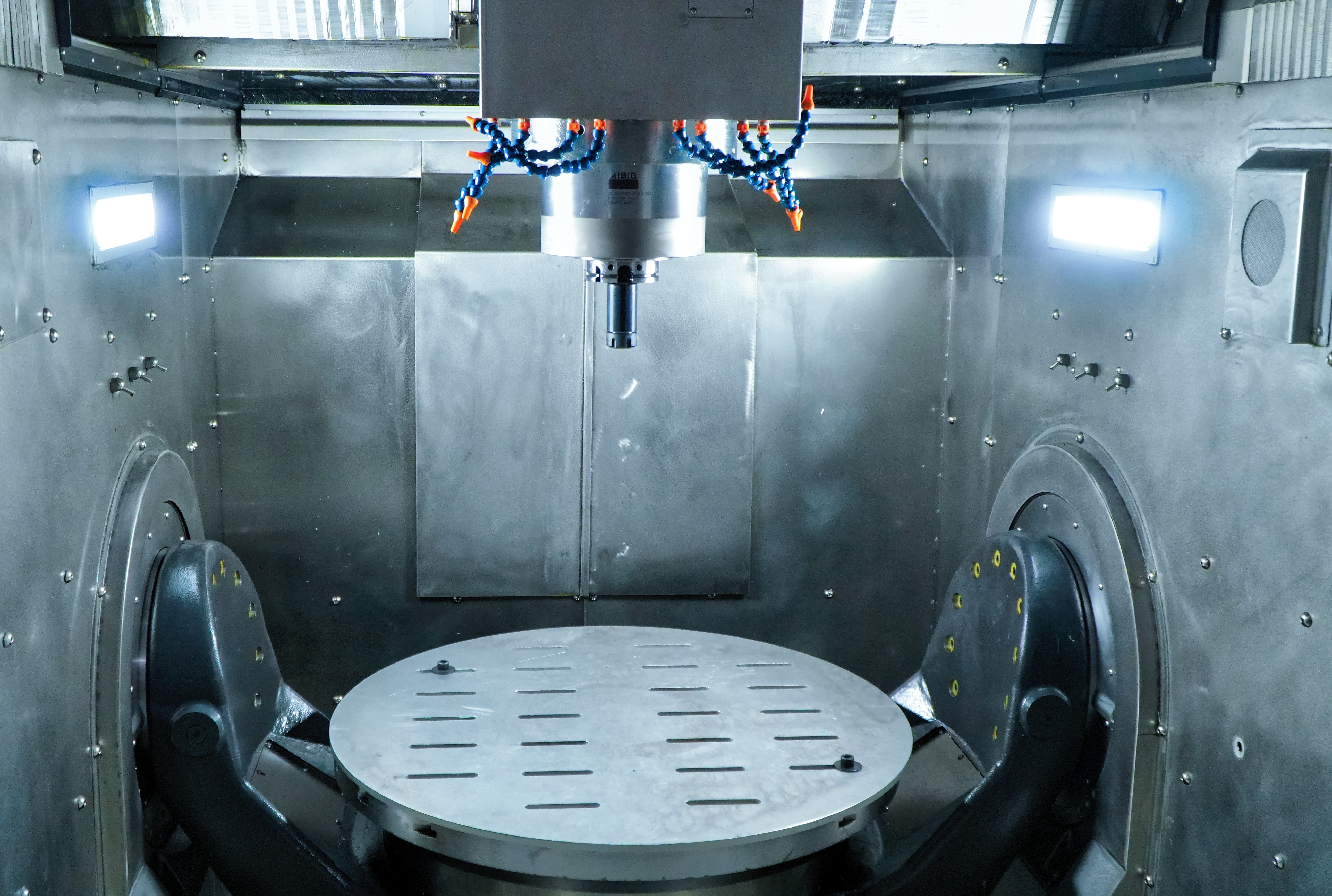
A 5-axis CNC machine changes this equation by allowing the workpiece or spindle to rotate around additional axes. Instead of physically repositioning the component for every machining direction, the machine can change the tool orientation within the same setup.
This does not mean that every part should automatically be machined in a single setup. Rather, it gives engineers more freedom to design a setup strategy around accessibility and process stability rather than simply around which surface can be reached.
Establishing a More Stable Datum
Maintaining the same datum throughout multiple operations is one of the most important advantages of 5 axis machining.
Every time a workpiece is removed and re-fixtured, there is an opportunity for alignment error. Even when the operator follows a careful procedure, small variations in positioning can accumulate across multiple setups.
With a suitable 5-axis strategy, several machining operations can be completed from a common workholding arrangement. This reduces the number of opportunities for setup-related positioning errors and helps preserve the relationship between critical features.
For precision machining, this consistency can be more valuable than simply reducing setup time.
The Second Gain: Better Workpiece Accessibility
Reaching More Surfaces Without Repositioning
Complex components frequently contain deep pockets, angled surfaces, undercuts, and features located on multiple faces. A conventional machine may require special fixtures or multiple setups to access these areas.
A 5 axis CNC machine provides additional rotational movement that changes the relationship between the cutting tool and the workpiece.
Instead of forcing the tool to approach every feature from the same direction, the machine can orient the cutting tool toward the surface that needs to be machined.
This creates significantly greater accessibility without requiring the operator to physically reposition the part.
For example, a component with several angled faces may require three or four setups on a conventional machining center. A well-designed 5-axis process may allow those surfaces to be reached sequentially from a single fixture.
Accessibility Can Be More Valuable Than Machine Size
Machine buyers sometimes focus heavily on axis travel and table dimensions when evaluating equipment. However, for complex components, accessibility can be just as important as physical machine size.
A larger machine does not necessarily make every surface easier to reach.
The relationship between spindle orientation, rotary-axis range, workpiece geometry, tool length, and fixture design determines whether a specific feature can actually be machined efficiently.
This is why 5 axis machining can provide substantial productivity improvements even when the machine itself is not physically larger than a conventional machining center.
The Third Gain: Improved Tool Orientation
Controlling the Cutting Angle
One of the most powerful capabilities of a 5-axis CNC system is the ability to control tool orientation during machining.
In three-axis machining, the tool axis is generally fixed relative to the workpiece. The machine can move the tool along X, Y, and Z, but the cutting direction remains limited.
With simultaneous five-axis motion, the tool can continuously change its orientation while following the surface.
This is particularly valuable when machining complex curved geometries.
Instead of forcing the cutting tool to remain perpendicular to a single plane, the programmer can define a tool orientation that maintains more favorable engagement with the surface.
Maintaining More Consistent Cutting Conditions
Tool orientation affects cutting speed, chip thickness, tool engagement, and cutting forces.
Poor tool orientation can result in excessive tool engagement or unfavorable cutting conditions. It can also force the use of longer tools, increasing deflection and reducing dimensional stability.
A carefully programmed 5 axis CNC machine can maintain a more favorable relationship between the tool and the workpiece.
The result can include:
- More consistent tool engagement
- Reduced tool deflection
- Improved surface quality
- Better access to difficult features
- More stable cutting forces
- Greater flexibility in tool selection
These advantages become particularly important when machining hard materials or complex freeform surfaces.
The Fourth Gain: Shorter and More Rigid Cutting Tools
Why Tool Length Matters
Tool deflection is a major concern in precision machining.
As tool length increases, the cutting tool becomes more susceptible to deflection and vibration. Long tools may be necessary when machining deep features, but they can compromise dimensional accuracy and surface finish.
A major advantage of 5 axis machining is that the machine can tilt the tool toward a feature rather than approaching it strictly along the vertical axis.
This can make it possible to use a shorter cutting tool for certain geometries.
Shorter Tools Can Improve Machining Stability
A shorter tool generally provides greater rigidity than a longer equivalent tool.
Greater rigidity can allow manufacturers to increase cutting parameters while maintaining better control over vibration and dimensional accuracy.
For complex parts with deep or angled features, the ability to orient the tool more effectively can therefore create a secondary productivity gain: the manufacturer may not only reach the feature more easily but also machine it with a more stable tool configuration.
This is one of the less obvious benefits of a 5-axis CNC machine.
The Fifth Gain: More Efficient Roughing Operations
Accessing Material From Multiple Directions
The productivity benefits of 5 axis machining are not limited to finishing operations.
During roughing, material must be removed as efficiently as possible while keeping cutting forces under control.
A multi-axis machine can approach certain areas from more favorable directions, allowing programmers to develop toolpaths that better match the geometry of the component.
Instead of relying exclusively on vertical plunges or conventional pocketing strategies, the tool can be oriented to improve accessibility and material engagement.
Reducing Unnecessary Air Cutting
Complex workpieces often contain irregular stock conditions. When the cutting tool cannot approach a feature directly, the toolpath may contain significant amounts of non-cutting movement.
These air-cutting movements consume machine time without contributing to material removal.
By improving accessibility, 5-axis CNC strategies can sometimes reduce unnecessary tool movement and make the machining process more direct.
The actual improvement depends heavily on part geometry, CAM strategy, machine kinematics, and tooling, but the potential for cycle-time reduction is significant on appropriately selected components.
The Sixth Gain: Better Surface Finishing
Why Tool Orientation Matters During Finishing
Surface finishing is one of the areas where 5 axis machining can produce some of its most visible results.
When machining curved surfaces with a conventional three-axis strategy, the tool may be forced into orientations that produce inconsistent contact conditions.
Ball-nose tools are particularly sensitive to tool orientation because the cutting speed near the tool center becomes very low.
By tilting the tool, a 5-axis CNC machine can move the actual cutting area away from the tool center and onto a more effective portion of the tool.
This can improve cutting conditions and reduce the need for extremely small stepovers.
Larger Stepovers and Fewer Passes
Advanced cutting tools such as barrel cutters can take further advantage of five-axis tool orientation.
Because these tools have a large effective cutting radius, they can produce excellent surface finishes with significantly larger stepovers than conventional ball-nose tools.
When combined with controlled tool-axis movement, this strategy can reduce the number of passes required to finish complex surfaces.
The result is not simply a better-looking part. It can also mean shorter machining cycles, lower tool wear, and greater consistency across production batches.
The Seventh Gain: Improved Dimensional Consistency
Fewer Opportunities for Setup Error
A complex part may contain multiple features whose positional relationship is more important than their individual dimensional tolerances.
Consider a component containing holes, angled surfaces, pockets, and mounting features distributed across several faces.
If each feature is machined during a separate setup, every re-fixturing operation introduces another opportunity for positional variation.
A 5 axis CNC machine can often machine more of these features within one coordinated setup.
This helps preserve the geometric relationship between features and reduces the accumulation of setup-related errors.
Supporting Precision Machining Requirements
For industries such as aerospace, medical, energy, and precision engineering, dimensional consistency is often critical.
A machine that can maintain a common reference throughout more of the machining process can simplify quality control and reduce the risk of errors caused by repeated workpiece repositioning.
This makes 5 axis machining particularly attractive for components where feature-to-feature accuracy is difficult to maintain through conventional multi-setup machining.
The Eighth Gain: Reduced Workholding Complexity
Fewer Specialized Fixtures
Complex parts often require equally complex fixtures.
When a component needs to be repositioned several times, each orientation may require a dedicated fixture or a complicated adjustable workholding system.
This increases fixture design time, manufacturing cost, storage requirements, and setup labor.
A suitable 5-axis CNC machine can reduce the number of orientations required during production.
That does not eliminate the need for carefully designed workholding. Instead, it changes the objective of fixture design.
The goal becomes securing the component rigidly while exposing as much of the workpiece as possible to the cutting tool.
Fixture Design Becomes Part of the Machining Strategy
The best five-axis processes are developed by considering the machine, tooling, workholding, and CAM strategy together.
A fixture that looks simple may actually provide greater value if it exposes multiple faces and allows the rotary axes to access difficult features.
For production environments, this can reduce setup labor and make repeat jobs easier to standardize.
The Ninth Gain: Reduced Secondary Operations
Completing More Features on One Machine
One of the major sources of production inefficiency is moving a part between different machines or processes.
A component may require milling, drilling, angled hole machining, contour finishing, and other operations.
If these features require different orientations or machines, additional handling and inspection steps are introduced.
A 5-axis CNC machining center can consolidate many of these operations into one machining process.
This can reduce:
- Workpiece handling
- Intermediate inspection
- Setup labor
- Queue time
- Fixture changes
- Transfer between machines
The benefit becomes particularly significant when production volumes are high or when each additional handling step introduces measurable risk.
The Tenth Gain: More Predictable Production Flow
From Individual Setup Optimization to Process Optimization
The true value of 5 axis machining becomes clearer when the entire production process is considered rather than a single cutting operation.
A conventional process may involve:
Setup → machining → inspection → repositioning → machining → inspection → repositioning → machining
A well-designed five-axis process can potentially reduce this to:
Setup → multi-face machining → inspection
The exact process depends on the part and tolerance requirements, but the principle is important.
Reducing process interruptions creates a more predictable production flow.
For production managers, predictability can be just as important as raw cycle time.
A process that consistently produces acceptable parts with fewer interventions is easier to schedule, monitor, and scale.
Where 5-Axis Machining Creates the Biggest Gains
Not every part requires five-axis machining. The technology delivers the greatest value when the geometry and production requirements make its additional degrees of freedom useful.
The strongest candidates typically include:
Complex Multi-Face Components
Parts requiring machining on several faces can benefit significantly from reduced repositioning and improved feature-to-feature accuracy.
Angled and Compound Surfaces
Components containing multiple angled surfaces can take advantage of continuous tool orientation.
Deep Cavities and Difficult-to-Reach Features
Five-axis positioning can provide better access while allowing shorter and more rigid tools to be used.
Freeform and Sculptured Surfaces
Aerospace components, molds, blades, impellers, and similar parts can benefit from continuous tool-axis control during finishing.
High-Value Precision Components
When the cost of scrap is high, reducing setup-related errors and improving process consistency can provide substantial financial value.
When Five-Axis Capability May Not Be Necessary
Despite its advantages, 5-axis CNC technology is not automatically the best solution for every component.
Simple prismatic parts with easily accessible features may be more efficiently produced on a conventional three-axis machining center.
If a component can be completed in one or two simple setups with standard tooling, the additional programming and machine investment associated with five-axis machining may not provide enough benefit.
The right approach is therefore not to ask whether five-axis machining is technologically superior.
The more useful question is:
Does the additional axis capability solve a meaningful production problem for this part?
If it reduces setups, improves accessibility, shortens cycle time, increases accuracy, or eliminates secondary operations, the investment can be justified.
From First Setup to Final Surface
The biggest gains from 5 axis machining are not concentrated in one individual operation.
They accumulate throughout the entire manufacturing process.
From the first workpiece setup, five-axis capability can reduce repositioning and simplify datum management. During roughing, improved accessibility can support more efficient material removal. During finishing, controlled tool orientation can improve cutting conditions and surface quality.
At the same time, fewer setups can reduce accumulated positioning errors, workholding complexity, handling requirements, and secondary operations.
This is why evaluating a 5-axis CNC machine solely by spindle speed, axis travel, or nominal machining accuracy does not provide the complete picture.
The more important question is how the machine changes the entire process from first setup to final surface.
When the machine architecture, workholding, tooling, CAM programming, and inspection strategy are properly integrated, 5 axis machining becomes more than a way to access additional surfaces. It becomes a process optimization strategy for complex part manufacturing.
For manufacturers focused on precision machining, the most valuable benefit may ultimately be the ability to produce complex components with fewer interruptions, fewer setup-related errors, and greater process consistency from the first cut to the finished surface.
FAQ
What is the biggest efficiency advantage of 5-axis machining?
The biggest advantage is the ability to complete multiple machining operations from fewer setups while maintaining better access to complex surfaces. This can reduce setup time, positioning errors, workpiece handling, and secondary operations. The actual productivity gain depends on part geometry and machining strategy.
Does 5-axis machining always reduce cycle time?
Not necessarily. A 5-axis CNC machine can reduce cycle time when its additional axes eliminate setups, improve tool accessibility, or enable more efficient toolpaths. However, simple parts that already require only one or two straightforward setups may see limited cycle-time improvement.
How does 5-axis machining improve surface finish?
By continuously controlling tool orientation, 5 axis machining can maintain more favorable contact between the cutting tool and the workpiece. This is especially useful for curved surfaces, where tilting the tool can move cutting away from the center of a ball-nose tool and support more efficient finishing strategies.
Can 5-axis machining improve dimensional accuracy?
Yes, particularly when the part would otherwise require multiple setups. Completing more features from a common setup can reduce the positional variation introduced by repeated workpiece repositioning. However, final accuracy also depends on machine calibration, thermal stability, tooling, fixturing, programming, and inspection.
Is 5-axis machining suitable for mass production?
Yes. A 5-axis CNC machine can be highly effective in production environments when the parts have complex geometries or multiple machining faces. Reduced setup requirements, improved automation potential, and repeatable machining processes can make five-axis technology particularly valuable for high-volume production.
What types of parts benefit most from 5-axis machining?
Aerospace components, molds, impellers, blades, medical components, complex housings, energy components, and other parts with multiple faces, angled surfaces, deep features, or freeform geometries are strong candidates. The more difficult a component is to access and reposition, the greater the potential value of five-axis machining.