
Introduction
Choosing the right 5-axis machining center is an important decision for manufacturers producing complex, high-precision components. While both trunnion and tilting-head configurations provide simultaneous five-axis machining capabilities, their mechanical architectures create meaningful differences in workpiece capacity, accessibility, rigidity, rotary motion, and setup requirements.
For manufacturers evaluating a 5-axis CNC machine, the choice is not simply about whether one architecture is better than the other. The more important question is which configuration better matches the geometry, size, weight, materials, and production requirements of the parts being machined.
A trunnion-style 5-axis machining center rotates the workpiece using a tilting rotary table, while a tilting-head configuration changes the orientation of the cutting tool by rotating the spindle head. These two approaches affect everything from fixture design and work envelope to cutting stability and tool accessibility.
This guide explains the key differences between trunnion and tilting-head 5-axis machining centers and provides a practical framework for selecting the appropriate configuration for precision machining applications.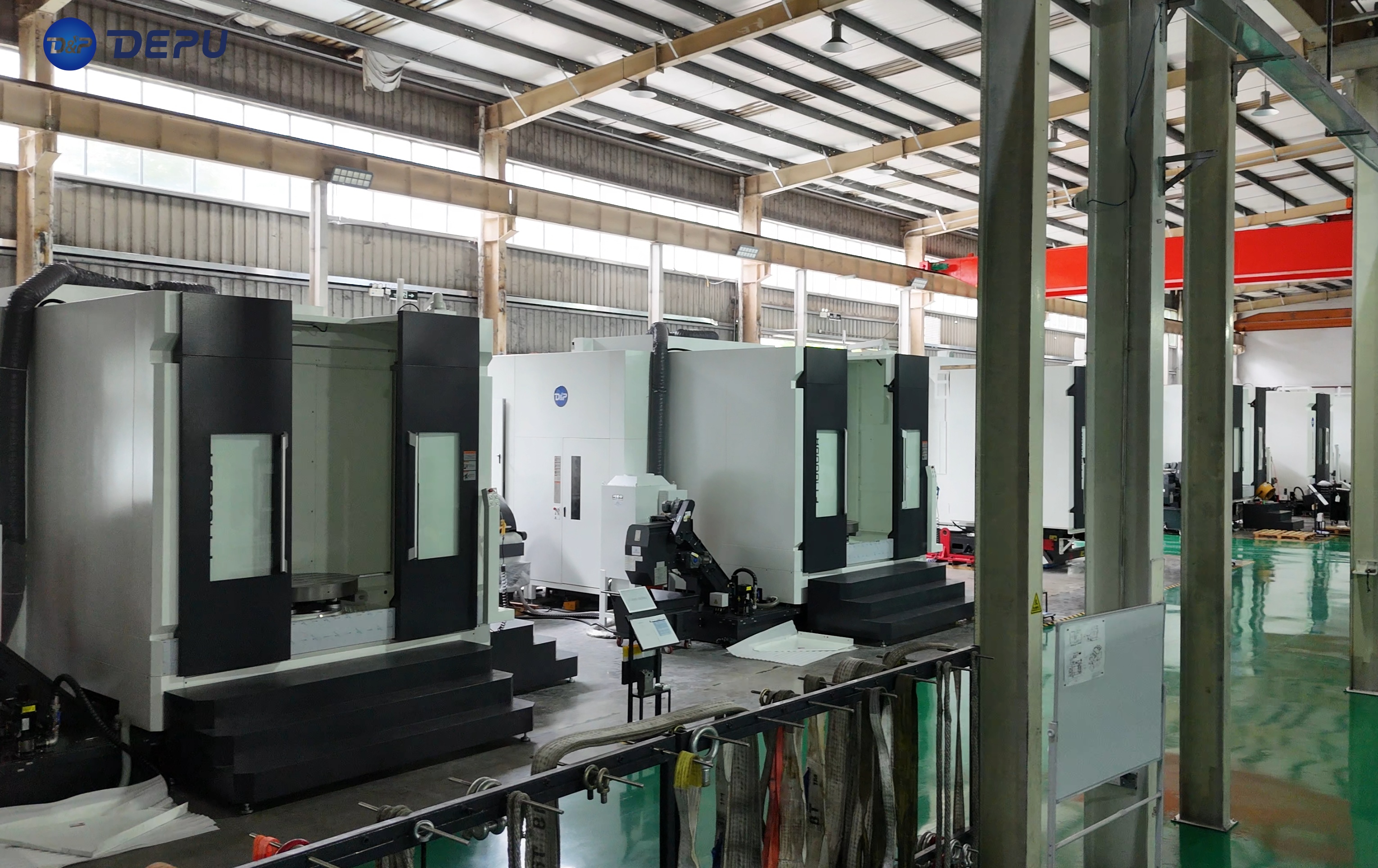
Understanding Trunnion 5-Axis Machining Centers
How a Trunnion Configuration Works
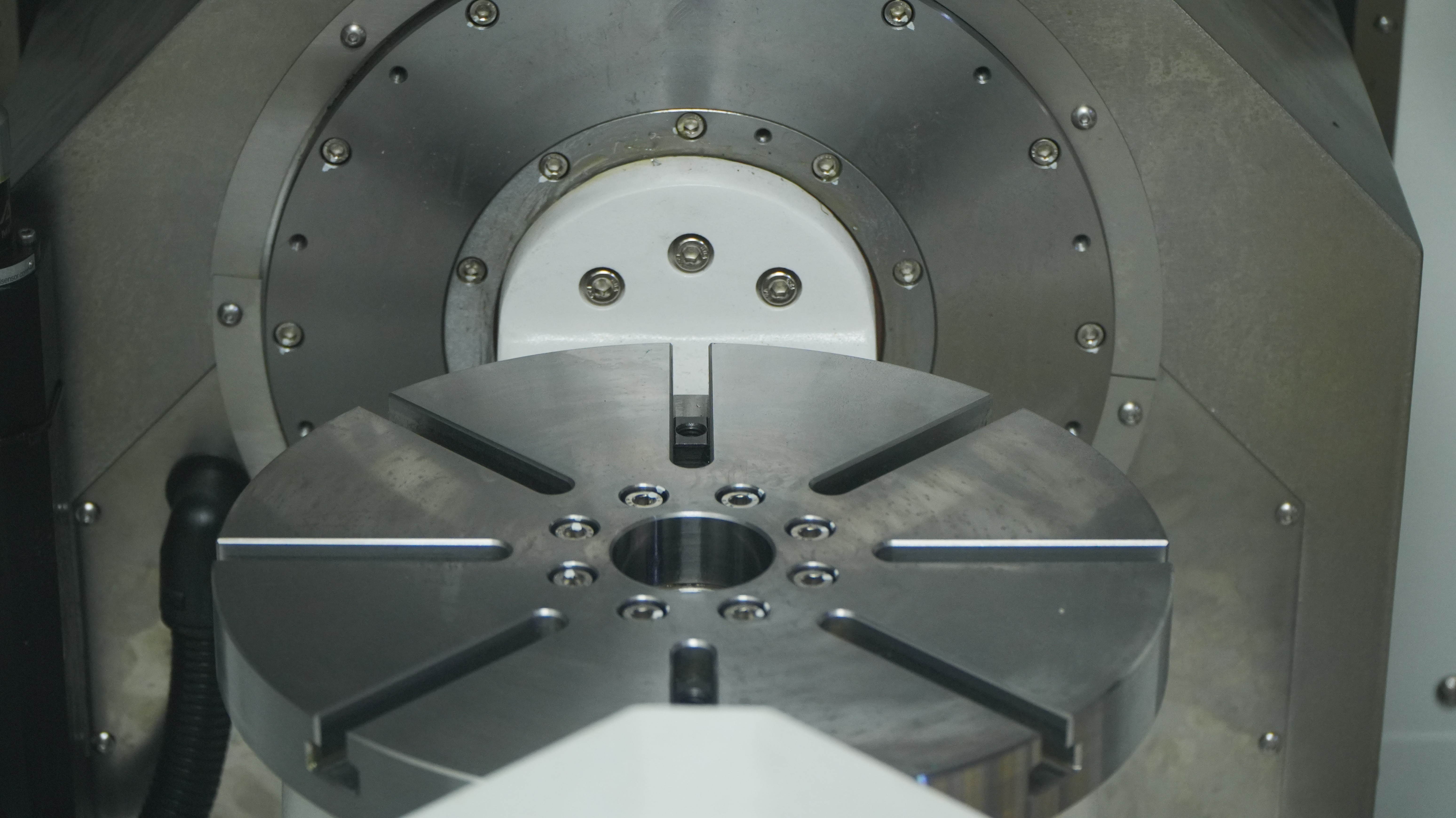
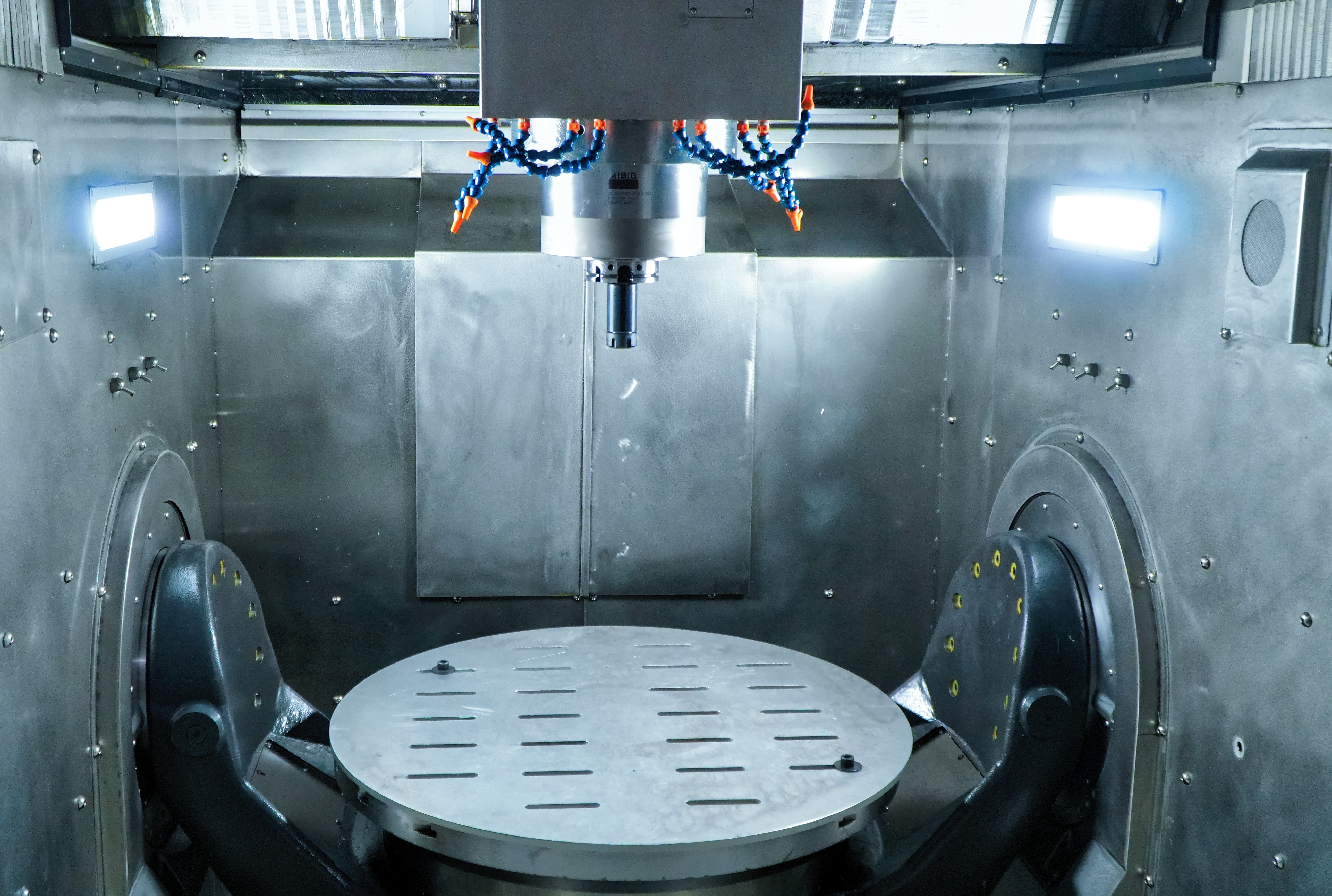
A trunnion 5-axis machining center typically uses a rotary table mounted on a tilting mechanism. The workpiece is secured to the rotary table, which can rotate and tilt around two rotary axes while the spindle performs linear X, Y, and Z movements.
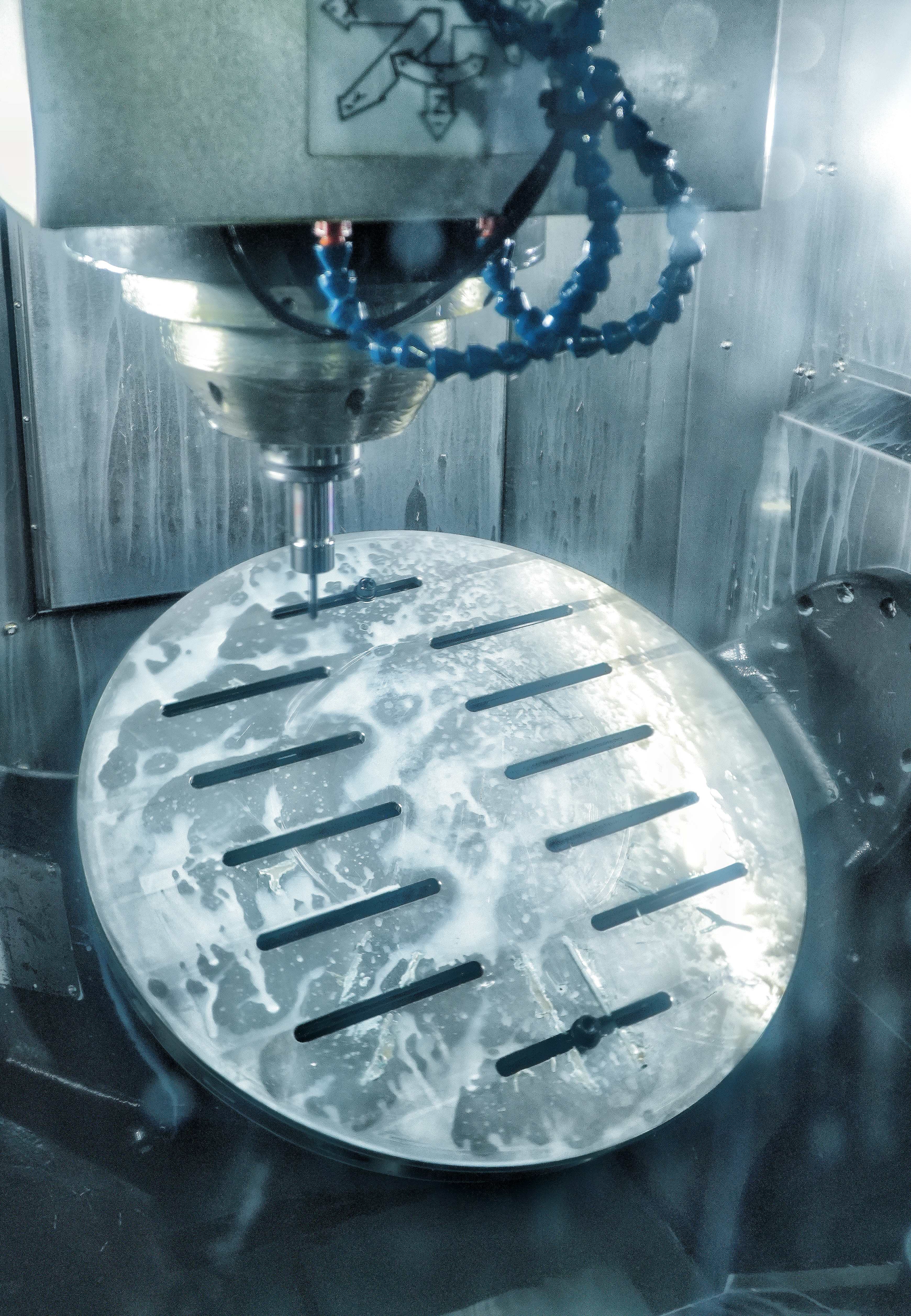
This architecture allows the workpiece to be positioned at multiple angles without removing it from the fixture. During simultaneous 5-axis machining, the rotary table continuously changes orientation while the linear axes move to maintain the required tool position relative to the workpiece.
The main advantage is that the cutting tool remains relatively stable while the workpiece is repositioned around it. This configuration is particularly effective for small and medium-sized components requiring machining on multiple faces.
Workholding and Part Accessibility
Workholding is a major consideration when selecting a trunnion 5-axis machining center. Because the workpiece rotates with the table, the fixture must remain within the machine's rotary envelope throughout the entire machining cycle.
This can limit the maximum workpiece size compared with some tilting-head configurations. However, for appropriately sized parts, the trunnion architecture provides excellent access to multiple surfaces and enables complex geometries to be machined in a single setup.
A properly designed fixture can also allow several components to be mounted around a rotary table or tombstone-style fixture, improving productivity for batch production.
Understanding Tilting-Head 5-Axis Machining Centers
How a Tilting-Head Configuration Works
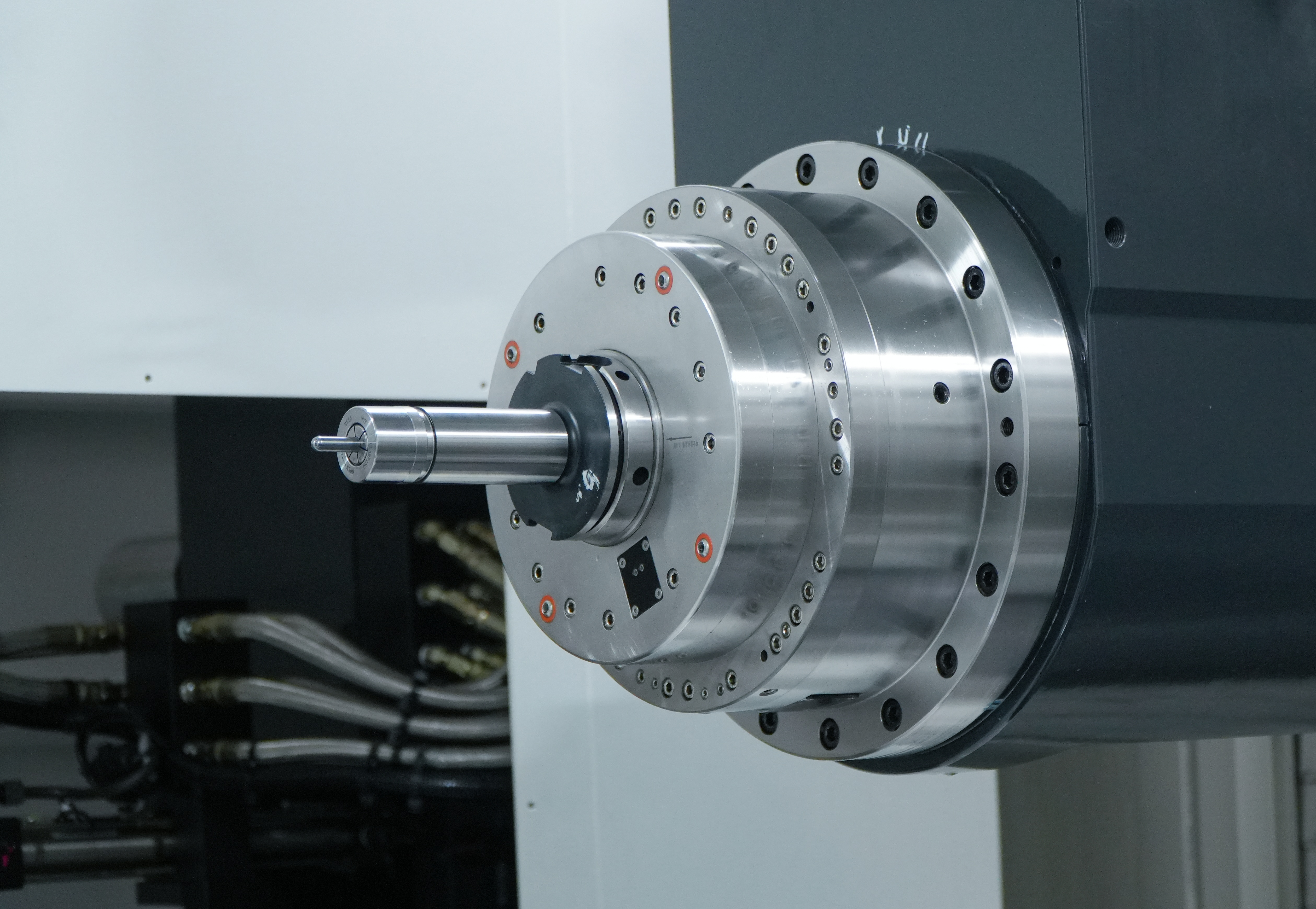
A tilting-head 5-axis machining center uses rotary axes within the spindle head to change the orientation of the cutting tool. Instead of rotating and tilting the workpiece, the machine changes the tool's angle relative to a stationary worktable.
This architecture can provide a larger effective work envelope because the workpiece does not need to rotate through the same physical space as a trunnion table. It is therefore particularly attractive for large, heavy, or geometrically challenging components.
The tilting-head configuration can also provide greater flexibility when machining parts that would be difficult to rotate on a conventional trunnion table.
Advantages for Large and Heavy Components
One of the strongest advantages of a tilting-head 5-axis machining center is its ability to accommodate large workpieces.
Heavy components can remain securely supported on a stationary table while the spindle head changes orientation to reach different surfaces. This reduces the need to move or rotate the workpiece during machining.
For industries such as aerospace, energy, heavy equipment, and large mold manufacturing, this can be a significant advantage. Large components may exceed the practical rotary envelope of a trunnion table even when the machine has sufficient linear axis travel.
Comparing Work Envelope and Part Size
Trunnion Machines for Small and Medium Parts
A trunnion 5-axis machining center generally performs best when the workpiece fits comfortably within the rotary table's diameter, height, and load capacity.
The work envelope must account for more than the nominal table size. Engineers should consider:
- Workpiece dimensions
- Fixture height
- Fixture diameter
- Rotary axis interference
- Tool length
- Tool holder clearance
- Maximum table load
- Rotary axis travel
A part that technically fits on the table may still become impractical once the fixture and tool clearance requirements are considered.
For compact components, however, the trunnion design can provide an excellent combination of accessibility, rigidity, and repeatability.
Tilting-Head Machines for Large Components
A tilting-head 5-axis machining center generally provides greater flexibility for oversized workpieces because the workpiece can remain stationary while the spindle changes orientation.
This architecture is particularly useful when machining:
- Large aerospace structures
- Energy components
- Heavy equipment parts
- Large molds and dies
- Complex castings
- Large precision mechanical components
When evaluating a machine, manufacturers should compare the actual usable machining envelope rather than relying solely on X, Y, and Z axis travel specifications.
Rigidity and Cutting Performance
Trunnion Rigidity
The trunnion architecture can provide excellent rigidity because the workpiece is positioned close to the rotary table and the cutting forces are transferred through a relatively compact mechanical structure.
For high-precision machining of smaller components, this can provide stable cutting conditions and predictable surface finishes.
However, the rigidity of a trunnion machine depends heavily on the size and design of its rotary table. As table diameter and load capacity increase, maintaining rotary axis rigidity becomes increasingly challenging.
Tilting-Head Rigidity
Tilting-head machines place the rotary mechanism in the spindle head. This creates a different structural load path and makes spindle head design particularly important.
For heavy cutting, the machine must minimize spindle-head deflection while maintaining rotary positioning accuracy. A well-designed tilting-head 5-axis machining center can provide excellent cutting performance, especially when the machine is designed around heavy-duty structural components.
The spindle head, rotary bearings, motor torque, and structural support all contribute to the machine's overall cutting stability.
Tool Accessibility and Complex Geometry
One of the primary reasons manufacturers invest in 5-axis machining is improved tool accessibility.
A conventional 3-axis machining center can struggle to reach undercuts, angled surfaces, deep cavities, and complex curved geometries. Five-axis motion allows the tool to approach these features from different orientations.
Trunnion Accessibility
A trunnion machine changes the workpiece orientation relative to the spindle. This makes it possible to expose different surfaces while keeping the spindle relatively stable.
For components with multiple angled features, this can significantly reduce the number of setups required.
The primary limitation is that the workpiece must rotate through the machine's available rotary envelope. Fixtures, clamps, and surrounding components must therefore be carefully designed to avoid collisions.
Tilting-Head Accessibility
A tilting-head machine changes the tool orientation instead of rotating the workpiece.
This can be especially useful when machining large components where rotating the workpiece would require excessive space or create interference.
The tool can approach the part from different directions while the workpiece remains securely fixed on the table. This makes tilting-head configurations particularly useful for large and complex components.
Workholding and Setup Considerations
Workholding strategy should be evaluated before selecting a 5-axis machining center.
A trunnion machine requires fixtures that can rotate with the workpiece. This means the fixture must be compact enough to remain within the rotary envelope and rigid enough to withstand continuous rotary movement.
For smaller components, this is usually manageable and can provide highly efficient one-setup machining.
Tilting-head machines offer greater freedom in fixture design because the workpiece remains stationary. Large fixtures and heavy workholding systems can often be supported directly by the machine table.
This makes tilting-head architecture attractive when the workholding system itself is large, heavy, or difficult to rotate.
Rotary Axis Positioning and Accuracy
Rotary axis accuracy is critical to any 5-axis machining center.
Errors in rotary positioning can create significant dimensional deviations, especially when machining complex surfaces where small angular errors can translate into larger positional errors at the cutting tool.
Manufacturers should evaluate:
- Rotary axis positioning accuracy
- Rotary axis repeatability
- Angular positioning resolution
- Rotary axis backlash
- Rotary axis bearing design
- Rotary axis calibration procedures
- Thermal stability
- RTCP performance
For both trunnion and tilting-head machines, accurate rotary axis calibration is essential.
The machine's ability to maintain the correct tool center point as the rotary axes move is equally important. A sophisticated controller combined with accurate rotary axis geometry allows the machine to maintain consistent cutting conditions throughout simultaneous 5-axis motion.
3+2 Machining vs. Simultaneous 5-Axis Machining
Both trunnion and tilting-head machines can support 3+2 machining and simultaneous 5-axis machining, depending on their configuration and CNC control.
In 3+2 machining, the rotary axes position the workpiece or spindle at a fixed angle before the three linear axes perform the cutting operation.
This approach is often easier to program and verify.
Simultaneous 5-axis machining continuously coordinates all five axes during cutting. This allows the cutting tool to follow complex surfaces while maintaining an optimized tool orientation.
For aerospace blades, impellers, medical components, molds, and other highly complex parts, simultaneous 5-axis machining can provide substantial advantages.
The machine architecture determines how these rotary movements are physically generated, but both configurations can deliver advanced 5-axis machining capabilities when properly engineered.
Choosing the Right Architecture for Your Application
There is no universal answer to whether a trunnion or tilting-head 5-axis machining center is better.
Instead, manufacturers should evaluate the following factors.
Choose a Trunnion Configuration When:
A trunnion 5-axis machining center is often a strong choice when your production involves:
- Small to medium-sized components
- High-volume production
- Complex multi-face machining
- Compact fixtures
- High repeatability requirements
- Strong rotary table rigidity
- Frequent 3+2 machining
- Parts that can comfortably rotate within the machine envelope
The compact architecture can provide excellent precision and productivity for appropriately sized workpieces.
Choose a Tilting-Head Configuration When:
A tilting-head 5-axis machining center may be more appropriate when your application involves:
- Large workpieces
- Heavy components
- Large fixtures
- Oversized castings
- Aerospace structures
- Energy components
- Large molds
- Complex components requiring extensive tool accessibility
The ability to keep the workpiece stationary while changing tool orientation can provide significant practical advantages.
Total Cost of Ownership and Production Efficiency
The initial purchase price should not be the only factor in selecting a 5-axis machining center.
Manufacturers should also consider:
- Setup time
- Cycle time
- Fixture costs
- Tooling requirements
- Operator training
- Maintenance
- Rotary axis service requirements
- Energy consumption
- Automation potential
- Machine utilization
- Expected part mix
A trunnion machine may provide excellent productivity for high-volume production of compact components, while a tilting-head machine may deliver greater value when the alternative would require multiple setups for large or complex workpieces.
The right machine is therefore the one that minimizes the total cost per finished component rather than simply the initial capital investment.
Final Considerations Before Selecting a 5-Axis Machining Center
Before purchasing a trunnion or tilting-head 5-axis machining center, manufacturers should test the machine against representative parts rather than evaluating specifications in isolation.
Ask the machine supplier to demonstrate:
- Your actual workpiece geometry
- Your intended cutting tools
- Your fixture configuration
- Required 3+2 operations
- Simultaneous 5-axis toolpaths
- Rotary axis positioning
- Collision avoidance
- RTCP behavior
- Expected cycle time
- Finished part accuracy
A machine that performs well on a specification sheet may not necessarily be the best choice for your specific manufacturing process.
The best purchasing decision comes from matching the machine architecture to the physical requirements of the parts, the production volume, the cutting strategy, and the long-term manufacturing plan.
FAQ
What is the main difference between a trunnion and tilting-head 5-axis machining center?
The primary difference is where the rotary motion occurs. A trunnion 5-axis machining center rotates and tilts the workpiece using a rotary table, while a tilting-head machine changes the orientation of the spindle and cutting tool. This difference affects work envelope, workholding, accessibility, and the types of components each machine handles most efficiently.
Which is better for large and heavy workpieces?
A tilting-head 5-axis machining center is generally more suitable for large and heavy workpieces because the part can remain stationary on the machine table while the spindle head changes orientation. This avoids the need to rotate a very heavy component and can provide greater flexibility for large-format machining.
Is a trunnion 5-axis machine better for high-volume production?
A trunnion 5-axis machining center can be highly effective for high-volume production of small and medium-sized components. Its rotary table allows multiple faces to be machined in one setup, while compact fixtures and repeatable rotary positioning can support efficient production cycles.
Which machine is better for simultaneous 5-axis machining?
Both trunnion and tilting-head configurations can support simultaneous 5-axis machining. The better choice depends on the machine's structural rigidity, rotary axis performance, CNC control, RTCP capability, spindle characteristics, and the specific geometry being machined.
How should I decide between trunnion and tilting-head 5-axis machining?
Start with the size and weight of your typical workpieces, then evaluate fixture requirements, machining accessibility, required rotary-axis range, cutting forces, production volume, and expected automation. If most parts are compact and production-oriented, a trunnion configuration may be advantageous. For large and heavy components, a tilting-head architecture may provide greater flexibility.
Does a 5-axis machine eliminate the need for multiple setups?
Not necessarily. A major advantage of 5-axis machining is that it can reduce the number of setups required, but fixture accessibility, part geometry, tool reach, and machine envelope still determine how many setups are necessary. Properly designed 5-axis machining can significantly reduce repositioning and improve positional accuracy between features.
Is a trunnion or tilting-head machine more accurate?
Neither architecture is inherently more accurate in every application. Accuracy depends on the machine's structural design, rotary axis construction, thermal stability, calibration, spindle performance, linear axis accuracy, CNC control, and overall machine build quality. The correct architecture is the one that maintains the required accuracy under your actual cutting conditions.
What should I test before purchasing a 5-axis machining center?
Use representative production parts to evaluate machine accessibility, workholding, rotary-axis motion, RTCP behavior, simultaneous 5-axis toolpaths, collision avoidance, cycle time, surface finish, and dimensional accuracy. A real application test provides much more useful purchasing information than comparing specifications alone.