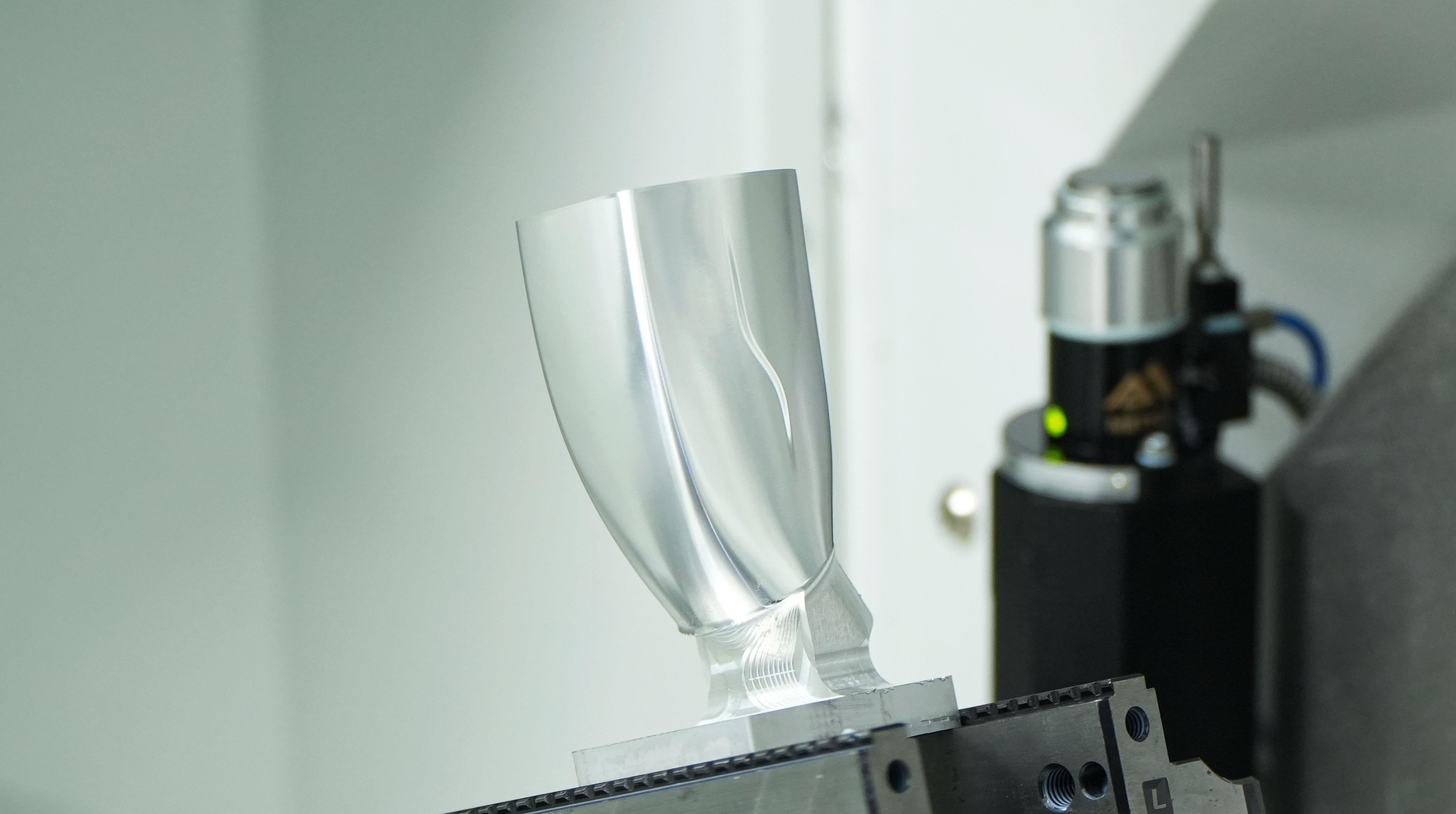

Why Scaling 5-Axis Production Is Fundamentally Different from Prototyping

Many manufacturers succeed with 5-axis CNC machining at the prototyping stage but encounter serious challenges when attempting to scale. Prototypes tolerate manual intervention, longer setup times, and operator experience. Scaling 5-axis production, however, exposes every weakness in machine stability, process design, and data consistency.
At scale, even minor variations in tool life, thermal drift, or axis behavior can multiply into significant scrap rates and downtime. This is why scaling decisions must be made strategically—not reactively.
Machine Stability: The Foundation of High-Volume 5-Axis Machining
Before increasing output, manufacturers must evaluate whether their machines are designed for high-volume 5-axis machining, not just short demonstration cycles.
Key indicators include:
-
Structural rigidity under continuous load
-
Rotary axis bearing life and preload stability
-
Thermal symmetry of the machine structure
Without long-term stability, scaling 5-axis production simply amplifies inaccuracies instead of efficiency.
Process Repeatability Over Peak Accuracy
Peak accuracy specifications matter far less than repeatability in industrial 5-axis CNC production. A machine that holds ±5 microns consistently across hundreds of cycles is more scalable than one that achieves ±2 microns once.
Manufacturers should verify:
-
Datum consistency across batch runs
-
Toolpath repeatability during simultaneous 5-axis motion
-
Stability of probing and in-process measurement
True 5-axis production scalability depends on predictable outcomes, not ideal conditions.
Automation Readiness: Scaling Requires Reduced Human Dependency
Manual setups and operator-driven adjustments limit scalability. Before expanding capacity, manufacturers must assess whether their current systems support automation.
Automation-ready 5-axis manufacturing readiness includes:
-
Single-setup machining strategies
-
Stable probing references for closed-loop control
-
Compatibility with robotic loading and pallet systems
Without these elements, adding more machines only increases labor complexity.
Tooling Strategy and Tool Life Management
Tooling inefficiency becomes a major cost driver when scaling 5-axis production. Advanced 5-axis processes rely on complex tool engagement angles that accelerate wear if not properly managed.
Manufacturers should evaluate:
-
Tool life predictability across long runs
-
Adaptive feedrate and load control
-
Standardized tooling libraries across machines
Consistent tool behavior is critical to maintaining surface quality and cycle time stability.
CAM Standardization and Post-Processor Consistency
Scaling fails quickly when CAM strategies vary between programmers or machines. Industrial 5-axis CNC production requires standardized post-processors, toolpath templates, and validation workflows.
Key questions to ask:
-
Are toolpaths transferable between machines?
-
Is collision avoidance validated consistently?
-
Are updates centrally controlled?
CAM inconsistency introduces hidden variation that undermines scale.
Quality Control and Data Traceability at Scale
As output increases, inspection must shift from reactive to predictive. Manufacturers scaling 5-axis production need integrated quality systems that connect machining data with inspection results.
Effective systems include:
-
In-process probing linked to SPC
-
Digital traceability for aerospace and medical compliance
-
Automated trend analysis for early drift detection
This data-driven approach protects both yield and certification status.
Cost Structure: Why Scaling Changes the Economics
The cost structure of scaling 5-axis production differs dramatically from low-volume work. Labor becomes less dominant, while machine uptime, maintenance, and energy efficiency take center stage.
Manufacturers should reassess:
-
Cost per spindle hour under continuous operation
-
Preventive maintenance schedules
-
Long-term spare parts availability
Ignoring these factors leads to unexpected cost escalation as production grows.
Organizational Readiness: Skills, Processes, and Culture
Finally, scaling 5-axis production is not purely technical—it is organizational. Teams must transition from craftsmanship-driven machining to process-driven manufacturing.
Indicators of readiness include:
-
Cross-trained operators and programmers
-
Documented process standards
-
Clear ownership of machine performance metrics
Without this shift, scaling efforts stall regardless of equipment quality.
Scaling Success Depends on Systems, Not Machines Alone
Successful scaling 5-axis production requires alignment across machines, processes, software, and people. Manufacturers that treat 5-axis expansion as a system-level transformation achieve stable growth, while others struggle with rising complexity.
The real question is not whether 5-axis machining can scale—but whether the organization is prepared to scale with it.
FAQ
What is the biggest risk when scaling 5-axis production?
Lack of machine stability and process repeatability is the most common risk, leading to scrap and downtime at higher volumes.
Can prototype-level 5-axis machines handle batch production?
Not always. Many machines perform well in short runs but lack the rigidity and thermal control needed for industrial-scale production.
How important is automation for scaling 5-axis machining?
Automation is critical. Without reducing manual intervention, scalability is limited and labor costs rise sharply.
When should manufacturers consider scaling 5-axis production?
When demand is stable, processes are repeatable, and machine performance is proven over extended production cycles.