
How 5-Axis Kinematics Affect Accuracy, Rigidity, and Long-Term Stability
Introduction: Why Kinematics Matter More Than Nominal Accuracy
When evaluating 5-axis CNC machining, many buyers focus on published positioning accuracy or repeatability figures. However, these values alone rarely predict real-world performance. What truly governs accuracy, rigidity, and long-term stability is the kinematic architecture of the machine—how linear and rotary axes are arranged, supported, and synchronized.
In aerospace, medical, and energy applications, poor kinematic design leads to tolerance drift, surface inconsistency, and escalating maintenance costs over time. Understanding 5-axis kinematics is therefore essential for making reliable, long-term manufacturing decisions.
What Is 5-Axis Kinematics?
5-axis kinematics describe the geometric relationship and motion behavior between the five controlled axes—X, Y, Z (linear) and A, B or C (rotary). This includes:
-
Axis orientation (table-table, head-table, head-head)
-
Distance between rotary centers and cutting point
-
Load paths through bearings, gears, and cast structures
-
Dynamic interaction during simultaneous motion
These factors determine how accurately tool motion is translated into material removal, especially under cutting load.
Kinematic Configuration Types and Their Mechanical Implications
Table-Table Kinematics: Stability vs. Load Capacity
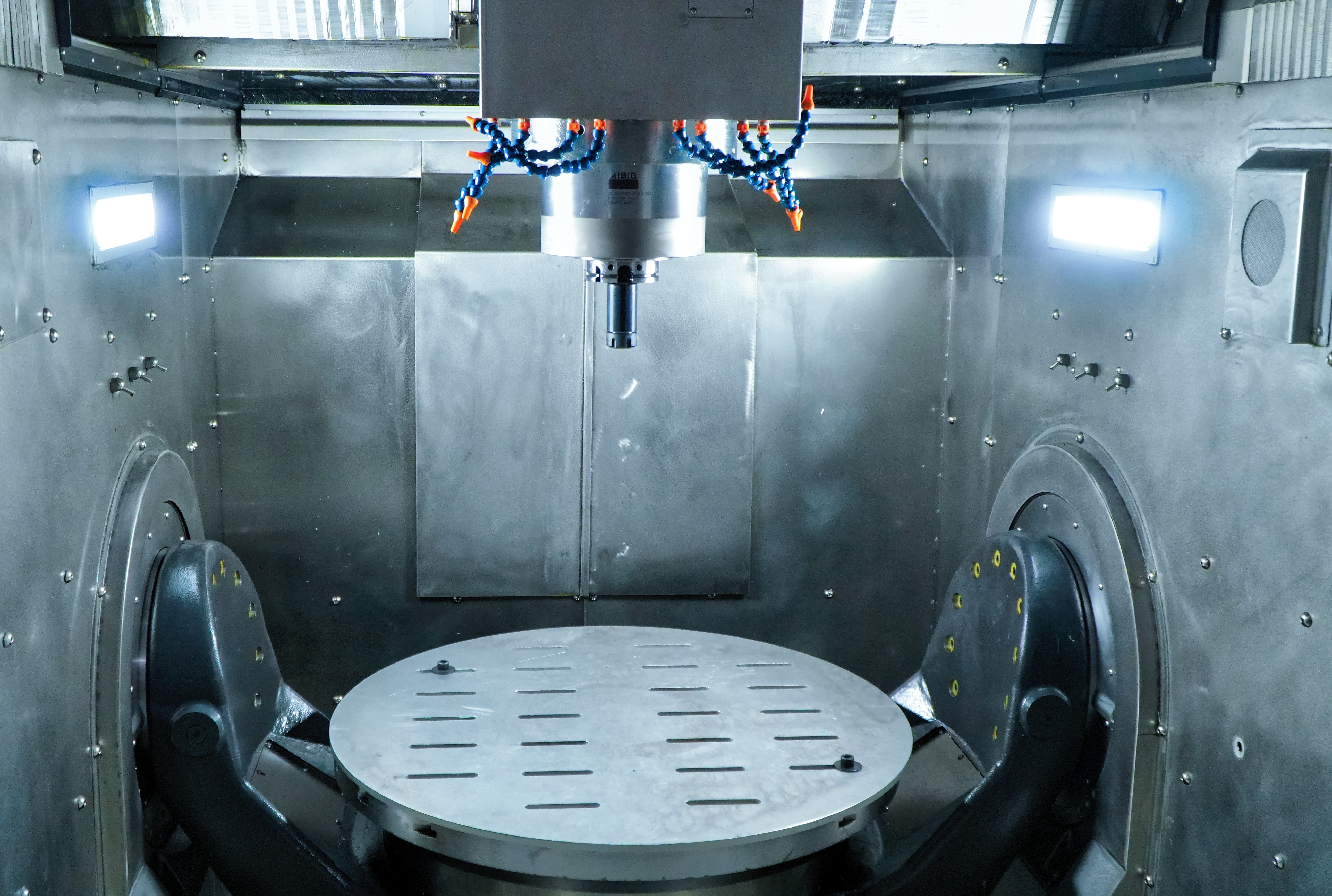
Table-table designs place both rotary axes beneath the workpiece. This configuration offers excellent geometric consistency for small, lightweight parts, as the tool center point remains relatively close to the rotary axes.
However, for large or heavy aerospace components, table-table machines face limitations:
-
Reduced load capacity on rotary axes
-
Higher bearing stress under off-center loads
-
Increased deformation during aggressive cutting
These factors directly affect long-term stability when machining dense materials such as titanium or steel.
Head-Table Kinematics: Balanced Accuracy and Accessibility
Head-table architectures combine one rotary axis in the spindle head and one in the table. This design balances accessibility, rigidity, and part size flexibility.
Advantages include:
-
Shorter force transmission paths
-
Improved rigidity during heavy cuts
-
Lower inertia on rotary motion compared to table-table designs
As a result, head-table 5-axis CNC machines often deliver better accuracy retention over extended production cycles.
Head-Head Kinematics: Reach at the Cost of Rigidity
Head-head machines place both rotary axes in the spindle head. While this offers maximum accessibility for complex geometries, it introduces mechanical challenges:
-
Longer lever arms amplify cutting forces
-
Increased susceptibility to vibration
-
Higher sensitivity to thermal growth
Without sufficient structural mass and damping, head-head kinematics struggle to maintain micron-level accuracy under sustained load.
How Kinematics Influence Accuracy Under Load
Static positioning accuracy is only meaningful without cutting forces. In real machining conditions, 5-axis kinematics dictate how forces propagate through the structure.
Key accuracy-impacting factors include:
-
Rotary axis bearing preload
-
Gear backlash and drive stiffness
-
Distance from tool center point to rotary center
Poor kinematic design causes tool center point deviation during simultaneous motion, resulting in contour errors, surface waviness, and dimensional drift—especially in multi-hour aerospace cycles.
Rigidity: The Foundation of Repeatable Precision
Rigidity is not solely determined by machine weight. It depends on how kinematics distribute load through the structure.
High-rigidity 5-axis CNC machining systems feature:
-
Optimized axis stacking to minimize bending moments
-
Large-diameter rotary bearings
-
High-stiffness drive systems
These characteristics allow machines to maintain stable cutting conditions, extend tool life, and preserve surface finish consistency.
Long-Term Stability: Accuracy Over Years, Not Weeks
Long-term stability is where kinematics have the greatest economic impact. Machines with poor kinematic symmetry experience:
-
Progressive axis wear
-
Increasing compensation requirements
-
Declining process capability (Cpk)
Well-designed 5-axis CNC machines maintain alignment through:
-
Thermally symmetric structures
-
Consistent load paths across motion ranges
-
Reduced reliance on software compensation
This stability directly lowers total cost of ownership by reducing recalibration frequency and unplanned downtime.
Thermal Behavior and Kinematic Sensitivity
Rotary axes are particularly sensitive to thermal expansion. Small temperature changes can shift rotational centers, amplifying positional error at the tool tip.
Advanced 5-axis CNC machining platforms mitigate this through:
-
Integrated temperature sensors
-
Active thermal compensation
-
Structural isolation of heat sources
Kinematic layouts that minimize rotary-to-tool distance inherently reduce thermal error amplification.
Why Aerospace and Medical Applications Demand Optimized Kinematics
In aerospace structural parts and medical implants, tolerances are often below ±5 microns across complex geometries. These requirements expose any weakness in kinematic design.
Optimized 5-axis kinematics enable:
-
Single-setup machining without datum shift
-
Consistent surface integrity
-
Predictable long-term performance under regulatory scrutiny
This is why heavy-duty 5-axis CNC machines dominate flight-critical and implant manufacturing environments.
FAQ
What are 5-axis kinematics?
5-axis kinematics describe how the linear and rotary axes of a machine are arranged and interact, directly affecting accuracy, rigidity, and motion behavior.
Which 5-axis kinematic configuration is the most rigid?
Head-table configurations generally offer the best balance of rigidity and accessibility for medium to large complex parts.
How do kinematics affect long-term accuracy?
Poor kinematics accelerate wear and increase thermal sensitivity, causing accuracy drift over time even if initial calibration is precise.
Why are kinematics critical for aerospace machining?
Aerospace parts require sustained micron-level accuracy under high cutting loads, which only optimized kinematics can reliably maintain.